Waterlog 1: The River Itchen, Winchester, Hampshire

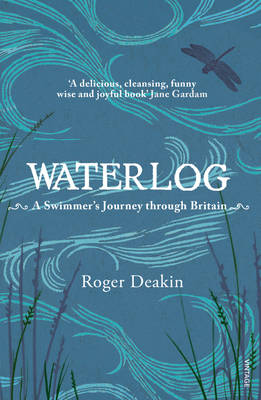
WaterlogMy bedtime reading this week has been Waterlog, by Roger Deakin, a potent and poetic defence of our right to swim anywhere we please – in ponds, in rivers, in the sea – anywhere that looks cool and inviting, and several that look downright perishing! I now know to ignore the omnipresent threatening signs warning of the risk of Leptospirosis (chances of actually catching it – 1 in 33,000) and take my dip anywhere I please. In fairness, I ignored them anyway – but it’s nice to have some expert backing.

In that vein, I thought I’d write up some of my favourite bathing places throughout the British Isles, in an ongoing series.

Compton Lock, The River Itchen, Winchester

This is the river I grew up closest to, and know the best. Itchen rises near Cheriton, and winds its way picturesquely through the village green. At this point, it’s only ankle deep, but by the time it reaches the famous water meadows of Winchester, it’s clear and swift and deep enough to swim in. Deakin devotes a chapter to bathing in the Itchen, but with typical bolshiness, he takes a swim in the exclusive stretch by Winchester College, and gets into an argument with the porters afterwards. I think he enjoyed it a lot more than I would – I subscribe to a quieter life, and bathe a good way downstream at Compton Lock just outside of Shawford, where the water flows over a weir and blossoms out into a deep and pebbly pool. There some good angel has shored up the edge of the pool with wooden stakes, and built a series of steps down into the water. Come the summer, the place is filled with boys and girls taking wild somersaults off the weir, sunbathing and showing off. What I love about the pool is its irregularity – I’ve spent hours diving down to discover its contours and hidden hollows, its currents and eddies. There’s a lot of submerged concrete down there – possibly from an earlier weir – so until you’ve explored it properly, it’s best not to risk diving. When you do know which patch of water to aim for, you can join the teenagers in their death defying dives, or ride the river over the weir as a natural water-slide, or simply get in a bit of swimming practice, striking out against the current and getting precisely nowhere.
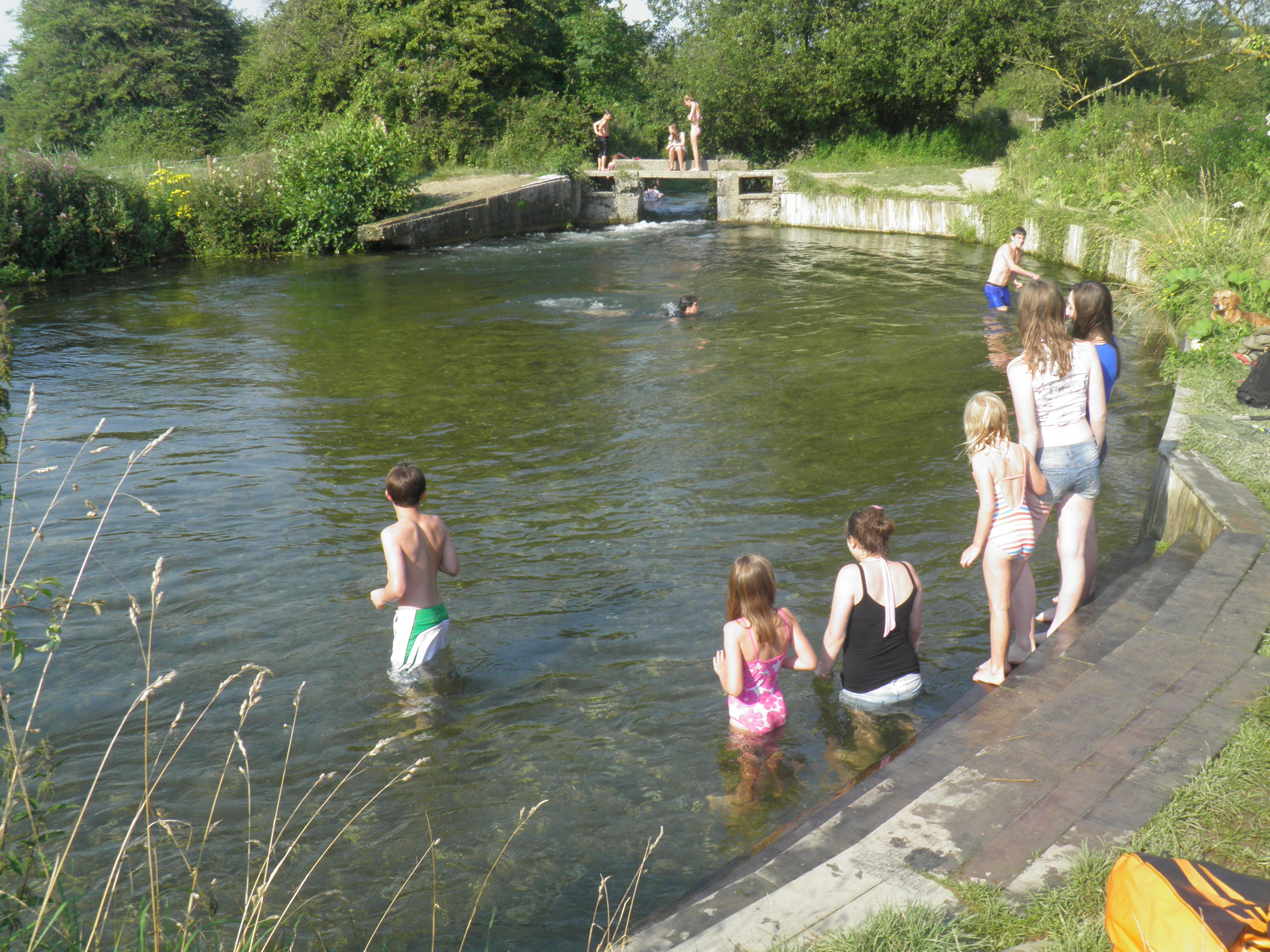
OLYMPUS DIGITAL CAMERAA little downstream the river shallows out into a pretty stretch much beloved by paddlers and kids with water-pistols – though painfully pebbly underfoot. Sandals are recommended. On the far side of the banks, every back garden seems to have its own jetty, though I can’t imagine anything larger than a coracle or a lilo being much use. The path emerges by The Bridge pub in Shawford, a good place for a pint or a bite to eat after your dip, and the best place to leave your bicycle, if you don’t want to lug it over half a dozen stiles or risk swerving into the water.

For a picnic and a summer’s dip, I don’t really think you could do better than this quiet, cool, pleasant stretch of river. If a colder and more bracing swim is more to your taste – there’s plenty of dips in my notebook that could accomodate you. Tune in next time!

Tending Bar at the Cardiff University Ale and Cider Festival

logo with dragonThis coming Thursday, I’ll be bunking off a seminar and taking a long train journey down to Cardiff for the Real Ale and Cider Society’s 17th Annual Festival. It’s the largest student festival in Britain. There should be about 50 ales and 50 ciders – I’m told there is a list, but apparently it’s being kept Top Secret until the festival begins – 5 types of mead and 7 types of wine. My mouth is watering at the very thought.

Despite this being my fourth year at the festival, I have never visited as a customer. I’ve always worked behind the bar, recommending my favourite brews, serving up the ale with a flourish and partaking liberally in the quiet moments. A certain degree of familiarity with the different types of ale is a most desirable characteristic, and so long as you don’t drink more that you serve, the few genuinely sober people about are quite forgiving.

On my first year, I went home for the festival weekend, and only worked on the Thursday – how little I knew back then! Still, I returned to my halls addled enough to forget to shut the shower door, and completely drenched my ensuite – so evidently it was not time wasted.

The second year was a bit of a blow out, I admit. I managed to time myself so perfectly on the Thursday that the last thing I remember is last orders. And then, as usual, I woke up in bed, in my pyjamas, to find it was the next morning. My survival instincts often astonish me like that.

The festival that year was a sell out success, so there wasn’t the same chance to drink myself under the table as there was on the Thursday night – the paying customers had it all, the greedy beggars! I blame the undercover policemen, who prowled around quietly on the first night and came back to drink on day two in a massive group. But my memories are good. Being the most beardy member of the society at that point, I was quite identifiable, and got a lot of hugs. There was a lovely moment when I was listening to a band I’d helped book – who were fantastic – with a pint of ale in my right hand and my left around a rather pretty girl, and I thought how jealous and disbelieving my sixteen year old self would have been if he could have seen me now. I felt cool, which, God knows, doesn’t happen often enough. Unfortunately, I blew it almost immediately by reaching that plateau of drunkenness where I can dance completely unselfconsciously. The last band started off by covering Staying Alive, and got cheesier by the minute. At no other point have I, or would I EVER, dance to Gay Bar.

But all too soon the beer and cider had vanished down a thousand thirsty throats, and it was all over save for taking everything down the next morning, and the massive fried breakfast that inevitably follows.

The next year was not quite so exuberant, as I had begun to develop an (utterly unjustified) reputation about the committee, and they refused to give me any mead after nine o’clock. Spoilsports. There was a rather fun moment in the clearing up, where my housemate lent her head against my arm and said ‘Carry me home.’ She was out of the Great Hall and halfway out of the building before she managed to convince me it was a joke. What the security guards must have thought, I don’t know.

Surprisingly, considering I hadn’t drunk myself into complete insensibility, that morning was the worst hangover I’ve ever had at the festival. I stumbled into work at 3pm in my day-old festival t-shirt and oldest jeans, looking like hell and smelling of stale beer. Yet to my astonishment and delight, I pulled shortly after last orders, and turned up to the fried breakfast on Saturday with a big cheesy grin on my face that didn’t fade for a week afterwards.

I doubt I’m going to get that lucky again. But whatever happens, I’m going to have two nights of good music, cracking cider and wonderful ale, among some lovely people who I haven’t seen for over half a year, and that’s more than worth the journey.

The Cardiff University Real Ale and Cider Society Festival is open from 2pm to Midnight on the 21st and 22nd of February. Entry is £3 with a commemorative pint glass.

Super Tramp Chicken

Anyone who has ever been camping will know and recognise how much better everything tastes when cooked outdoors over a campfire, though not every outdoor cook would go to the lengths taken by W.H. Davies, a tramp and minor poet of the early 20th century, now probably best known for his poem ‘Leisure’ (‘What is this life if, full of care’), best known to those my age from a successful Centre Parks advert.

Originally from Newport, Davies spent much of his early life as a homeless vagabond travelling around the United States and Canada. He made his way by begging, for the most part, but also tried his hand at fruit-picking and canal building, and made several Trans-Atlantic trips as a cattle-man. All that came to an end one day in Canada, when he had the misfortune to stumble whilst trying to jump onto a moving freight train, and the wheel severed his right foot at the ankle.

Five weeks later, he returned to Britain, equipped with a new wooden leg, and began his attempts to establish himself in a literary career. This recipe is taken from The Autobiography of a Super Tramp, his most popular prose work.

  1. Take one chicken, unplucked.
    N.B. It is probably not a good idea to inquire too closely into where this unplucked chicken came from. The choice of the verb ‘Take’ is not as innocuous as it might be in other cookbooks.
  2. Cover it in a thick layer of mud.
    You heard me.
  3. Bake under a pile of hot ashes, until the mud has dried into a solid crust.
  4. Break off the mud crust. The chicken beneath should be ‘as clean as a new born babe, with all its feathers and down stuck hard in the mud.’

The result, according to Davies, is a chicken ‘far more tasty than the one at home, that was plucked and gutted with care and roasted or baked to a supposed nicety’ – though perhaps it is best suited to those who bemoan, like him, that  ‘this food of civilisation certainly seemed to suffer from a lack of good wholesome dirt, and I should have liked to have had my own wood fire at the end of the backyard, were it not for shame.’

Stargazing

English: The most famous depiction of the 1833...
One of the many ways artists make shooting stars look far more exciting than they actually are.

One clear night in North Wales, after everyone else had retired to their tents, my friend and I stayed out with a flask of whisky to watch for shooting stars. The Leonids were passing over that weekend, and it was supposed to be quite a show.

Shooting stars are literal blink-and-you’ll-miss-them affairs, fleeting streaks of light across the sky that last less than a second, and leave you wondering if you really saw them, or whether it was just your imagination playing tricks. My friend saw a couple, and I saw one – and then we saw the same one together. Having my sighting corroborated was utterly thrilling. It might just have been that I was three sheets to the wind at the time, but I went back to my sleeping bag grinning all over my face.

True-color picture of Saturn assembled from Vo...
Exactly like this, but smaller.

I first began to stargaze in college, heading out to the back garden on clear nights, with a copy of the starchart programme Cartes du Ciel on my creaky old laptop, and my Dad’s birdwatching telescope. It wasn’t a fancy rig by any means, but it was still a revelation. The peak of excitement was catching sight of Saturn, because even through my underpowered telescope it was bright yellow and had distinctive rings. It looked like a child’s picture of Saturn someone has cut out of a book and pasted into the night sky. Mars looks a little reddish, and Jupiter has some distinctive moons, but Saturn is by far the most exciting of the planets. I also had fun observing the Orion nebula, the Pleiades, and once caught sigh of a faint, fuzzy blob I thought might be Andromeda. Rich pickings indeed, considering I hardly knew more than six constellations.

Serious astronomy fell by the wayside in University, but the knowledge never left me and proved handy on various night hikes, where I was astonished and disgusted by how many people believe that Polaris, the north star, is necessarily the brightest one in the sky. Most of the time they alighted on a planet, but at other points they ended up selecting Sirius, the dog star, which is in the south for most of the year! I wasn’t slow to set them right.

I got back into astronomy recently thanks to York University AstroSoc. Whenever there’s a clear night and the first year physics students haven’t been messing with the telescope, they’re my first port of call. Otherwise, I can be found standing stock still and gormless in some corner of the campus whenever there’s a break in the clouds, tracing the faint V-shape of Taurus where it lies beside the brilliant cluster of the Pleiades, or trying to spot the twins in Gemini. One thing I learnt only recently is that there’s not just shapes up there in the sky – there’s drama, too. Orion the hunter holds the two dog constellations of Canis Major and Canis Minor on a leash as they chase the great and little bears (Ursas Major and Minor) across the night sky. Where Leo (the Lion) and Cygnus (the Swan) come into this schematic is anyone’s guess, but it’s a nice attempt at bringing a few of the age-old figures together in a narrative. As in my postgraduate researches, I penetrate deeper and deeper into realms of fiction and history, of theme and symbol, of abstracts and theories, it’s pleasant every now and again to learn something that brings you closer to the real world, where it be learning a new knot, or the name of a wildflower by the roadside, or being able to locate a new constellation in the clear night sky.

Hearts and Hand Grenades

cowleyRecently, I was reading Samuel Johnson’s splendid Life of Abraham Cowley, a minor poet of the English Civil War, wherein he takes to task the whole school of metaphysical poets of which Cowley was a part, a school which includes John Donne, Andrew Marvell and John Cleveland, for their use of far-fetched and disparate images. One passage of Cowley which he particularly censures against as ‘grossly absurd, and such as no figures or license can reconcile to the understanding’ runs

Woe to her stubborn heart, if once mine come
Into the self-same room,
‘Twill tear and blow up all within,
Like a grenado shot into a magazine.
Then shall Love keep the ashes, and torn parts
Of both our broken hearts,
Shall out of both one new one make;
From hers, the allay; from mine, the metal take.

American Idiot

Johnson isn’t wrong in finding these verses to be absolutely terrible poetry. Yet the poem’s central image, which he treated with such derision, has gone on to bedeck the cover of a best-selling album, and can now be found on posters, stencils, tattoos and accessories. It is in fact one of the most instantly recognisable images of the past decade.

In his famous essay on the metaphysical poets, T.S. Eliot presents the case for a strong relationship between metaphysical and modernist poetry, arguing that “the poet must become more and more comprehensive, more allusive, more indirect, in order to force, to dislocate if necessary, language into his meaning. Hence we get something which looks very much like the conceit – we get, in fact, a method curiously similar to that of the ‘metaphysical poets’ “. I fancy the old elitist would have been horrified if he could have seen how far away from the difficult and exclusive world of modernist poetry and into popular culture the influence of the metaphysical poets would extend.

Book rhymes

When I was cataloguing marginalia and provenance information in the Cardiff University Rare Books Collections, I discovered many interesting things – not least how dirty three century old books could be. Inside a tiny duodecimo copy of The Whole Duties of a Communicant, I found a beautiful hand-drawn map of Bath that someone had tucked away for safe-keeping. There was a wonderful, lavishly illustrated 17th century book on The Buccaniers of America that I would have given my whole months wages to walk off with, and plenty of the marginal annotations I’d been told to catalogue – some learned, some argumentative, some very funny.

One of my favourite discoveries were the book rhymes. They were the precursors of bookplates, lines of catchy doggerel that interested readers would scribble inside their front covers along with a few personal details, to mark the book as theirs and remind recalcitrant borrowers to return it promptly. The first one I came across was:

If thou art borrowed by a friend,
Right welcome shall he be
To read, to study, not to lend,
But to return to me.
Not that imparted knowledge doth
Diminish learning’s store,
But books, I find, when once they’re lent,
Return to me no more.

A nice enough piece of doggerel, but my favourite book rhyme is somewhat shorter, snappier, and more punchy:

If this book you steal away
What will you say
On judgement day?

Which summons the pleasant thought that when Christ descends from Heaven on the Last Day, to judge the quick and the dead, he will be particularly harsh on the subject of stolen books. Let the unrighteous tremble!

As to a book rhyme for the title page of my own volumes, I gave the matter five minutes of thought while I was in the shower the other night, and came up with the following attempt:

Steal this book away from me;
You are my enemy.
Drop it idly in the bath
And taste my wrath.
Tear or dog-ear any page
And feel my rage.
Break the spine, or spoil the story
And know my fury.
Return it safely to the shelf;
And stay in perfect health.

A little over-protective, perhaps – but no more than any of my treasures deserve.

Poetry Reading: A Chilean Pine in Wales

The monkey-puzzle tree tosses its boughs
Like great green fishbones swimming on the wind,
The wind that swept the high Welsh hillside bare
And tumbled every stone from stone to ruin
Where once a farmhouse stood beneath its shade,
Now roofless, roomless, shelterless and lone.
Made fanciful, I wonder at the cat
That stripped the fishflesh from these kippered bones
And who would hang them up and let them grow
So mouldering and green – so dead and full
Of life. This might have been a home of giants;
These branches might have been the skeletons
Of salmon, spawned from him that secret lies
In Llyn Llifon, the Ancient of the World
That once bore Arthur’s knights upon his shoulders.
The family that planted first the seed
Is vanished into history or myth,
Yet still the Chilean pine remains and thrives.
You might have thought it swam its way across
The wide Atlantic on its own, so strong
And agilely the branches tailfins flick
With stroke on stroke upon the fluid air.

From my diary of the time: ‘Sunday [29th May 2012] I dared the rain and high winds & set off to Neath with the ramblers. We had an interesting walk on the Afan forest trail. I enjoyed the windswept ridge, & the ruined farmhouse where we stopped for lunch, with the wildly out of place monkey puzzle tree tossing its branches above us, like great green fishbones trying to swim on the wind. Unfortunately, by the walk’s end my arms were stinging with the cold, & my toes wet in my boots, so it was a relief to reach the minibus & be back to James and Julie’s house for tea and biscuits.’

The first image of the fishbones was with me from the start, but the rest of the poem was slow in coming. The tree was stuck in my imagination. Flourishing and verdant and completely out of place, it seemed to have a mythic power that was completely disproportionate to its origins. It reminded me in some ways of the dragon bones I once saw, which they still keep chained up outside the Wawel Cathedral in Krakow, Poland. The guidebook said that they were probably bones of a mammoth, or a rhinoceros, or a whale, but it was impossible to believe they were anything other than a dragon. Equally, it was impossible to believe that such a tree had been so prosaically carried across the ocean and planted here, as the noticeboards said, and I began to think of other explanations.

The salmon of Llyn LLifon is one of the most fascinating figures in the surviving Welsh mythology. He first appears in the magnificently bonkers tale of How Culhwch won Olwen, in the Mabinogion, where Kei and Bedwyr (Kay and Bedivere) ride upon his shoulders to the rescue of the imprisoned knight, Mabon son of Modron. I borrowed him from a wonderful early R.S. Thomas poem, ‘The Ancients of the World‘.

The Big Sleep Out of 2009

While I was volunteering for Winchester Churches Nightshelter, as described in a previous blog post, I was asked if I fancied sleeping rough to raise money for them. The plan was to spend the night beneath the stars in Winchester Cathedral Close, a pleasant patch of grass behind the Cathedral that was easily shut in and quite safe. It was my gap year, and I was determined to say yes to all new adventures: on the grounds that if the expeditions I’d planned for the summer suddenly fell through, I wanted to say I’d done something, at least. So I agreed quite readily. And on a rather damp Friday night in May, I packed my sleeping bag, roll mat and woollies into my old Duke of Edinburgh rucksack, and headed down to join in.

I had doubled the £60 minimum sponsorship easily by applying diligently among my friends and acquaintances. I was even sponsored £5 by a complete stranger to whom I happened to mention it to while working on the tills at WHSmith, which was lovely. And the first part of the evening was really remarkably pleasant. The Army caterers came out and did us a fantastic bowl of curry, and it was great to have the whole of Winchester Cathedral to ourselves for the evening, without tourists or services to disturb us. That said, the program organised by the people in charge was extremely thought provoking. We heard from Ed Mitchell, a talented journalist who had fallen into alcoholism and ended up sleeping on the streets, and an accountant from Eastleigh whose business had failed, and who ended up sleeping rough in Winchester, having nowhere else to turn. It really did go to show how being homeless could happen to anyone.

Around eleven o’clock, when the real rough sleepers were settling down for the night in the grounds outside the Cathedral, we settled down in Cathedral Close. And here a series of small disasters occurred. Firstly, I had forgotten my survival bag, a big orange heat-trapping plastic sack, within which I’d hoped to spend the night in a tolerably snug and waterproof fashion. Secondly, while I’d been socialising and gobbling up the curry, everyone else had been preparing immaculate cardboard palaces in which to spend the night – and there was none left for me. Fortunately, I eventually managed to scrounge a few forgotten sheets from behind the bins, tucked my feet into my rucksack, and bedded down. I actually changed into pyjamas first, which gives you some idea how little about roughing it I knew. Not having anywhere dry to leave my hearing aids – for they don’t work at all if the damp gets into them – I clutched them in my right hand all night.

I woke up about 1 am because it was raining on my face. This was round about the time many people made a sudden dash for inside of the Cathedral and a drier night, but whether from drowsiness or my own natural bloody mindedness, the thought never occurred to me. There wasn’t enough cardboard to pull it over my head, so I dropped my hat over my eyes instead, and listened to the rain drumming against the waxed cotton brim. I tried to recite all I could remember of Robert Browning’s ‘Childe Roland to the Dark Tower Came‘. And somewhat miraculously, I fell asleep.

I have never been quite so glad in my life to wake up at 5am and find the sun up. People were up, and moving around, there were cups of tea to be had, and I could divest myself of my cardboard cocoon, now a claggy coat of mush, and my damp sleeping bag. I could get up and chase the chill out of my bones. And this is what I did. I wandered around the Cathedral for the next few hours, reading Milton and feeling pleasantly chewed out and hoary. Then they fed us a bacon sandwich, and we all went home to our beds – suddenly much more comfortable by comparison.

I’ve slept rough twice since then – once on the streets of Bilbao when we couldn’t get a room, which was just another lousy episode in a lousy trip, and once again for charity, which was embarrassingly easy. I had a good sleeping bag and we were in a car park instead of under the stars, so I got an uninterrupted 7 hours and went home quite refreshed. The Big Sleep Out was the hardest and most authentic it got – and the most authentic I hope it gets, for me.

Evenings with the Homeless

cropped-outside_article_imageThe Service section of my Gold Duke of Edinburgh’s award required a twelve month stint doing charitable work in the community, but just what to do was a puzzle to me. I’d collected my silver award by doing a stint behind the till in a charity shop, but I fancied something a bit more challenging. Besides, at that point, being behind the tills was my day job, and I was already starting to get customers coming and going in my dreams.

I tried hospital radio for a bit, but it didn’t really gel. Then I thought I’d try the local homeless shelter, the Winchester Churches Nightshelter, and ended up doing my year’s stint there. In fact, I ended up being so interested that I slept rough outside Winchester Cathedral to raise money for them, came back for multiple shifts during the University holidays, and even got my parents into the routine of  cooking for them once in the month. I still look in, if I’ve got a few weeks free and nothing to do.

The nightshelter is well known, but rarely noticed. Its premises are tucked in beside the library – or the Winchester Discovery Centre, if you favour the rebrand – and behind Maison Blanc, bordering on a small car park so busy that the nightshelter parking spaces have to be guarded with multiple traffic cones and religious zeal. Inside there are 17 beds in single and double rooms, showers, laundry facilities, a TV and computer lounge, a dining hall and a kitchen, in addition to the daytime offices. The staff consists of one supervisor, who stays till morning; one or two evening helpers who stay from 6-9pm; an overnighter, who stays from 9pm till morning; and visiting cooks. All but the supervisor are voluntary. The homeless visitors – ‘guests’ in the nightshelter parlance – are breathalised as they come in, and sent for a brisk walk down to the King Alfred statue and back if their blood alcohol content is too high. So it’s never rowdy, and usually ends up being a quiet night in front of the TV in the lounge. They’re an incredibly mixed bunch, of every age and nationality. I’ve met people who’ve been long term homeless and sleeping on the streets; married men and women who’ve been thrown out of the house; men who’ve just got out of prison and need somewhere to go; and even ex-students who could be me in  a couple of years (most unnerving). Occasionally you’ll get someone who’s the life of the party, but mostly the guests are a bit glum, or grumpy – and with good reason, to be honest. I’ve met some great people, and I’m always willing to talk if someone wants to, but mostly we leave each other alone.

I started off as an evening helper, and found it a remarkably comfortable and easy way to tick off my award. Once in a while I got asked to make the tea, or do some washing, or help with the meal, but mostly I just sat in the corner with a book or watched whatever’s on TV with the other guests. And then, when dinner’s served, I tend to eat larger portions than any of the homeless! Being an overnighter takes a bit more effort. The room you get is windowless, and usually stifling. There is AC, but hardly anyone knows how to use it, so I usually come in to find the isolator switch turned off and buried behind a mountain of junk. After my first few nights of trying to sleep on the bed, I gave up, and started bringing a sleeping bag and stretching out on the floor, where I can usually get four or five hours of sleep. It’s not exciting, it’s not picturesque and it doesn’t feel particularly philanthropic – until I think that just because I’m here, rolling around in my sleeping bag or sat reading in a clapped-out armchair, 17 people are getting TV, internet, a full meal, and a warm place to stay, who would otherwise be on the streets. If you’re living in Winchester, and can spare a few hours of your evening, you could do a lot worse with your time.

Poetry reading: Love song of Iron


Love song of Iron

“Like a blacksmith the Love God has hammered me and crushed me
on his anvil, and has plunged me in a wintry torrent”
Anacreon of Teos, translated by Richmond Lattimore

Blacksmith girl, bright sweat pearled, copper skin flaring red,
Seizing me up from the flames of your forges, you
Held me in tongs as you hammered me, moulded me.
Pinned on your anvil, by hot fires made pliable,
Slowly I yielded, I bent to your rhythmic strokes,
Took to the shapes that your great strength impressed on me;
Ornamentations and stamps of your craftsmanship,
Bent to your blows, till at last you were satisfied.
Then when you took me and plunged me in cold water,
Hissing and spitting around me in spitefulness,
Chilling my heart till I set hard, unchangeable;
No longer flexible, fluid, mercurial;
Lumpen and cold with a frigid solidity.
Now as I lie here forgotten and purposeless,
Rusted, decaying and crumbling to uselessness,
Buried in scrapheaps in desolate wastelands, I
Yearn for the forges, the touch of high temperatures,
Scorching away at the tarnish of centuries,
Rending me down and restoring to purity
My mundane metal, recasted, reborn again
Reshaped anew at the hands of the blacksmith girl.


As a self-taught poet, the hardest part of learning the craft was iambic pentameter. No-one could seem to make it clear. They would say “It has ten syllables, and goes “dee-dum dee-dum dee-dum dee-dum dee-dum”, and I would be as in the dark as I ever was. Fortunately, I had a job on the tills at WHSmiths at the time, and had taken up memorising poetry as something to do to keep my brain alive and prevent me from becoming a check-out zombie. Halfway through Tennyson’s ‘Ulysses’, iambic pentameter simply decoded in my head. Like the proper union of gin and vermouth, it was a great and sudden glory.

It was still a long while and many scratched out lines of verse before I could write confidently in metre. ‘Love song of Iron’ is only the second poem I ever wrote that I am prepared to exhibit, and dates that my learning period. Yet this ended up somewhat to the poem’s advantage. It was not written in iambic pentameter, but in a spondaic metre I devised from scratch while I was trying to get my head around the difficult metres of Ancient Greek poetry. If it ever sounds forced, it’s because it was written to the sound of hammer on metal – a repetitive three-beat DONG-DONG-dong. That beat rang out in my head for years, and made it impossible to read the poem properly. I was reading to the hammer blows, not to the natural rhythm of the words, and under those impacts the poem shattered to pieces in my mouth. Much later, when the hammer beat had faded, I came back and read it again, and – to my surprise – found it satisfactory. This is a natural, unforced reading of the poem – yet I think you can still hear the hammer beats beneath it, the relentless rhythm that is driving the poem on.