Looping the loop

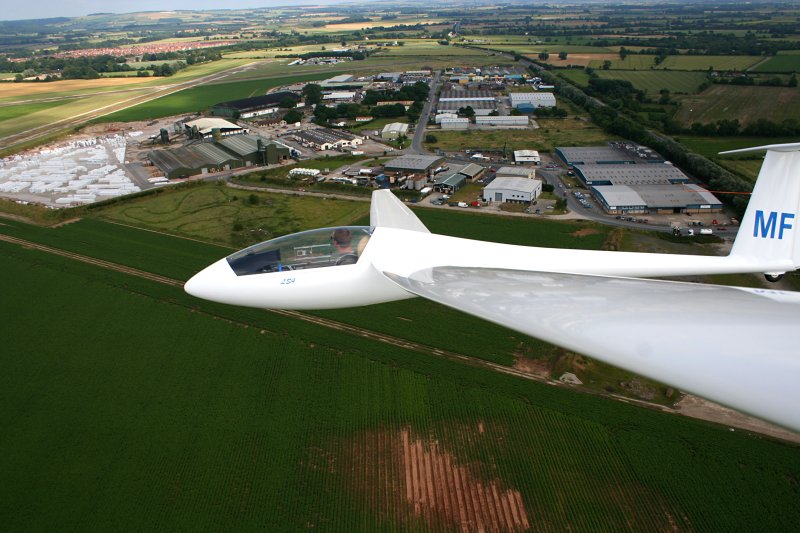
mf_airfield_lOn Pocklington airfield the early cloud had broken away, and the sun came out as the afternoon lingered, offering the occasional bit of thermal lift for the adventurous pilot. I’d already had my three flights for the day, and was satisfied. There were plenty of people about to hold the wing, do control checks and keep the flying logs, so my presence wasn’t really necessary. I had been thinking of returning home and getting to work on the first chapter of my dissertation, but it came to me suddenly that I had a vaguely relevant book, a seat in the sunshine, and the occasional diversion of watching gliders taking off, whereas all my room could offer me was a blank screen and a sense of claustrophobia.

I was deeply into an account of David Garrick’s stage practice when the words ‘does anyone want to do a loop-the-loop?’ drifted through my ears. The book flew from my lap as I sprang to my feet instantly, but too late. Marit, a Norwegian girl on her first visit to the airfield had raised her hand before me, and the flight was hers. Jealousy overwhelmed me.

‘I’ve been here for months, and I’ve never got to do a loop-the-loop!’ I hissed to her instructor. Tony was a bearded Yorkshireman in the most eye-achingly awful flat-peaked cap anyone has ever invented. Foul Fashions, the label said, and didn’t lie.

‘I’ll take you up next if you like.’ he said.

‘Oh. Thanks.’ I said, nonplussed, my rancour swiftly deflating.

Five minutes later they were off, shooting upwards at 45 degrees on a winch cable. Some thousand feet of ascent later, they detached, and we watched attentively as they turned left, dove for speed, then looped back on themselves in a smooth, easy, beautiful loop.

‘We used to do those all the time in the bad old days.’ one of the duty pilots reminisced. ‘Loop-the-loop, chandelle, and a beat-up.’

A chandelle I knew – it was a turn so steep the glider seemed to stand upon its wing. ‘What’s a beat-up?’

‘It’s where we used to turn back towards the airfield, and buzz past without landing.’ He chuckled to himself. ‘We used to hold up scorecards as they passed, like diving judges. Six, seven, eight point five. But health and safety put paid to that, of course.’

I had seen a beat-up once, on a frosty morning, when ice had begun to form on the glider’s wing on the first flight up, and the pilot had brought it low and fast across the airfield, in the hope of shaking it off. Flying had been delayed for hours.

Something other than glider aerobatics now caught the attention of those on the airfield. A few miles away at Elvington, a Vulcan bomber had taken off, its distinctive delta-winged silhouette clearly visible as it engaged in turns and stunts similar to our own. It was only just visible above the tree-line and the industrial estate, but a large crowd gathered to speculate about its fuel consumption, swap plane facts, and watch in envy. Our attention was briefly drawn back to our own airspace a few minutes later, when Chris and Alexis went up to fly aerobatics.

‘Do you suppose they’re making Vulcan noises as they do that?’ someone asked, as the K21 went through some incredible loops and turns. No-one would put it past them. For all that the advertising material goes on about the joys of silent flight, there’s a fair bit of nneeeooowww braka-braka-braka that goes on – in people’s heads, if nowhere else.

Finally, it was my turn to go up. Clipped into my parachute, strapped into my seat as tightly as possible, I watched in excitement as the winch cable, lazy as a grass snake, slithered its way to tautness.

‘All out!’ someone shouted, and in five seconds we were flying. All through the thirty second ascent, usually so entertaining, my eyes were riveted to the altimeter. A poor launch, and we would have to abandon the aerobatics and do a circuit, and my dreams of looping-the-loop would be on hold till next time. I watched with baited breath as the needle swung around. 900 feet – 1000 – 1200…

The winch cut off. The cable detached with a clunk.

‘Oh no!’ the instructor cried, as the glider’s nose plunged and we began to hurtle towards the ground.

I wasn’t fooled for a minute – not for more than half a second of giddy terror. Then the stick came hard back, and the sky, the horizon, and open fields began to whirl in front of me. The g-force pressed me down into the seat, my nose beginning to run with the sheer strength of it. Then, with a whoop, we turned into a chandelle, levelled, and began another loop-the-loop.

I would have thought I would be frightened, or a bit sick, or at least giddy, but it was nothing like the edgy, out-of-control sense a roller-coaster cultivates. You could feel that the pilot knew what he was doing, the glider was well within its limits, and all that remained was the adrenalin rush, the g-force, and the sheer sensation of looping-the-loop. Now I’m properly hooked.
Spring on the Airfield

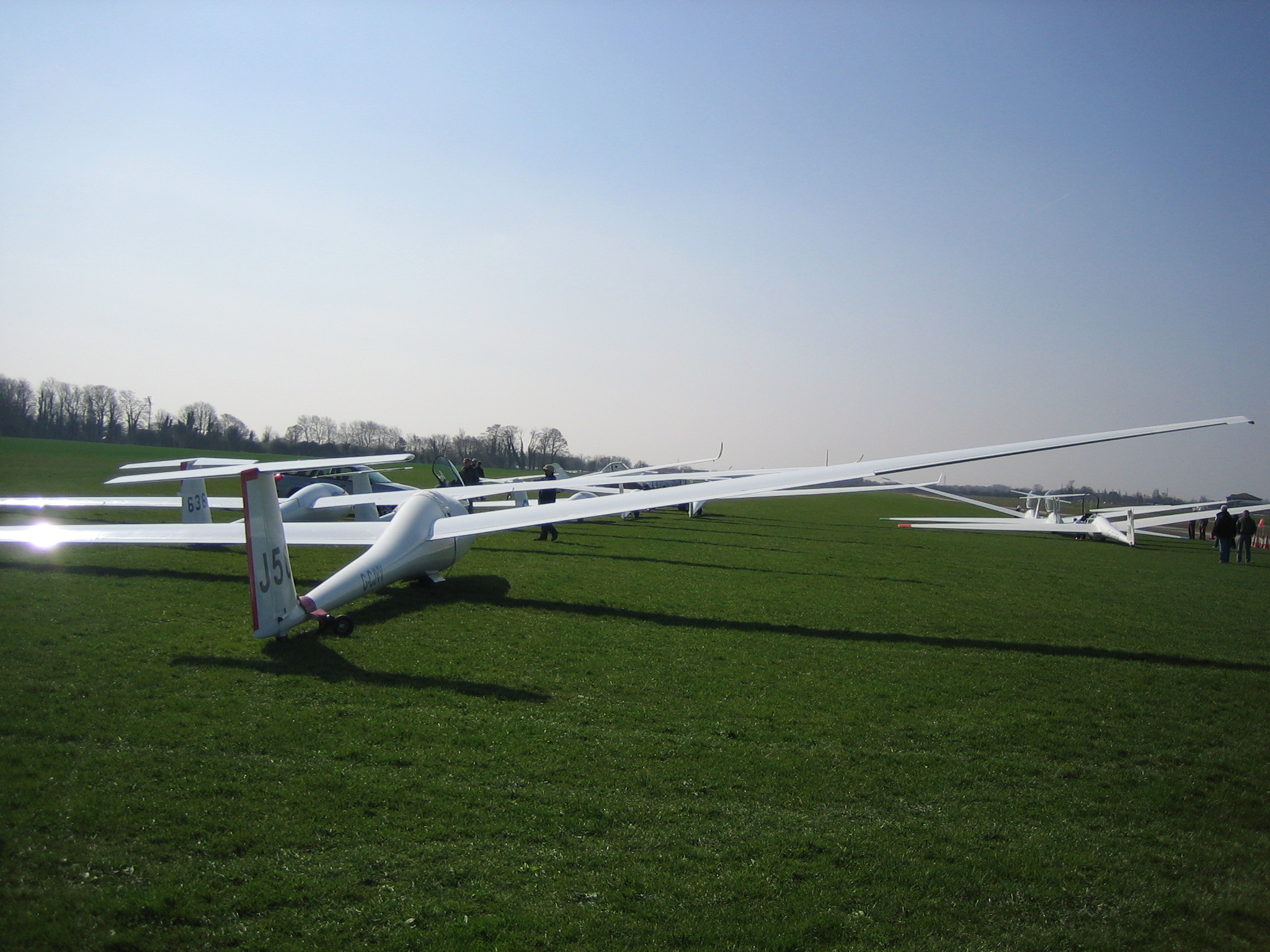
IMG_4181A belated spring has finally reached Britain. The trees are beginning to come into leaf, a couple of months after the first flowers poked their heads above ground, only to be buried deep in snow and frozen into submission. Down at Pocklington airfield, everyone is out of doors and a grand fleet of gliders is lined up in two orderly queues, for winch launches and aerotows respectively. The first of the spring thermals have arrived, and no-one wants to miss a moment of flying time.

Thermals are columns of hot air rising from the earth below, which can be hijacked by gliders and used to gain height. The lack of any warm air at all during the winter months is what makes gliding relatively neglected for half a year, when all anyone can do is descend as slowly as possible. In spring, when the nights are cold and the days are warm, and the temperature differential is at its strongest, the thermals are at their fiercest. It is possible to climb thousands of feet in just a few minutes.

I’ve been gliding all winter through, and coming out to Pocklington once a fortnight on average. I’ve been up a dozen times, but even so my total flight time is still just under an hour. An average winter flight lasts about 5-7 minutes, and even if you’re lucky and get 3 flights in a day, it’s still not a lot of time. Often rain, or adverse winds, or ice on the wing, will scupper your chances of getting into the air.

By contrast, my first flight this spring lasted 38 minutes, and took me to heights of 3500 feet. It was terrifying – but then I find everything terrifying while I’m flying a glider. It’s part of the reason I go. In this case, my head knew, abstractedly, that the higher we are the safer we are, that we have more room to manoeuvre, more opportunities to find another thermal,even – God help us – more time to bail out should anything go catastrophically wrong. My stomach, however, has only just got used to seeing Pocklington from a thousand feet up, and is really unused to this new perspective. It doesn’t help that climbing in a thermal involves spiralling inside a column of hot air, and maintaining that spiral in despite of all the efforts of wind and turbulence to force you out of it. It requires a tight look out, careful handling of the controls, and a strong stomach, particularly on rough days. By the time I land, I am noticeably green around the gills.

Yet there’s fun to be had on the ground too. Once we huddled in the tea bus, hunkered over our mugs and shivering, while mist poured from our mouth and nostrils with each exhalation. Now everyone is sat out around a table, telling the tall tales of lightning strikes and crash landings that are so much a part of the gliding experience. All around us, the birds are back in force. Since almost all our aircraft are silent, and the one strip of tarmac we have dates back to World War Two and is harder to land on than the grass, there’s little to scare them away. The swallows are all over the place, and popular with everyone except the man who’s job it is to keep them out of the aircraft hanger, where they have an irritating habit of nesting inside the gliders. The moment one entrance is stopped up, they find another. It’s a never ending task. Swifts and skylarks are to be seen in profusion, and I was once halfway through my circuit when I looked to my right and found two buzzards flying a few feet off my wing. Of course, I couldn’t let that go by without writing a poem.

Birdwatching on the Airfield.

The swallows nest in gliders in the spring.
Leave one uncovered for a week and when
You check inside the canopy or wing,
You’ll find them stowed away there in their den,
Awaiting launch by aerotow or cable,
As if they thought to fly up like the wren
Upon the eagle’s back, in Aesop’s fable.
This spring, there’s many kinds of birds around,
I’d name them all for you, if I were able,
But of the ones whose proper names I’ve found,
I like the skylark best for its ambition.
Because, like us, they’re born upon the ground
But will not be content with their condition.
To see them struggling skywards in full song
Fills we with – well, a kind of recognition
Of my desires in them. Oh, prove me wrong
If you’ve a mind to, but I think we share
A certain glee in flight, now Winter’s gone.
It wasn’t long ago I saw a pair
Of buzzards in a thermal spiralling
Beside my glider on the rising air,
And as we soared together, wing to wing,
I thought: to us, with human speech’s gift
There’s mystery in all they do or sing,
But sympathy as well. Why, take the swift:
Would it play all the games it does in flight
With drag and thrust and gravity and lift
If with us it shared not the same delight
In ease and speed and silentness and height?

Lament for Enobarbus

Patrick Stuart as Enobarbus

A question I often ask to break the ice at parties is “If some mad theatre director came up to you in the street one day and told you that you had the perfect face, that he knew he could cast you in any role in the whole of Shakespeare – black, white, male, female, anything – and you’d succeed brilliantly: what role would you ask for?”

(Yes, I go to a lot of these kind of parties. I study English Literature.)

I’ve had some interesting responses. One girl wanted to be Hecate in Macbeth, who gets cut out of the play in most versions for probably not being genuine Shakespeare; someone else wanted to be the bear in The Winter’s Tale, whose part consists of a single stage direction – though it is, to be fair, the most justly famous stage direction in all Literature.

Of course, as is the case with most of these questions, my answer has been carefully worked out beforehand. I universally opt for Enobarbus, from Antony and Cleopatra, which promotes many puzzled looks.

Enobarbus is the forgotten man of Shakespearean tragedy, his tear-jerking end subsumed into Antony’s bungled suicide (like Charles II, he takes an unconscionable time a-dying) and Cleopatra’s magnificent, stately death by snakebite. And yet, of all Shakespeare’s characters, he’s the one I’ve come closest to crying over. Of Shakespeare’s characters, he alone manages to combine both high poetry and solid earthiness, and does so brilliantly. He’s not above getting drunk when there’s a truce to be celebrated, or pugnaciously defending his fighting reputation to a rival, or mocking the tipsy gullibility of Lepidus. And yet to him fall some of the most beautiful passages of description in the whole play, no, the whole of Shakespeare, when he describes Cleopatra for the men of Rome.

Age shall not wither her, nor custom stale
Her infinite variety: other women cloy
The appetites they feed, but she makes hungry
Where most she satisfies.

He is perceptive enough to see that Anthony cannot possibly hold true in his marriage to Caesar’s sister, Octavia, and that by his infidelity the truce between Antony and Caesar is sure to be broken; he perceives that Antony should fight on land, rather than risking a naval battle at Actium, and that if he does fight at Actium, the last thing he should do is take Cleopatra along to spectate. But Antony, of course, does so anyway. Seeing his master’s fortunes turned around, and inevitable defeat facing the Egyptian lovers, Enobarbus who, like most soldiers, is a realist by training, makes the decision to defect to Caesar’s company. But in what is simultaneously his tragic flaw and his saving grace, he can’t live with himself afterwards. To turn from the beauty and romance of Egypt to the solemn and ordered ranks of Rome; from the impetuous trust of Antony to the suspicion and neglect of Caesar is too much for him. When Antony, in a magnanimous gesture, sends after him the treasure Enobarbus abandoned in his escape, he becomes so ashamed he resolves to ‘go seek / Some ditch wherein to die: the foul’st best fits / My latter part of life.’ His final speech runs thus:

O sovereign mistress of true melancholy,
The poisonous damp of night disponge upon me,
That life, a very rebel to my will,
May hang no longer on me: throw my heart
Against the flint and hardness of my fault:
Which, being dried with grief, will break to powder,
And finish all foul thoughts. O Antony,
Nobler than my revolt is infamous,
Forgive me in thine own particular;
But let the world rank me in register
A master-leaver and a fugitive:
O Antony! O Antony!

Calling upon his master, he sinks down and dies. A master-leaver and a fugitive he may think himself – yet what I like best about him is that the realist and the poet contend in him, and though the realist gets the upper hand for a time, the poet eventually wins. To die, as Cleopatra recognises, is far better than to be carried back to Rome by Caesar as an ignominious token of victory. Even by dying of shame, Enobarbus affirms adventure and romance over mean profit-seeking, and though his death cannot match the awful tableau of Antony and Cleopatra’s finale, one feels he too is entitled to the queen’s aching lament over her departed lover.

Oh, withered is the garland of the war.
The soldier’s pole is fall’n! Young boys and girls
Are level now with men. The odds is gone,
And there is nothing left remarkable
Beneath the visiting moon.

Waterlog 5: Holy Isle, Scotland

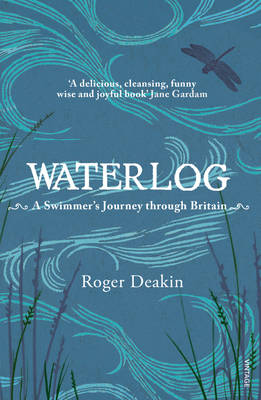
WaterlogThe seasonality of wild swimming is an organising theme of Roger Deakin’s Waterlog, which begins in April in the Scilly Isles, and climaxes with a Christmas Day plunge into the North Sea. If I haven’t been quite so adventurous as to keep my wild swimming habits up in the depths of the English winter (I gave up in November), at least my season opener, a fortnight earlier than Deakin’s plunge, and in the far north of the country, has a certain daring to it.

Holy Isle, Scotland

I rose from my sleeping bag on our second morning of camping out, feeling greasy and hungover, and smelling strongly of BO and woodsmoke. Our campsite  had no showers, and offered little to do after dark but build enormous campfires and drink heavily. We were on the Isle of Arran, just off the west coast of Scotland. It had made the news a fortnight ago by suffering snowstorms so severe that the north end of the island had been virtually buried, and all power from the mainland broken off. When we arrived, the snows were gone save from the tops of the very highest peaks, and the sole memory of that week were the great rectangular generators, lined up on trucks all down the Brodick seafront, and still visible down many a highway and byway throughout the island. We had some fears that the islanders might have resorted to cannibalism, but it turns out that when face with the breakdown of civilisation, they had done the British thing, and retired to the pub to play board games.

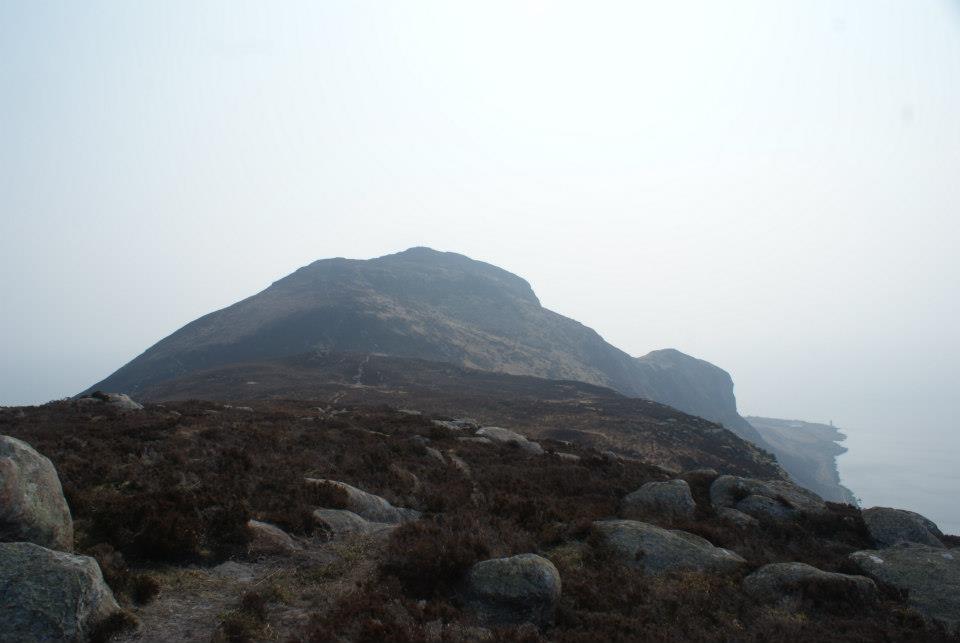
Even in the absence of snow, the morning was remarkably chilly, and I pulled on every scrap of clothing I had as I went about the morning chores of making skillet and filling my water bottle. A thin, chill mist hung over everything, blurring the peaks that had been pin-sharp yesterday, and making the sunlight fall weak and watery on our faces. The decision was made to go for a walk on Holy Isle, just off the coast of Arran, once the hermitage of a Celtic Saint and now the location of a successful Buddhist retreat. Half the island is a nature reserve, and some of it is devoted to a group of reclusive nuns who’ve retired from the world for the next four years, but there’s still plenty of scope for a hike up the island’s sole mountain, Mullach Mor, and a walk back along the seashore.

ArranThe island was an odd place, with bright, wind-ragged Buddhist banners flying high above the heather, and hardy brown Asian sheep, with great curved horns, browsing on the thin winter grass. As we reached the top of the mountain it became clear that the chill morning mist had somehow turned to baking noon haze, without thinning or thickening or altering in the slightest. The mainland was completely cordoned off from the eye, and the isle was covered in a luminous, Celtic Twilight atmosphere that photos don’t really do justice to. Temperatures were reaching 18 degree highs, and all the softshells and banded jackets we’d donned that morning were being stuffed back into our groaning daysacks.

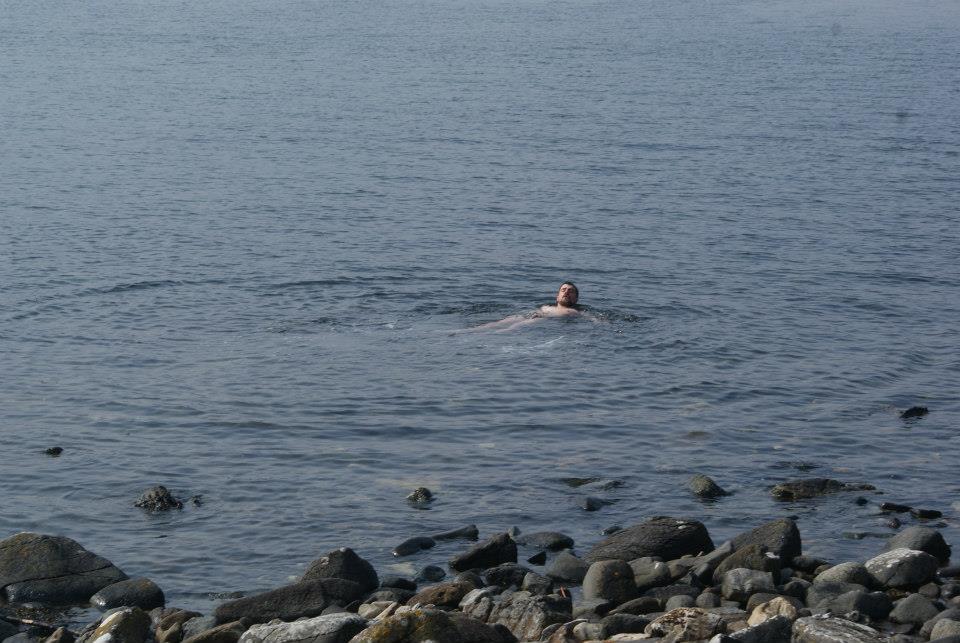
Cooling off slightly, we came down to the shore, where some split off to wander into the caves, others to admire the beautiful Stevenson lighthouse, and still others to skim stones skillfully across the water. I decided to paddle – but paddling is an art I’ve never quite mastered. Somehow, I always seem to end up going swimming – and even when I don’t, I still get damp shorts. In this case, I waded in and splashed my face for a bit, and then thought ‘Hell with it’ and took the plunge.

in the seaThe agony and the ecstasy of the water was almost sexual in its intensity. I drifted out from shore on my back, hyperventilating mildly from the cold shock, while my friends on shore waved and cheered. It felt like I was undergoing a whole body attack of pins and needles. Every drop of blood beneath my skin had decided there was somewhere else it would much rather be, and fled back to my core. A deep and purifying cold was scouring the sweat and woodsmoke from me.

I rolled over onto my front and executed four strong strokes towards Arran, with swiftly numbing limbs; then thought the better of it, turned again, and struck out for the shore. I had swum almost a mile in the sea off Mallorca a week ago – but that had been the warm Mediterranean, and I’d still emerged shivering and blue around the edges. Outside of a wetsuit, this was not a sea in which you would want to spend a lot of your time. As I emerged and began to towel some feeling back into my limbs, I had the pleasant experience of seeing my friends cautiously dipping their feet into the water, and jerking back with pained expressions. And so a new year of wild swimming begins!

Waterlog 4: Squam Lake and the River Derwent

WaterlogLooking again through Roger Deakin‘s classic wild swimming manifesto, Waterlog, I realised that while there’s an awful lot of swimming for pleasure, or adventure, or exploration, he never really covers jumping in the lake as an alternative to jumping in the tub. Quite often, after the really long cold swims, he has a piping hot bath awaiting him when he gets out – and actually, it’s hard to blame him for that. But this got me thinking of the two times in my life where swimming has replaced washing, and what that felt like.

Squam Lake, New Hampshire.

It was my first time in America, and we were paying a visit to some family friends called the Butterworths. They had visited England when my father was a kid, but apart from the prosaic business of having children and letting their hair grow white, they didn’t seem to have grown much older in the meantime. Which suited me fine, seeing that I was nine at the time.

This was their summer holiday, and the whole extended family were living in log cabins they’d built for themselves, on the edge of Squam Lake. Electricity really ran out at the fridge, which was in a little hut of its own a few hundred yards up the road. It limped on as far as the main cabin, where it powered a single bulb – but that was it. No modern plumbing, no TV or radio, no hot water. You woke up, went for a swim, then had breakfast. I was nine, and it was paradise. I’d never been around people with their own canoes before, and suddenly it was Swallows and Amazons come to life. It was a perfect, innocent, boys’ own adventure story.

Case in point RE the innocence – it was accepted etiquette for those living on the opposite side of the lake to swim across and greet new arrivals, rather than going to all the trouble of walking round. Our nearest neighbours happened to be a pair of Swedish girls, and as they rose dripping from the water to introduce themselves, I couldn’t work out for the life of me why my father was so impressed, and my mother so irate with him. It would continue to be a mystery to me for a good couple of years.

We pretty much lived in the water – it was always cool, but it was never a shock to get into, and even when we were mucking around in canoes, we were always looking for an excuse to capsize or fall overboard. Being in the water was simply much more fun than being on it -and that’s an opinion I hold to this day.

I’ve forgotten most of it now, and envy my sister’s memory, who can ever recall the pattern on the sides of the canoe, and the path through the woods to every hut. For me, the whole thing has receded into the golden mists of boyhood, and I can hardly believe I ever lived a life that much like something out of a book.

The River Derwent, Peak District

Swimming didn’t replaced bathing again until a recent trip to the Peak District with a walking group from Cardiff. Our bunkhouse was close on the River Derwent, and while we were searching for a footpath that the river, then in spate, had completely overflowed, we discovered a rather convenient bathing hole by the side of an old mill. Upstream the river was shallow and tame – downstream it thundered down a long stretch of rapids out of sight, and in the middle there was a long deep pool on the edge of the weir where a man could get a few strokes in before beaching himself on the gravel.

It was nothing like Squam, where the lake was deep and the swimming was limitless. Unlike the gentle American waters, the river was cold enough to take my breath away, even in summer. But it was a beautiful river, between the moorhens and the willows on one side and the foam, spray and thunder on the other. When our hastily re-routed walk was over, I returned to wash off the dust – and returned again, morning and evening, for the next four days, sometimes with friends and sometimes alone. It was astonishing how it would alter my mood. I’d walk down tired and snappish and grimy, and return revitalized, cheerful, and awake. Everyone I swam with commented on it. For four days I neither soaped, shampooed or showered, but plunged in the river and emerged feeling like a king. But then the rain came down, the temperature dropped a few degrees, and I made a cowardly retreat to the hot water of the bunkhouse bathrooms. Yet just as I was finishing up, my hand found the temperature dial and gave it a sudden, violent, anticlockwise twist, and I gasped and spluttered beneath an ice-cold torrent for thirty excruciating seconds before I got out. That too has become a habit.

Benjamin Franklin meets Voltaire

Portrait of Benjamin Franklin

History is full of great men and women running into each other by coincidences that must have seemed like nothing at the time, but which often throw their biographers into flights of speculation as to what was said, and what was thought, and how each must have reacted. Sometimes the results are seismic, but too often the encounter ends in disappointment. John Keats meeting William Wordsworth was, by all accounts, a social disaster. Elizabeth Gaskell, the industrial novelist, lived on the same street for years as Friedrich Engels, co-author of The Communist Manifesto, without either of them appearing to know who the other was. Edward Thomas and Wilfred Owen would have known each other by sight without either of them having any idea that the other wrote poetry – much less some of the best poetry of World War One.

In the case of Benjamin Franklin meeting Voltaire, however, the charm of the occasion is that the spectators appear to have pre-empted the biographers, and been positively rabid with excitement.

On a Wednesday in April 1778, Benjamin Franklin, at that time a Minister Plenipotentiary to the newly formed United States of America, had with dinner with John Adams, the commissioner and the future President of the United States, and both went afterwards to hear a few papers read at the Academy of Sciences, the premier intellectual gathering in Paris. Benjamin Franklin was already famous throughout France for his discovery of the lightning rod and the electric properties of thunderstorms, in addition to his many literary and philosophical works and his staunch defence of his country’s new independence. Dubbed L’ambassador electrique, he moved among the social circles of Paris with much greater facility than Adams, whose stern republicanism was shocked at the frivolity the French mixed together with the serious affairs of science and diplomacy.

Also attending the Academy of Sciences that night was Voltaire, a voluminous writer whose religious and political scepticism had made his life one long litany of imprisonment in, and banishment from, his native France, but whose many sufferings had never stopped him writing , and served but to increase his fame and popular appeal. Now aged 83 and aware he had only a few months to live, and that the current climate was sympathetic to his opinions, he had broken a three decade sentence of exile and returned to Paris.

According to Adams’ account, the meeting began routinely enough, with D’Alembert, the president, reading eulogies on the recently deceased members of the Academy. But some of the crowd, electrified at the presence of two living legends of the Enlightenment among them, began to demand that Franklin and Voltaire be introduced to one another. The two philosophers bowed formally and spoke to one another, but this was no satisfaction to anyone, and served but to increase the clamour of the audience. As Adams dryly notes:

Neither of our Philosophers seemed to divine what was wished or expected. They however took each other by the hand…. But this was not enough. The Clamour continued, untill the explanation came out “Il faut s’embrasser, a la francoise.” The two Aged Actors upon this great Theatre of Philosophy and frivolity then embraced each other by hugging one another in their Arms and kissing each others cheeks, and then the tumult subsided.

What the two thought of each other, we hardly know, and the meeting led onto nothing new in the careers of these two titans of the Enlightenment, whose greatest triumphs were now behind them. All the same, one would have loved to have been there.

A-roving by the light of the moon

moon_20020517

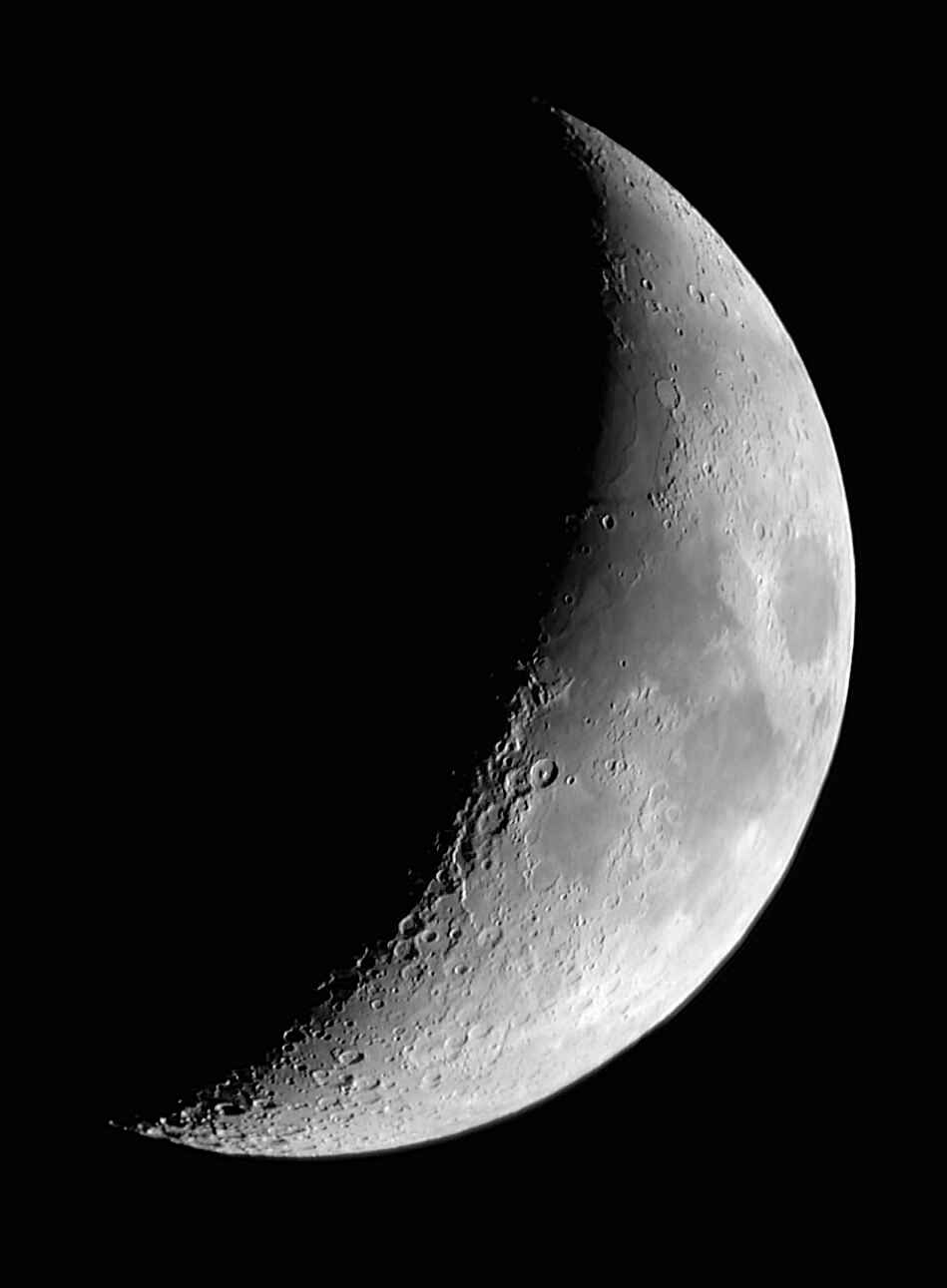
It was a brisk February night and I was camping out in the Lake District with my mountaineering friends. I had been hoping to get a spell of stargazing in, and things looked pretty good as I dismounted from the minibus, with Orion above the mountains, and the usually faint constellation of Lepus (the hare) clear beneath his feet. Unfortunately by the time we’d put our tents up a high light cloud had swept in across the sky like a veil, hiding everything except the waning crescent of the moon, to which it gave a diffuse and lovely lustre. My hopes of stellar observations were evidently thwarted. It was time we gave up and headed for the pub.

Yet as my friends pulled their head torches over their foreheads, and brilliant white diodes illuminated the road ahead in their wavering glare, the poet in me rebelled, and I hung back. The moon gave enough light to walk by, and I was keen to enjoy the night on its own terms. If I couldn’t admire the beauty of the heavens, this was the next best thing.

It took my friends a long time to pass me, and they would keep turning back for some parting comment on my eccentricity, and inadvertently dazzling me by the glare of their head torches. Finally, the last of them turned the corner, and I was alone on the unlighted road. The moon was behind me as I walked, and my eyes fed upon the darkness, slowly weaning themselves from the light. From the first I could make out the lines of the mountains that surrounded the valley, stark against the skies – then the trees overhanging the road – then the stones in the dry stone walls, and the sheep in the fields beyond them. A puzzling fork in the road turned out to be the twin arches of a bridge beneath which the river roared unseen.

Surprisingly, I find tarmac is one of the hardest things to walk on at night simply because it’s so featureless, so black and so even. The eye can’t pick out its texture, and each step is a battle against the half-conscious suspicion that a yawning pit is about to open beneath my feet and swallow me. In the woods, by contrast, the very roughness ground makes me swifter and more sure of myself. This added a new frisson to the fine chill February night, which already had more than a touch of the Gothic about it for those of us wandering beneath the moonlight. It was such a night as Coleridge describes:

Is the night chilly and dark?
The night is chilly but not dark.
The thin grey cloud is shed on high;
It covers, but not hides, the sky.
The moon is behind and at the full
And yet she looks both small and dull.
The night is chill, the cloud is grey.

I half expected to glimpse Christabel kneeling beside an old oak tree as I passed by. There were no electric lights in sight now, and I had become an anonymous traveller in the anonymous, timeless night.

In the eighteenth century, to travel at night and by moonlight was common. Country balls would be held at the full moon, so as to give enough light for the coaches to drive home when the evening wound to its close. In the great comic novels of Henry Fielding, Tom Jones and Joseph Andrews, the heroes travel as much by night as they do by day, frequently striking out from unfriendly inns at unlikely hours. They would have relied solely on their night vision. Only in the big cities would you have linkboys with flaming torches to guide late night drinkers from door to door.

Today it seems hard to imagine. My mountaineering friends had a gorgeous story of how they had arrived in Snowdonia on a brilliantly clear night, and decided on a whim to forsake their tents and climb Snowdon by starlight – but I had little doubt they’d done it all with their head torches shining out before them. In these days of constant lamplight and pocket torches, the darkness beyond has become more sinister, peopled with God knows what. It requires a real effort of will to step into it, to let your eyes adjust to the darkness, and resign yourself to the fact that each footfall is a leap of faith.

I turned a corner, and the electric lights of the pub dazzled me. The night vision I’d acquired over the course of half an hour was gone in a flash. My thoughts turned from Coleridge and Fielding to those famous lines of Byron:

Though the night was made for loving,
And the day returns too soon,
Yet we go no more a-roving
By the light of the moon.

Waterlog 3: Rhossili Beach, Gower Peninsula, South Wales

WaterlogRecently, I’ve been reading Waterlog, by Roger Deakin, a potent and poetic defence of our right to swim anywhere we please – in ponds, in rivers, in the sea – anywhere that looks cool and inviting, and several that look downright perishing! I now know to ignore the omnipresent threatening signs warning of the risk of Leptospirosis (chances of actually catching it – 1 in 33,000) and take my dip anywhere I please. In fairness, I ignored them anyway – but it’s nice to have some expert backing.

In that vein, I thought I’d write up some of my favourite bathing places throughout the British Isles.

Rhossili Beach, Gower Peninsula 

English: Worm's Head, Gower. Taken by me flyin...

The Gower peninsula is an extraordinary place. A big comma on the South Wales coastline between Swansea bay and Cardigan bay, it offers largely untouched countryside, one of the many candidates for the grave of King Arthur and the best surfing beaches in Wales. The favourite place both for swimming and surfing is Rhossili beach, at the far end of the peninsula, a long straight stretch of sand facing out directly to the west, flanked at either end by two small islands with tidal causeways: Burry Holms to the north, and Worm’s Head to the south.

One of my great regrets about leaving Cardiff was that I never, in three years, managed to get to the end of Worm’s Head, a long, snaky ribbon of bright green grass extending out into sea. Once I got as far as the inner head, a ludicrously steep dinosaur spine of a hill that confronts you as you cross the causeway. Then, however, the tide came back in, and we had to rush back across before we were cut off. The far end of the peninsula remains a mystery to me, fitfully illuminated by long hours gazing at Ordnance Survey maps, or re-reading Dylan Thomas’s classic short story ‘Who Do You Wish Was With Us’.

I’ve swum twice off Rhossili beach. The first time was on May 3rd, 2010 – I remember this particularly because it was 200 years since Lord Byron swam the Hellespont, the tumultuous Turkish strait dividing Europe from Asia. He was in good, romantic company – the legendary lover Leander is supposed to have swum across each night to visit his lover Hero, swimming back the next morning, until his amorous career was cut short by a tragic, but entirely predictable, death by drowning. Byron survived the feat, which he immortalised in a witty minor gem of a poem. I was not out to do anything so staggering, but a commemorative swim seemed in order, and the weather was most propitious. It was a warm day, and lunching on Rhossili Down I saw my first swallow of the summer. By the time we reached the beach, I was very keen for a swim – and it just so happened that the tide had come in far enough to cut Burry Holms off from the mainland. I swam out through the cool salt water in a Byronic breaststroke, and managed to land on the island without losing any skin to the rocks, which is always the trickiest part. I wandered up and down, waving at my friends back on the mainland, trying to avoid stepping on stinging nettles and wondering how it would feel to have swum the 3 mile distance from Europe to Asia, and swum back again, enjoying the small act of homage to my favourite poet.

Eighteen months later, in November of 2011, I wasn’t expecting to go swimming at all. I had no towel, no swimming trunks, nothing. It was too cold, I told myself, and I was a solemn third year undergraduate now. I was leading walks, armed with map and compass, instead of faithfully following on behind. A little Byronic posing on exposed pinnacles was all I could expect. But fate brought me two people equally as crazy as I was, keen to make the most of the fading Autumn warmth. With Rob I shared a tendency to sandpaper stubbliness, and a love of intrepid, broad-brimmed hats. On the way up, I nicknamed him Ragdoll for his habit of flopping forward bonelessly whenever I applied the brakes. Then there was Lauren, who had proposed the swim at lunch, as if sea-bathing in November was the most natural thing in the world. Before her slow, mischievous smile all the practical difficulties seemed as nothing. As we plunged together into the icy November sea, jumping and splashing and spluttering, I bethought myself of the words of J.K. Rowling:

There are some things you can’t share without liking each other, and knocking out a twelve-foot mountain troll is one of them.

This, I decided, was another.

Waterlog 2 – Caerfanell, Brecon Beacons

WaterlogSouth Wales is sadly underserved in Roger Deakin’s classic wild swimming manifesto, Waterlog. The west of England is covered pretty thoroughly, and the Rhinog Mountains in North Wales get a chapter to themselves, but the sole mention South Wales has in the whole work is a brief aside where Deakin contemplates jumping into the Monmouthshire and Brecon canal near Talybont-on-Usk, and decides against it. Knowing as I do how close he was to the Talybont reservoir, a three kilometer long pool surrounded by farmland, forest, and the high peaks of the Brecons, or to the spectacular, boulder-strewn course of the river Usk, his timidity seems all the more unusual. A little further exploration, and he might have found one of my favourite swimming holes.

Caerfanell, Brecon Beacons

A favourite walk with the Cardiff University Hiking and Rambling society was to drive up into the Brecons, climb the recklessly steep Craig y Fan Ddu, and circle the ridgeline, taking in the wreckage of a World War II Wellington bomber and the memorial to its Canadian flight crew, before descending into the valley beside the course of the river Caerfanell. So popular was it that I walked it three times in three years, and went swimming every time.

slidingThe first time I took a dip in Caerfanell was in October, in the second wettest day I’ve ever been out in the Brecons. As we came along the ridge, all the dozens of little streamlets were being blown back upon themselves in arcs of spray. Not having any waterproof trousers with me, I was absolutely soaked by the time we got down to the bathing pool – a deep cauldron of a place beside the road, with a tree stretched out over it from whence the brave can take daredevil leaps into the deep water. I figured going swimming in this weather was daredevil enough. It had been advertised as a swimming walk, but it seemed that only I’d been foolish enough to bring a towel and swimming costume, and since I’d already lugged them over hill and dale – well, why not?

Skidding down a steep slope that left a long trail of mud across my legs and back, I immediately cleaned myself off by jumping in. The water was icy, but after the first half minute of breathless gasping and frenzied doggy-paddle, I found myself rather enjoying it, and even took time to cool my head off beneath the waterfall before climbing out, dressing, and making the welcome escape to the minibus and the warm showers of home.

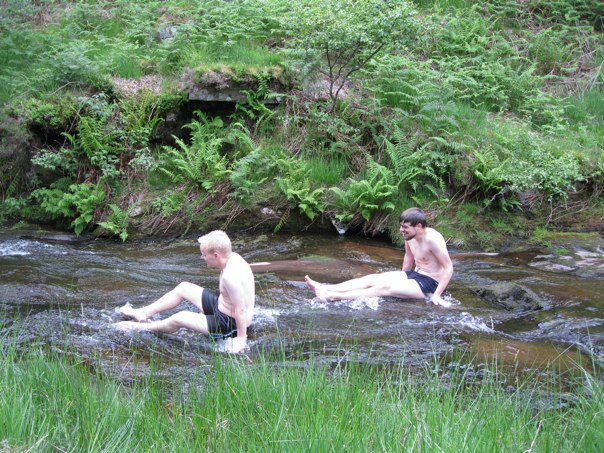
Blaenyglyn2A year and a half later, I walked the same route with a largely different group of people, on a spectacularly sunny day. Word of my wild swimming propensities had circulated the club by now, so we were on the look out for a swimming hole – but this time everyone in the society seemed keen to join me. It had been a long hot sweltering walk that day, and everyone was keen to wash off the sweat and dust. We found a likely place, a deep, cool, brown pool, much further up the path and hidden from the road. And for the first and only time in my three years with them, everyone in the hiking club joined me. There was a great deal of splashing and teasing and frolicking, and the little pool became so full I clambered out again and began exploring upstream, threading my way barefoot along rapids and waterfalls. I found several pleasant little pools, though none so nice as ours, and succeeded in giving myself a limp for a week by trying to slide down a waterfall. I found to my cost that, limpid and slow as the stream may be, once you’ve built up a bit of momentum the slide is terrifying. “Oh God, I’m going to bang my head and drown!” I remember thinking as I bumped and tumbled over half a dozen small drops before clawing to a panicky halt just before plunging into the final pool. Yet, clambering down, I found myself celebrated for my daring, and would rather like to repeat my slide to this day – with perhaps the small additions of a helmet and a wetsuit.

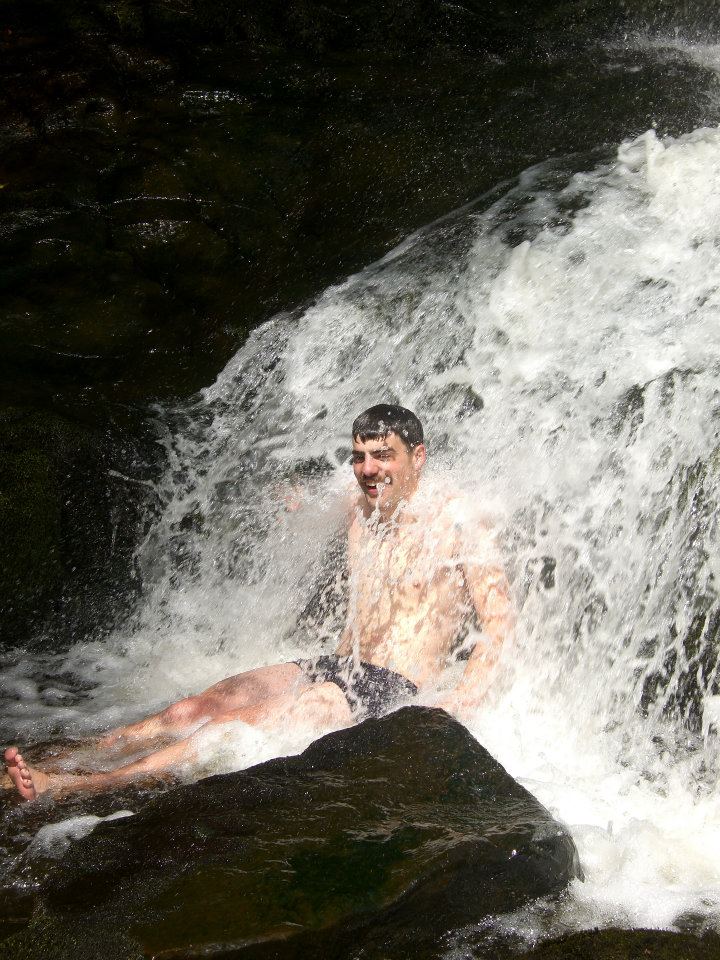
under waterfallThe third year I did the walk was a slightly melancholy affair, as my time at Cardiff wound to a close, and many of the people I’d been walking with on the last two occasions had already moved on, to employment or unemployment. Now I was leading the walk, introducing the wonders of the Brecons to the freshers, and it was hard to chase my thoughts away from the young, hardy, ridiculously enthusiastic fresher I used to be. Still, there’s nothing like a nice cold dip to chase the blues away, and while the pool I found this time was rather too shallow for the purpose, it had a fantastic waterfall. Sitting underneath it was something like being in a cold shower and a massage chair at once, and tilting my head back, I enjoyed a beautiful and unusual view of a waterfall from the bottom upwards. It was a fine way to wind up three exceptional years, and three exceptional swims in a gorgeous river.