Teaser trailers are getting stingier. True, they were always meant to tantalise us with a few seconds of footage from films and TV programmes we wouldn’t get to see for months, but as studio execs get slicker at viral marketing and riding the hype whilst keeping every bit of plot information they can under wraps, the teaser trailer is torn in two directions – revelation and secrecy. Too often, this becomes a pointless exercise in frustrating your audience.
To illustrate my point, let us return to the halcyon days of my youth – to the golden year of 2001, when two of my favourite books hit the big screen at once: Harry Potter and the Philosopher’s Stone, and Lord of the Rings: The Fellowship of the Ring.
At the time, I thought Harry Potter was the better movie. I was young and naieve. It’s still plain, however, that while the Lord of the Rings teaser is overloaded with exposition, the Harry Potter teaser contains everything a young fan might want to see without giving too much away – the letters swooping down the chimney! The Hogwarts Express! Hagrid! The Great Hall! Dumbledore! Snape! McGonagall! Harry, Ron, Hermione, and the tantalising prospect of Quidditch on the big screen! Nothing could be more exciting.
Fast forward to 2012, and the teaser for The Dark Knight Rises resembles something put out by one of those irritating people who fake trailers for new movies by splicing together footage from old ones. Some offcuts from Inception – a few clips from Batman Begins and The Dark Knight – while Commissioner Gordon wheezes something inaudible from a hospital bed. Even the blink-and-you’ll-miss-them appearances by Bane and the new Batman costume can’t save it.
It is possible to do this properly, as JJ. Abraham’s trailer for Star Trek (2009)showed. It contains no footage from the film we saw in cinemas – it doesn’t even tell you the name of the film. Yet, lifted as it is by marvellous sound design, Leonard Nimoy’s goose-pimply voice over and the surprise reveal, it’s a wonderful bit of cinema in its own right, and a concise introduction to the dynamic visual style of the Star Trek reboots.
The worst culprit is the most recent – the first teaser trailer for Doctor Who Series 8, the first season starring Peter Capaldi as the Doctor. Of the 15 seconds the trailer lasts, 10 of them are taken up with the Doctor Who logos that top and tail it. 2 of the remaining 6 seconds are taken up by staring at a dark screen. The other 3 seconds show a few frames of Peter Capaldi, standing in silhouette, against the TARDIS console. And that’s it. No monsters, no Daleks, no alien planets. No glimpse of the main characters in action – not even a proper look at the new Doctor’s costume, and photographs of that were released to the media months ago. Instead, a total waste of 30 seconds of my life.
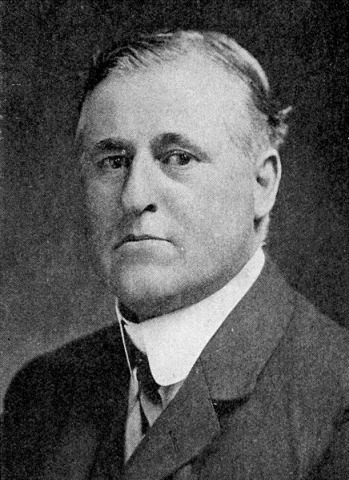
Time has not done any favours for Sir William Watson. Time, in fact, has not served any of the patriotic verse writers of the early twentieth century particularly well, but Rudyard Kipling gets credit for hidden depths as well as sympathy for losing his son in World War One, and Henry Newbolt (‘Play up! Play up! And play the game!’) still gets quoted for British Imperial Poetry at its most jingoistic. The poetry of Sir William Watson, by contrast, was neither subtle or ambivalent enough to stand on its own merits, nor tasteless enough for notoriety. Born in 1858, he proved to be a staunch Victorian and literary conservative and could not or would not assimilate the increasingly influential modernist movement into his poetry. By the time of his death in 1935, his entry in the Oxford Dictionary of National Biography records that he was almost totally forgotten, and many were surprised that he had survived so long into the new century. He is now out of print, rarely anthologised and few even among academic specialists spare him a thought from day to day.
Such is literary fame. Some very few writers, like Shakespeare or Austen, may write volumes, and find that future generations will prize every word of them, and treasure every signature and trace they leave in the world. Others write volumes, and find of their hundreds of thousands of words a couple of poems survive, or a single book. Others may only contribute a single line or a phrase that bobs like a lonely spar on the surface of an ocean, into whose forgotten depths the edifice it was once part of has plunged without a trace. Some, like Sir William Watson, are almost completely forgotten – yet if I had to nominate a single line of his poetry to survive the cataclysm, I’d opt for the first line of his Hymn to the Sea:
Lover whose vehement kisses on lips irresponsive are squandered
This is a verse form called a Homeric, or Dactylic, Hexameter, consisting of a metrical foot of one stressed and two unstressed syllables, repeated six times. It is an English version of the Ancient Greek metre in which the Iliad and Odyssey were written, and one that proved to be bizarrely popular throughout the nineteenth century. The flaws of the English hexameter are obvious to anyone who tries to read or to write a such a poem – such as Coleridge, who complained:
All my hexameters fly, like stags pursued by the staghounds,
Breathless and panting, and ready to drop, yet flying still onwards,
I would full fain pull in my hard-mouthed runaway hunter ;
But our English Spondeans are clumsy yet impotent curb-reins ;
And so to make him go slowly, no way left have I but to lame him.
In English, it is a forced, unnatural metre, turgid, droningly repetitive, almost impossible to rhyme (though Swinburne made a good shot at it) and which owes its nineteenth century popularity entirely to the novelty and difficulty of the metre, and the cultural cachet of its Homeric associations. The most famous and readable works in it are Henry Wadsworth Longfellow’s Evangeline, and Robert Southey’s notorious A Vision of Judgement, which includes lines like:
Thus as I stood, the bell which awhile from its warning had rested,
Sent forth its note again, toll, toll, thro’ the silence of evening.
And which inspired a brilliant parody by Byron, in the far more expressive form of ottava rima.
Having found the dactyllic hexameter completely unsuited to the English language, it is surprising to find that in Sir William Watson’s line, it almost works. The poem as a whole quickly gets repetitive, but in the musical phrase
Lover whose vehement kisses on lips irresponsive are squandered
I can find what the English hexameter has universally lacked: the marriage of sound and sense. In the whispering of the repeated sibilance; in the crash of the opening stresses and the melancholy, long, withdrawing roar of the weaker syllables, there is something evocative of the very motion of the sea, the ‘tremulous cadence slow’ that haunts Arnold’s ‘Dover Beach’ and Tennyson’s ‘Passing the Bar’. Counterpointed by the strikingly original image of the sea imparting her passionate kisses to the land, it makes this single dactylic hexameter as close to perfect as the English language can make it. It is a line well worth remembering, and one which I do remember, every time I go down to the seashore.
My account of the conference is reblogged from the BARS blog, curated by Matthew Sangster.
– – – – – – –
I had not even started my PhD when I first saw the call for papers for the BARS early career and postgraduate conference on Romantic Locations, but I had come away from an internal postgraduate conference at York brimful of misplaced confidence, and that very week I was hitch-hiking into Keswick for a few nights free board at the youth hostel where my friend worked. I took a copy of Wordsworth’s Guide to the District of the Lakes with me, and in the meditative moments between the rambles and the wild swims, an idea took root. It grew slowly – I sent my final abstract from a public library in Christchurch, New Zealand, in the three month interregnum, and I received my invitation to present a paper just before I moved into Cardiff for my PhD.
As the conference approached, I was filled with nervousness. I was after all a PhD of only three months seniority, and my research area wasn’t even properly in Romantic Studies. Would the others sniff me out as a romantic imposter, the Dr. Polidori amidst the Byrons, Clairmonts and Shelleys around me?
Such was the gloomy tenor of my thoughts, but as the train left Oxenholme and began to rumble towards Windermere, I found myself uplifted by the sublimity of the scenes around me. Arriving in Grasmere, I followed the hum of mighty workings into the Jerwood Centre, and over a reviving cup of tea I was reassured to discover that more than a few of my peers had cudgeled their brains, ransacked their notes and creatively re-interpreted their research plans in order to attend a conference in so splendid a location as Wordsworth’s own Grasmere; furthermore, I was the only one who would be talking about Romanticism and cartography, and would have a wide field in which to range. Feeling much more confident, I sat down to the first panel.
Highlights of the first day included Kate Ingle’s paper on ‘Personal Place-names and Dorothy Wordsworth’s Writing of Grasmere’, which immediately made me want to run out and find all the places mentioned; Daniel Eltringham’s on upland enclosure and Wordsworth’s ‘Michael’, which read more critical theory into the practice of sheep-farming than I thought it ever could hold; and the final panel of the day, where Alexis Wolf, Honor Rieley and George Stringer introduced us to the impact of Romanticism in places as diverse as France, Canada and India. The concluding plenary lecture was given by Professor Simon Bainbridge of Lancaster, whose paper on Romanticism and the history of mountaineering made every postgraduate with a pair of muddy boots in their luggage wish they had thought of the idea first. The wine reception, held by candlelight in Dove Cottage, was an experience I am sure that none of us will forget.
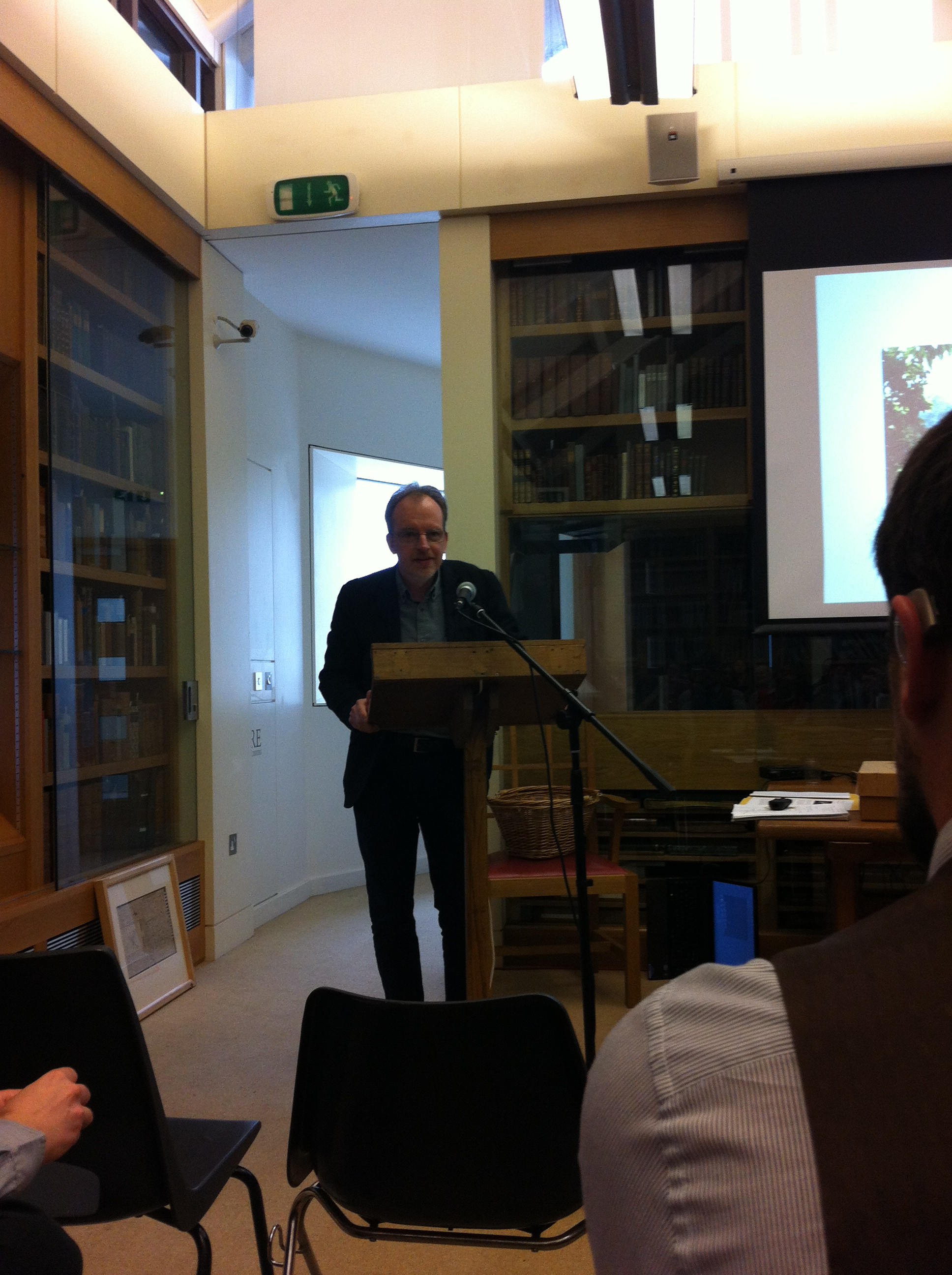
Next morning dawned bright and early, and in despite of having drunk an inadvisable amount of wine the night before, the fresh air and change of location wrought wonders. This was a good thing too, as my paper on ‘The map, the territory, and the small cloud between Scafell and Great Gavel’ opened the first panel of the day, at 9:30 in the morning. Other highlights included Philip Aherne’s ‘Incomplete Communion: The Reception of the Conversation Poem’ and Leanne Stokoe, whose paper on Jeremy Bentham, Adam Smith and Shelley’s prose I had secretly been dreading, but which turned out to be absolutely fascinating. The day was varied by a talk from Jeff Cowton, curator of the Wordsworth Trust’s collection (pictured below), who passed around plenty of original manuscripts for us to coo over and sent us home with our very own love letters – from Mary to William. This was followed by a seminar with Jeremy Davies on Percy Shelley’s time in Tremadoc, North Wales.
After the last panel of the day, we adjourned to the Traveller’s Rest for dinner. Last orders was called at eleven o’clock, but by a combination of special pleading and skilful flirting, we kept the drinks coming until well after midnight, and it was a little after two in the morning before this bleary postgraduate scrambled into his bunk. Nonetheless, Shoshannah Bryn Jones Square, Hannah Britton and Joanna Taylor had clearly eaten their Shreddies the next morning, and their panel on Romantic Borderlands was one of the best of the conference. It left me eager not only to discover Mary Shelley’s Matilda, but to reread The Eve of St Agnes and the poems of Hartley Coleridge with the benefit of their insights.
Interesting papers on Byron’s closet dramas, Mary Tighe’s sonnets and the layout of Hardwick Park followed, alongside a film by MA students from Newcastle University, who took on the challenge of presenting Wordsworth to a new audience with fortitude and invention. Sadly, after two nights of wine and revelry, not even the combined brilliance of Craig Lamont, Tristan Burke and Mary Shannon could keep my head from nodding a little during the final panel. I was, however, much refreshed by the second plenary lecture, where Professor Nicola Watson, president of BARS (below), entertained us all with her tales of fell walking with Jonathan Bate and Duncan Wu, and the wizard-like way in which she transformed a block of wood from a thing, to an object, to a literary artifact before our very eyes.
With that, the conference concluded. Some were whisked off by minibus to Windermere to begin their journey home, while others (myself among them) remained for a weekend of walking the fells and communing with nature. As Wordsworth said,
Enough of science and of art;
Close up these barren leaves;
Come forth, and bring with you a heart
That watches and receives.
The trouble with any long period away is that it includes such a variety and wide range of incidents, anecdotes, encounters and adventures that it’s nigh impossible to provide a short, cogent answer to a question as simple as ‘How did you find New Zealand?’ apart from the utterly banal (‘I liked it, thanks.’)
I attempted to make things more interesting by summarising my month and a half in New Zealand in a few sentences of Dickensian length and complexity, but since they’re a little too rhetorical to recite by heart, I mostly copy them into letters, Facebook statuses and blogs:
From the streets of Christchurch, where life and culture thrives even among the rubble and dead hulks of its earthquake-stricken centre; to the star-brilliant skies above the blackness of Lake Tekapo; to the mist-shrouded bulk of Mt Cook, waterfalls pouring down its cheeks in angry cataracts; all down the jagged line of the southern alps, past the icy lakes of Wanaka and Wakatipu and into the sheer mountains and impenetrable rainforests of Fiordland, bridged by a single stoney track beneath which the clear Routeburn flows through valley and gorge, I ventured; then turning northward along the dangerous, ever-sounding shores of the west coast, where the glaciers sink slowly backwards into the mountains and the sea foams and spouts like a tempestuous geyser among the tortured and labyrinthine rocks; to the golden sand of Abel Tasman, where western eyes first glimpsed the young country, and paths lead through waist-deep tidal bays to the farther shore; to the vine groves of Marlborough and thence to the verdurous pastures and rainbow-haunted skies of North Island: the snowy crater and steaming volcanic lake of Ruapehu; the redwood forests and bubbling mud pits of Rotorua, and the deep azure mineral pools in which ferns silver and decay; up past Hobbiton and the black water caves of Waitomo to the northern capes and islands where the country began; where the great kauri, taller even than redwoods, pierce the canopy; then south once more to volcano-spotted Auckland, spanning the peninsula from the Pacific to the Tasman Sea: such were my travels in New Zealand. I flew gliders higher and for longer than I ever had before, leaped from planes and the top of skyscrapers, guided kayaks over wide, deep lakes, ascended sheer walls of blue ice and pitted rock, and plunged gasping into lakes, oceans, rivers and waterfalls. And there were beers cooling in the stream, and the scent of wood shavings on the forest air, the geothermal pools were hot and the lakes were cold,there were kisses by moonlight, shooting stars and new constellations, seals swimming the the rivers and kea clowning for scraps, and a beautiful woman did a hula dance in an apartment by the sea.
In any case, I was complaining of this excess of anecdote to my friend Ffion recently, and she cut through my pontificating by asking me to tell her a story about a chicken.
‘Oh yes, we hypnotised one.’ I said, and realised this was a story that I’d neglected to write into my diary, never told anyone of, and completely forgotten until now.
With an archly raised eyebrow and a subtle bulging of the eye, Ffion invited me to go on.
This was in the midst of my coach tour from Queenstown to Auckland, just outside Abel Tasman National Park. Our coach driver, Vince, was brilliant, fearless – one of those people who can persuade with a grin and a quiet word where others would spent gales of breath and bluster failing to convince. He seemed to have a girl in every place we stopped, and tonight he’d come up with two – Cathy and Marie. I’d ended up joining them and a few more of the livelier members of the bus group in playing ‘Never have I ever’. Vince did a lot of drinking, and I haven’t felt like such an innocent since before my first kiss.
Over the course of a dozen-odd beers that evening, Vince happened to mention that he could hypnotise a chicken. It was at that stage of the evening when everything has to be tried, and accordingly we trooped outdoors to where the chickens were roosting in the trees. Vince would bend the branch down low enough for one of us to make a clumsy grab, and an extremely startled chicken would slip through our drunken fingers and make for the hills. This continued until all the chickens on the campsite had received a rude awakening, and then we started to hunt them through the bushes. Cathy eventually managed to catch one after we closed in on it in a threefold pincer movement.
The Wikipedia page on chicken hypnosis is absolutely fascinating. First described in 1654 by Athanasius Kircher, it is mentioned by Nietzsche (“the streak of chalk bewitcheth the hen”) and the article includes tips on technique by a German Chancellor and a U.S. Vice President. Vince’s method was simple and classical. His lovely assistant, Cathy the chicken wrangler, held the chicken at chest height, facing Vince, who held out a piece of chalk at the chicken’s eye level. Slowly the two squatted down to floor level, when Vince drew a long straight line of chalk running away from the chicken and between his legs. Both of them stepped away, and the chicken continued staring fixedly at the line of chalk, completely hypnotised. Only when someone disturbed it by a shove or a loud noise would it snap back into life.
Having proved it was indeed possible to hypnotise a chicken, we left it in the tent of an unsuspecting Dutch woman and went back to our drinks. It would have been the highlight of another weeks diary, but in the midst of all the adventures it passed entirely unrecorded.
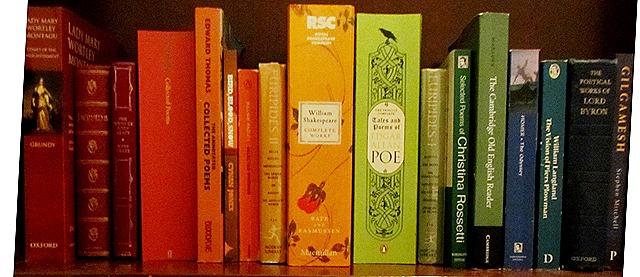
Clearing out my childhood bedroom recently, I found throwing out all my old books to be a miserable experience. There’s something crushing about coming face-to-face with those hopes and ambitions of long ago and realising that there’s no day rainy enough that I’m going to read the Mahabharata, that research project on Dark Age Wales has long since fallen by the wayside, and that no-one, not even Andrew Motion, has ever written a halfway satisfactory sequel to Treasure Island. Still, now that I’ve moved them all to my new flat and have begun to find them homes on my shelves, I find the cliché is truer that many people realise: books really do furnish a room. Of course, you can bind them all identically in morocco leather and house them in oak cabinets; or you can buy individual cased hardbacks from the Folio Society to adorn your living room in style; but even my ragtag collection of poetry, science fiction, outdoor adventure and Russian Literature; ranging from svelte, selected modern paperbacks to tome-like turn-of-the-century collected works; even this can furnish a room. It provides an abstract pleasure for the eye as it slides along the row of spines, enjoying the change of colour and texture from jacket to jacket without thinking unduly of authors or subjects. A well-tuned bookcase can be a work of art, a kind of linear mosaic that provides visual pleasure independent of intellectual association. After having moved and reshelfed several times in the past few months, I can see fragments of the old patterns on my shelves, broken up where I unloaded a box in a different order, or found space to squeeze in an extra volume. It would be possible to agonise infinitely over the placement of everything, but I’ve decided to slot them in in any order and let them settle in for themselves.
A French friend once asked my advice on ordering her books, and I flippantly suggested colour-coding them by spine. What I didn’t realise is that French paperbacks are an almost uniform flat white, of a sort I only recall seeing here on the spine of a 1970’s Dickens reprint, so that idea was doomed from the start. English books may be more colourful, but they present their own problems. Do I shelf the matte black Penguin Classics together in one great uniform block, or leaven the effect by scattering them among the more vivid shelves? What do I do with something like Branch Lines: Edward Thomas and Contemporary Poetry, whose publishers gave it a dust jacket that was half green, half brown? Do I even own any indigo or violet books? At least the Faber and Faber paperbacks provide a basic spectrum from which to expand.
All this for the moment is academic; perhaps some very rainy day, after I’ve laid the Mahabharata aside, I may set to work on an aesthetic theory of bookshelves. In the meantime, it merely adds a new pleasure to that small empty space in the bottom right hand corner, where every night, at the stroke of midnight, the ghosts of all the books I have ever owned and am yet to acquire flicker past; red, purple, green and sober black, they dance briefly and then vanish into a haze of possibility.
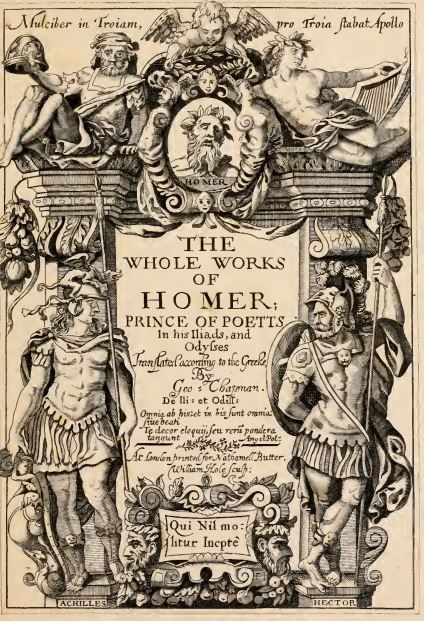
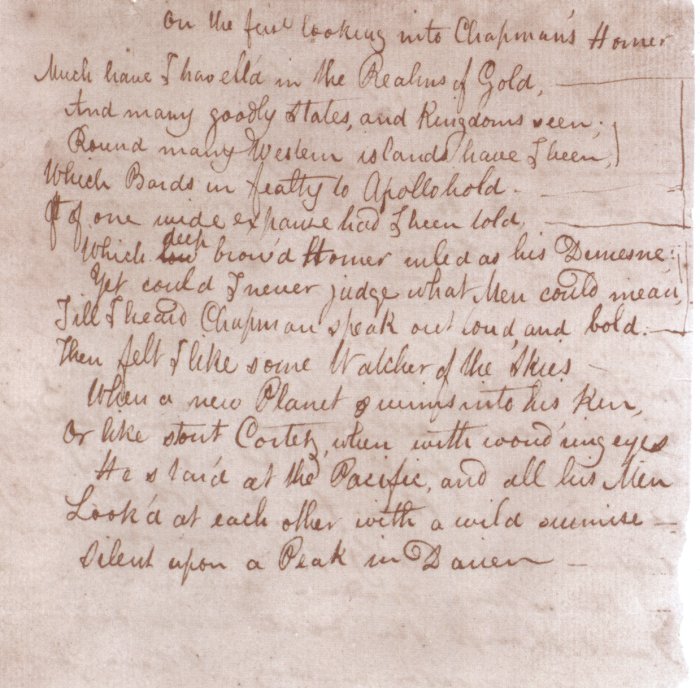
One evening in 1816, a minor poet named Charles Cowden Clarke invited another minor poet friend of his to spend a few hours reading a new antiquarian book he’d recently purchased: an outdated Elizabethan translation of Homer’s Iliad and Odyssey. The translator was George Chapman, a man who, even in the Renaissance, boasted of being too obscure for the common reader. It was not a night out that seemed initially promising: but as it happened, Clarke’s minor poet friend was John Keats, and the sonnet he found on his breakfast table next morning commemorating their evenings reading is likely to last as long as the English language – and a good deal longer.
Then felt I like some watcher of the skies When a new planet swims into his ken…
The original manuscript of Keat’s sonnet On First Looking Into Chapman’s Homer
It’s a beautiful, resonant image that has now become part of the common cultural currency, but modern reader of Chapman’s Homer, when faced with the same passages that inspired and electrified Keats, will probably experience something more like William Herschel’s original sensation of squinting down a large glass tube at a faint, blurry object he initially mistook for a comet.
In Keats’s day, Chapman’s translations were long out of print and hard to get a hold of, displaced and superseded by the trim, correct, neo-Augustan translations of Alexander Pope. Today, you can buy a cheap paperback edition for a couple of quid from Wordsworth Classics, a publishing company with a knack for getting a hold of the oldest, creakiest translations of any work of world literature. Their texts are often a century or so out of copyright, but by reaching back five hundred years to Chapman’s Odyssey and Iliad they excelled themselves.
Yet why should you read the Elizabethan version when there are excellent modern versions by Robert Fagles, D. C. H. Rieu and Robert Fitzgerald, doubtless for similar prices should you find the right second-hand bookshop? Is there anything remaining of that spark that electrified Keats?
Well, if you take it from the beginning and try to read it all through, it’s undeniably a tricky read. Chapman’s Iliad begins in magisterial form: Achilles baneful wrath resound, O Goddess, that imposed Infinite sorrows on the Greeks, and many brave souls los’d From breasts heroic; sent them far to that invisible cave That no light comforts; and their limbs to dogs and vultures gave: To all which Jove’s will gave effect; from whom first strife begun Betwixt Atrides, king of men, and Thetis’ godlike son.
Thereafter, it’s far too easy to become bogged down in the ghastly ingenuity required to force Homer’s catalogue of Grecian ships and captains into rhyme and metre, and in the intentionally confused syntax that is used to reflect the mayhem of the battlefield. The Odyssey is an easier read, and its episodic adventures are much more palatable than the continuous war of attrition the Iliad chronicles. It’s hardly surprising the imagery of the Keats sonnet draws heavily on the former while hardly featuring the latter. Still, a better bet might be to read one of the modern translators mentioned above, or start where Joyce started, with Charles Lamb’s The Adventures of Ulysses, to gain an idea of the plot, where the good bits are, and which bits you can afford to skip. It may feel like cheating, but skipping to the most dramatic episodes is probably the best way to enjoy the Odyssey and the Iliad – and probably Joyce’s own masterwork, too.
Things are complicated in The Odyssey too: Odysseus is referred to throughout by his Roman name of Ulysses, except where Chapman decides the metre or rhyme require he be called Ithacus (man from Ithaca) or Laertiades (son of Laerties), confusing matters somewhat. Things get even more complicated when he starts calling Odysseus’ son Telemachus as ‘Ulissides’.
Chapman’s freewheeling couplets are a delightful experience and an obvious inspiration for Keats’s own loose couplets in his long poem Endymion, but Chapman does occasionally come out with doggerel like: But his decrees, That holds the earth in with his nimble knees, Stand to Ulysses longings so extreme, For taking from the god-foe Polypheme His only eye – a Cylop, that excell’d All other Cylcops…
The god with the nimble knees is Poseidon, by the way – not one of his most renowned characteristics. (Fitzgerald translates ‘Only the god who laps the land in water.) Then again, those of us inured to the rigours of Shakespeare, Chaucer and Spenser will have little difficulty ingesting Chapman’s archaic language, and our reward is the experience of reading a unique version of the Odyssey with none of the neoclassical coolness of Pope, the plain novelistic narration of D.C.H. Rieu, or the beautiful, spare modern verse of Fagles or Fitzgerald. It’s the kind of tale Odysseus’s crewmen might have told themselves, if any of them beside the hero had endured being eaten alive by the Lestrygonians, drowned in the whirlpool Charybdis, or waking with a bit of a start and falling off Circe’s roof (way to go, Elphenor)! It’s a delight to read aloud, a rollicking, freewheeling, anarchic collection of adventures with plenty of tall stories thrown in and plenty of swagger. It’s hard not to love Chapman for the moments where the Anglo-Saxon vernacular breaks through in ways no modern translator would dare. Most dramatic is this passage, in which Odysseus finally reveals his true identity to the suitors who have been wooing his wife while feasting and drinking at his expense, and exacts a bloody revenge upon them all. The upper rags that wise Ulysses wore Cast off, he rusheth to the great hall door With bow and quiver full of shafts, which down He pour’d before his feet, and thus made known His true state to the wooers: ‘This strife thus Hath harmless been decided; now for us There rests another mark, more hard to hit, And such as never man before hath smit; Whose full point likewise my hands shall assay And try if Phoebus will give me his day.’ He said, and off his bitter arrow thrust Right at Antinous, that struck him just As he was lifting up the bowl, to show That ‘twixt the cup and lip much ill may grow.
But for a sample of Chapman’s verse at its most intense and characteristic, it is hard to fault the passage which Cowden Clarke tells us Keats was most struck by. It is in Book Five, where Odysseus has been shipwrecked and tossed in a storm for days, at the mercy of Poseidon’s wrath. Finally, spent and all but drowned, he makes landfall on Phyrigia. Then forth he came, his both knees falt’ring, both His strong hands hanging down, and all with froth His cheeks and nostrils flowing, voice and breath Spent to all use, and down he sunk to death. The sea had soaked his heart through; all his veins His toils had rack’d t’a labouring woman’s pains. Dead weary was he.
Sleeping in summer, the stars of winter night
Blaze with a cold clear blaze in his dull dreaming.
Sirius arises, the hard-to-see hare,
Lepus, lies plain at the feet of Orion,
Bright as Taurus, Auriga and Cassiopeia,
In the untinted ink of a sun-deserted sky.
Who would prize those months of midnight haze
Over the cold crispness, when the air catches
And bites cleanly, steaming as it leaves the lungs
Like the breath of the dragon, wound between the lesser bear
And the greater? He groans for it, stewed in his night-sweats,
Suffering his sky-lack, his star-thirst.
Meantime, at four in the muggy morning
The day’s dawned a dull blue-grey.
Sometimes I dream in verse, but all that ever seems to leave me in the mornings is a few maddening, strange fragments of poetry. This one is the other way around – a dream I had one extremely hot, muggy summer night, where I hadn’t seen the night sky for days, and which I worked into a poem when I woke up.
Since then, I’m glad to say the sky has cleared a bit, and I recently spent a pleasant hour stargazing in the middle of a dark cricket pitch. During that time I learnt a few new constellations and spotted one of the Aquarid meteor shower streaking through the southern horizon, so it hasn’t all been as bad as the poem makes out.
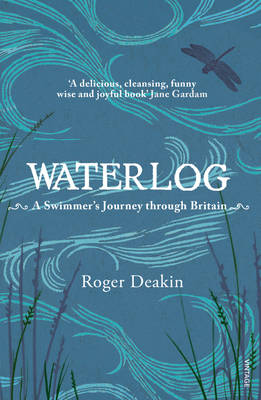
Roger Deakin’s original Waterlog was a diary of wild swims strictly taking place within the borders of the United Kingdom. To go swimming abroad is a more common thing; after all, and many people who wouldn’t dream of leaping in an English lake will plunge quite happily into a European one. This swim, no matter how far-flung it was, was spectacular enough to demand an entry of its own.
Lake Louise, Canada
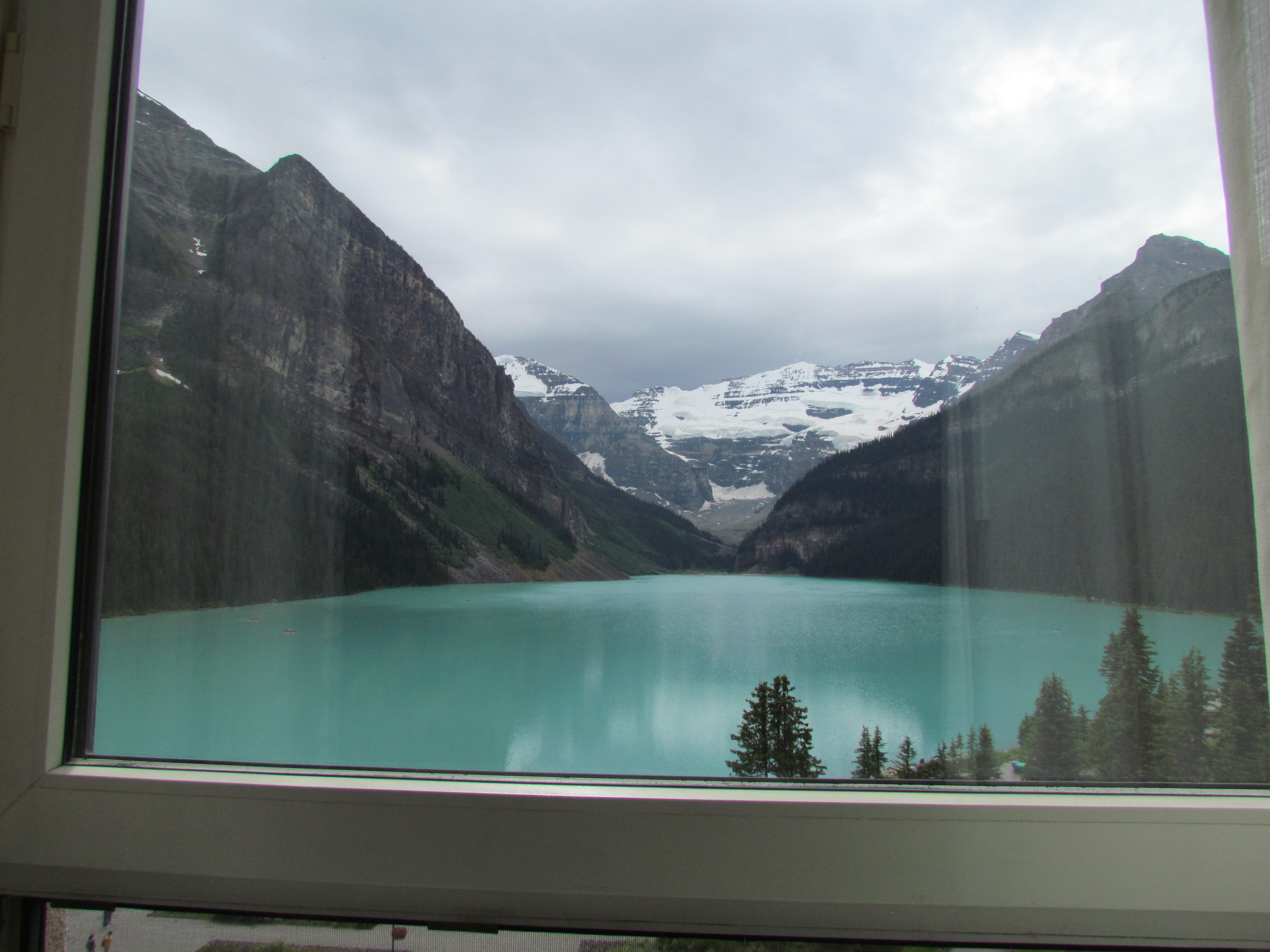
Lake Louise, in the Canadian Rockies, was made world famous by the arrival of the Canadian Pacific railroad, which drew up at its doorstep. The magnificent art deco Chateau Lake Louise Hotel was built on the lakeshore for overnighting passengers. Looking out of the windows, they would see the azure-blue waters of the glacial lake framed on each side by the jagged peaks of Mount Whyte and Fairview Mountain, while lowering at the end of the lake and the plain that follows, the glaciers hung preciptiously on the sheer side of Mount Victoria, seeming both precarious and immeasurably powerful. This was also the view from my bedroom.
The view from the window
Thanks to a generous cousin, working in a hotel chain with very generous friends and family rates, I was booked for the night in one of the world’s most iconic hotels. No sooner had I thrown down my backpack and tested the bed, indeed, when room service came by with two of my favourite beers, courtesy of my cousin’s opposite number in Lake Louise. My parents had a bottle of white wine, my uncle a bottle of red, and we all met one of the hotel rooms a little later, to have a refreshing mid-afternoon drink and to plan how to make best use of our time. We only had three and a half hours until dinner, and had to leave for the airport early next morning. I decided to see as much as I could as fast as I could, travelling fast and light. Duly, I set off towards Lake Louise via a steep forest track, jogging through a light shower in t-shirt and shorts and relying purely on exertion to keep me warm. I was carrying only my room key, a towel, a swimming costume (in case the opportunity presented itself) and my iPod, shielded from the rain by a plastic bags that originally belonged to the in-room ice bucket. When I needed water, I drank from the glacial streams.
Alternating between jogging and power walking, I managed to cover twenty kilometres in three and a half hours, taking in both Mirror Lake and Lake Agnes, and the summit of the Big Beehive, the first mountain in the long chain stretching down the north side of Lake Louise. Coming down the mountain, there was just time for a detour to take in the Plain of Six Glaciers, which offered a spectacular panorama of many mountains that had been obscured behind each other from the lake’s end, including the terrifyingly vertiginous Mitre. I returned along the river, and the shores of Lake Louise, arriving exhausted just in time for tea.
Next morning I woke up early to find that every muscle in my legs had stiffened into rigidity, and I was moving like a man of eighty. With nothing but a long car journey and a long flight ahead of me, this was something that would obviously get worse before it got better. There was one thing I could do to limber myself up though – the one thing I hadn’t found time for during yesterday’s walk, the one part of the Lake Louise experience still unfulfilled. I rolled out of bed, and pulled on my swimming trunks.
Looking back towards the hotel
Even at half past six, the occasional guest could be seen wandering by the shoreline, or sipping coffee on the steps. A couple of canoes were out as well. Even before this minimal audience, I was too nervous to walk straight out of the hotel and leap into the lake, which was right by its doorstep. What if I chickened out while everyone was watching? Instead, I walked a little way around the lake, to where a set of steps descended into the water and a stand of pines hid me from direct view of the hotel.
The lake bottom was a series of rounded boulders, and I was so absorbed in trying to keep my footing on them that I was in up to my waist before I’d really had a chance to take stock. From there, I took a moment to gaze out across the lake’s surface and up, to the incredible mountains beyond, before I took a deep breath and threw myself forward into a brisk breast stroke.
The water was cold enough to numb me instantly, but unlike the sea off Scotland in April, it didn’t give me instant pins and needles. The surprise how buoyant it was. I had an unusual sense of its physical presence all around me, and a confused notion of its being both a friend and an enemy at once, as it simultaneously held me up and snatched my body heat from me.
I managed twenty strokes out from shore and paused to tread water, the mountains yet more sublime and mighty from my shrunken perspective. There’s something about swimming that reduces us in nature’s scale. Birds that would have flapped away in fright ignore a head bobbing by, and the swans and the fishes cruise smoothly on without even deigning to notice us as we bob by. This sensation can often be peaceful, or even spiritual, but out here in the strange, pale blue waters, under the shadow of Fairview mountain, it was distinctly unnerving. I was chilled by more than the cold when I turned out and struck for the shoreline.
My sense of awful sublimity was dispelled, though, by the wonderful sensation of emerging from the water into the sudden warmth of the air, and the vigourous buffeting of the plush hotel-room towel. It was fun too, to exchange knowing grins with those passers-by who were amused with my bravery or foolhardiness. My favourites were the three middle-aged men, lined up on the steps of the hotel like a Greek chorus, or the old men of the village in Asterix in Corsica.
‘You’ve got more balls than I have.’ said one of them. ‘Now go back and get them!’
Not many adventure sports begin by punting down the Isis on a sunny afternoon. To our left, a posse of medical students were drifting by on a relaxed revision cruise, testing each other’s gynaecological knowledge with the aid of various textbooks. No dirty joke here – this was what they were actually doing. To our right, there was nothing but green fields, cows, and the occasional jogger – that portion of Oxford that I only ever seem to see from the river.
We, the relics of a garden party for my sister’s 21st birthday, were in two groups. In my punt was Tom Codrington, who had the build I normally associate with a racing biker, but who turned out to be a rock climber – and a dab hand with the punting pole. His girlfriend Tabitha was with us. In the second, much rowdier punt were my sister Jessamy, her boyfriend Steve, and a smattering of friends from Oxford and Winchester. They had all the left over food from the garden party, some of which they would thoughtfully toss our way whenever the punts bumped together.
So far, there was nothing to separate us from the dozens of other luncheon parties on the river, save perhaps for the coils of climbing rope, carabiners, and tangled harnesses in the till of the punt. That, and the energetic way in which, when the punt came to a low-lying bridge, the occupants would swarm up over the side of it and drop back down into place, while the punt glided smoothly on beneath.
After about half an hour’s lazy cruising, we came to a taller bridge. It was a gorgeous twenty foot arch that crossed the river in a single span, simple, functional, yet still of a piece with Oxford’s greater architectural glories. Here we moored down stream, gathered up the rope and harness, and set to work getting the whole thing set up.
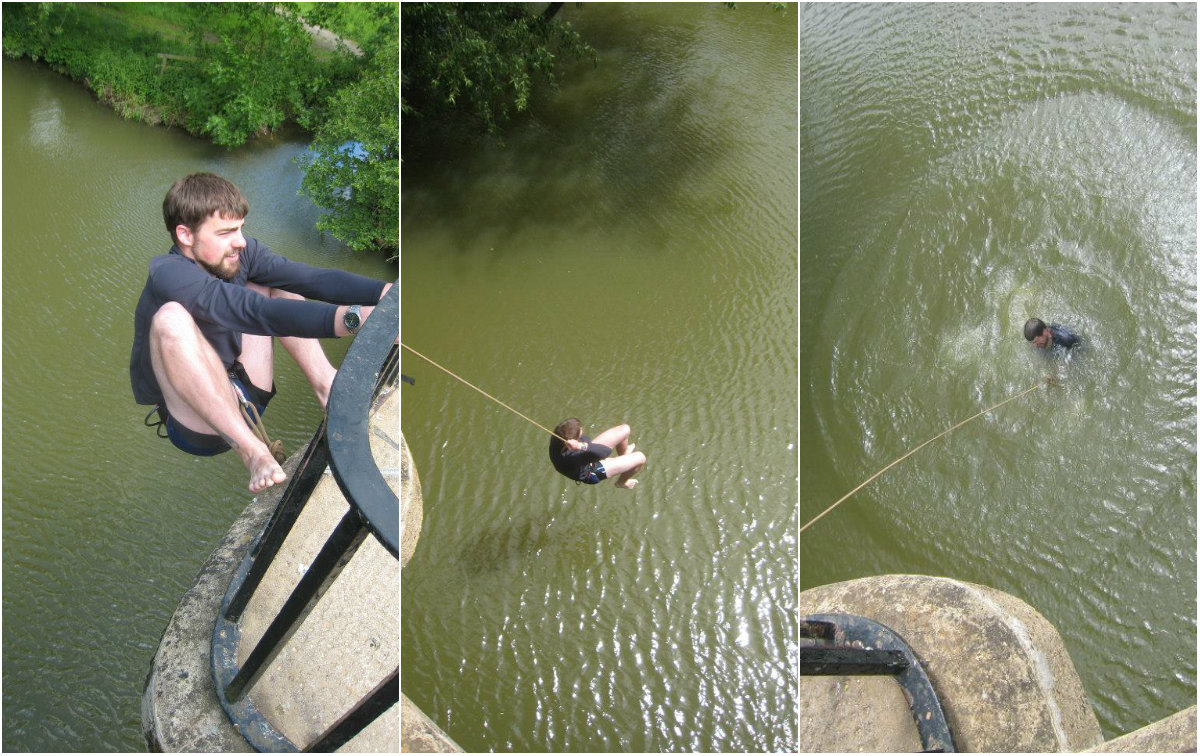
Bridge swinging, in its commercial form, is an alternative to bungee jumping where people swing to-and-fro like a pendulum instead of bouncing up and down like a yo-yo. Large sums of money are paid to do this. In its amateur form, I found, you fix a rope to the railings of the bridge, cross to the the far side, and then swing the other end underneath, high enough so someone on the other side of the bridge can catch it. This is a complex activity which requires timing, foreshortening, and good reflexes on the part of the person in charge of catching the rope. Tom Codrington proved to be expert at this, as well. When that’s done, all you need is someone foolhardy enough to climb into a fluffy, tatty climbing harness, long since discarded from actual climbing duties, clip themselves to the far end of the rope and leap over the railings. My sister went first, and I was close behind.
It was a nervous business, actually, since I had got to get as low as possible to be sure of a good swing, feet pressed flat to the stone and fingers gripping the railings for dear life, while the people on the other end of the bridge took in the tension until this new umbilical was stretched almost horizontal under the bottom of the bridge, taught as a guitar string. Then all I had to do was let go.
Three or four wild, whooping arcs ensued, as I swung crazily between the bridge and the water: then, at the apex of the upswing, Tom Codrington slacked his hold and I crashed into the silver-green Isis, surfacing seconds later, gasping for breath and wiping the water from my eyes. I trod water for a minute while I fumbled with the carabiner’s screw-lock, detached from the rope, and struck out for shore.
Except for Jess’s boyfriend Steve, who was too cool for it, we all took a turn. The girls shrieked, the boys whooped – even the most timorous went, after a false start or two. I went three more times, with varying degrees of disaster – the first time I leaned too far back and inverted, swinging around upside-down like a bungee jumper in a high wind. Then Tom Codrington and I decided to do a swing together, but the rope stretched too much and we kept crashing into the water on the down swing, slowing us down and taking up from the perpendicular to the pendulous in seconds.
We finished up utterly soaked, thoroughly exhilarated, and with the satisfaction of giving all those picnicking upon the riverbank a little lunchtime entertainment. It was a good afternoon’s work.
A new word hit the OED in November of 2010 – Glamping. It’s a form of luxurious camping where you’ve got all the pleasures of the outdoors without any of the trials – where your tent, for instance, happens to be an Indian tepee or a Mongolian yurt, and your campsite includes a sauna and a jacuzzi.
My formative camping experience was my Duke of Edinburgh expeditions, where you carried everything you’d need for the next 3 or 4 days on your back. Buying anything, or sleeping beneath a roof, was forbidden. Strictly speaking, they weren’t keen on you walking through towns or along roads, either. Hence, my idea of camping is the opposite of glamping. It’s a holiday from the luxuries, as well as the distractions of urban life. Unless I’m bedding down on a battered roll-mat with a bundled-up jumper for a pillow, in a campsite where the plumbing runs to two toilets and a cold tap, it doesn’t really count as camping.
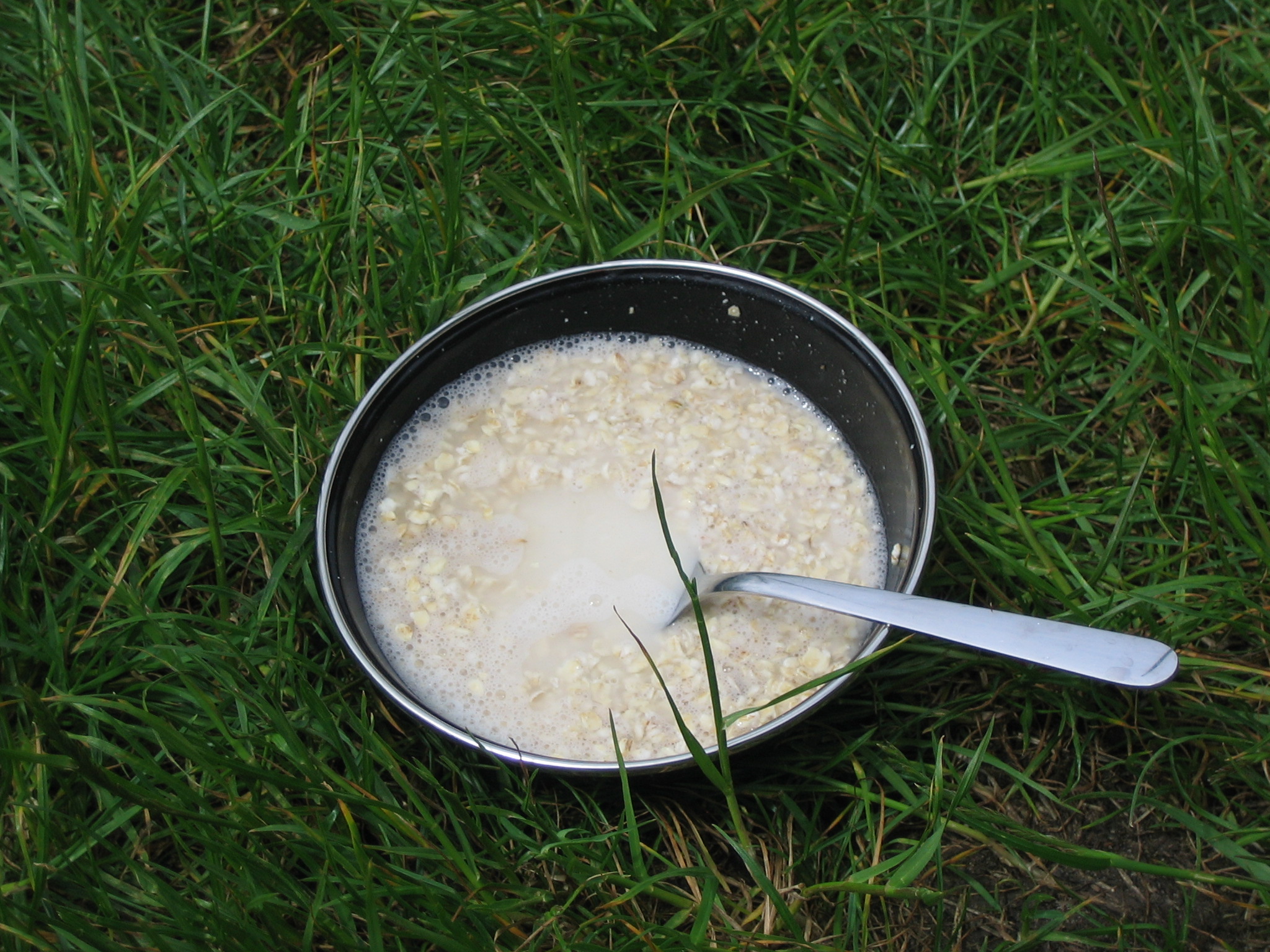
A whole new level of asceticism was reached while I was preparing for a weekend in the Highlands of Scotland. I had to bring along my own breakfast and lunch for both days, but I couldn’t be bothered to bring anything fancy. So I brought four bags of oats. One with hot water for breakfast, and one with cold water for lunch. I was thinking chiefly of Robert Louis Stevenson’s Kidnapped, where David Balfour and Alan Stewart go on the run through the heather with nothing but a bag of oats to sustain them – hot porridge when they can risk a fire, cold porridge without. I seem to remember it being called skillet, like the frying pan, but a brief search of the online text reveals I was probably making that up. The recipe is:
Take 250-300g of oats, for one serving.
Add water until the oats are submerged. Stir until the water goes a milky colour.
Eat.
It is lightweight, compact, hydrating, extremely economical, and leaves you with a pleasant feeling of having eaten something. It gets you plenty of attention and something of a hard-man reputation from those you’re walking with. On the other hand, you have to really, really like the taste of oats. Even so, it’s a pretty grim meal. I generally eat a chunk of fruit and nut chocolate afterwards to balance the carbohydrate with some sugar. Yet it’s quite reassuring, I think, to know that if things get really tough, in life or on the trail, all I really need to survive indefinitely is access to fresh water and a really, really big bag of oats.




 A Fool Grows Wise