Oh, you tease

Teaser trailers are getting stingier. True, they were always meant to tantalise us with a few seconds of footage from films and TV programmes we wouldn’t get to see for months, but as studio execs get slicker at viral marketing and riding the hype whilst keeping every bit of plot information they can under wraps, the teaser trailer is torn in two directions – revelation and secrecy. Too often, this becomes a pointless exercise in frustrating your audience.

To illustrate my point, let us return to the halcyon days of my youth – to the golden year of 2001, when two of my favourite books hit the big screen at once: Harry Potter and the Philosopher’s Stone, and Lord of the Rings: The Fellowship of the Ring.

At the time, I thought Harry Potter was the better movie. I was young and naieve. It’s still plain, however, that while the Lord of the Rings teaser is overloaded with exposition, the Harry Potter teaser contains everything a young fan might want to see without giving too much away – the letters swooping down the chimney! The Hogwarts Express! Hagrid! The Great Hall! Dumbledore! Snape! McGonagall! Harry, Ron, Hermione, and the tantalising prospect of Quidditch on the big screen! Nothing could be more exciting.

Fast forward to 2012, and the teaser for The Dark Knight Rises resembles something put out by one of those irritating people who fake trailers for new movies by splicing together footage from old ones. Some offcuts from Inception – a few clips from Batman Begins and The Dark Knight – while Commissioner Gordon wheezes something inaudible from a hospital bed. Even the blink-and-you’ll-miss-them appearances by Bane and the new Batman costume can’t save it.

It is possible to do this properly, as JJ. Abraham’s trailer for Star Trek (2009)showed. It contains no footage from the film we saw in cinemas – it doesn’t even tell you the name of the film. Yet, lifted as it is by marvellous sound design, Leonard Nimoy’s goose-pimply voice over and the surprise reveal, it’s a wonderful bit of cinema in its own right, and a concise introduction to the dynamic visual style of the Star Trek reboots.

The worst culprit is the most recent – the first teaser trailer for Doctor Who Series 8, the first season starring Peter Capaldi as the Doctor. Of the 15 seconds the trailer lasts, 10 of them are taken up with the Doctor Who logos that top and tail it. 2 of the remaining 6 seconds are taken up by staring at a dark screen. The other 3 seconds show a few frames of Peter Capaldi, standing in silhouette, against the TARDIS console. And that’s it. No monsters, no Daleks, no alien planets. No glimpse of the main characters in action – not even a proper look at the new Doctor’s costume, and photographs of that were released to the media months ago. Instead, a total waste of 30 seconds of my life.

(Yes, I played it twice.)

BARS Romantic Locations Conference 2014

BARS Locations - Thomas Tyrell

My account of the conference is reblogged from the BARS blog, curated by Matthew Sangster.

– – – – – – –

I had not even started my PhD when I first saw the call for papers for the BARS early career and postgraduate conference on Romantic Locations, but I had come away from an internal postgraduate conference at York brimful of misplaced confidence, and that very week I was hitch-hiking into Keswick for a few nights free board at the youth hostel where my friend worked. I took a copy of Wordsworth’s Guide to the District of the Lakes with me, and in the meditative moments between the rambles and the wild swims, an idea took root. It grew slowly – I sent my final abstract from a public library in Christchurch, New Zealand, in the three month interregnum, and I received my invitation to present a paper just before I moved into Cardiff for my PhD.

As the conference approached, I was filled with nervousness. I was after all a PhD of only three months seniority, and my research area wasn’t even properly in Romantic Studies. Would the others sniff me out as a romantic imposter, the Dr. Polidori amidst the Byrons, Clairmonts and Shelleys around me?

Such was the gloomy tenor of my thoughts, but as the train left Oxenholme and began to rumble towards Windermere, I found myself uplifted by the sublimity of the scenes around me. Arriving in Grasmere, I followed the hum of mighty workings into the Jerwood Centre, and over a reviving cup of tea I was reassured to discover that more than a few of my peers had cudgeled their brains, ransacked their notes and creatively re-interpreted their research plans in order to attend a conference in so splendid a location as Wordsworth’s own Grasmere; furthermore, I was the only one who would be talking about Romanticism and cartography, and would have a wide field in which to range. Feeling much more confident, I sat down to the first panel.

Highlights of the first day included Kate Ingle’s paper on ‘Personal Place-names and Dorothy Wordsworth’s Writing of Grasmere’, which immediately made me want to run out and find all the places mentioned; Daniel Eltringham’s on upland enclosure and Wordsworth’s ‘Michael’, which read more critical theory into the practice of sheep-farming than I thought it ever could hold; and the final panel of the day, where Alexis Wolf, Honor Rieley and George Stringer introduced us to the impact of Romanticism in places as diverse as France, Canada and India. The concluding plenary lecture was given by Professor Simon Bainbridge of Lancaster, whose paper on Romanticism and the history of mountaineering made every postgraduate with a pair of muddy boots in their luggage wish they had thought of the idea first. The wine reception, held by candlelight in Dove Cottage, was an experience I am sure that none of us will forget.

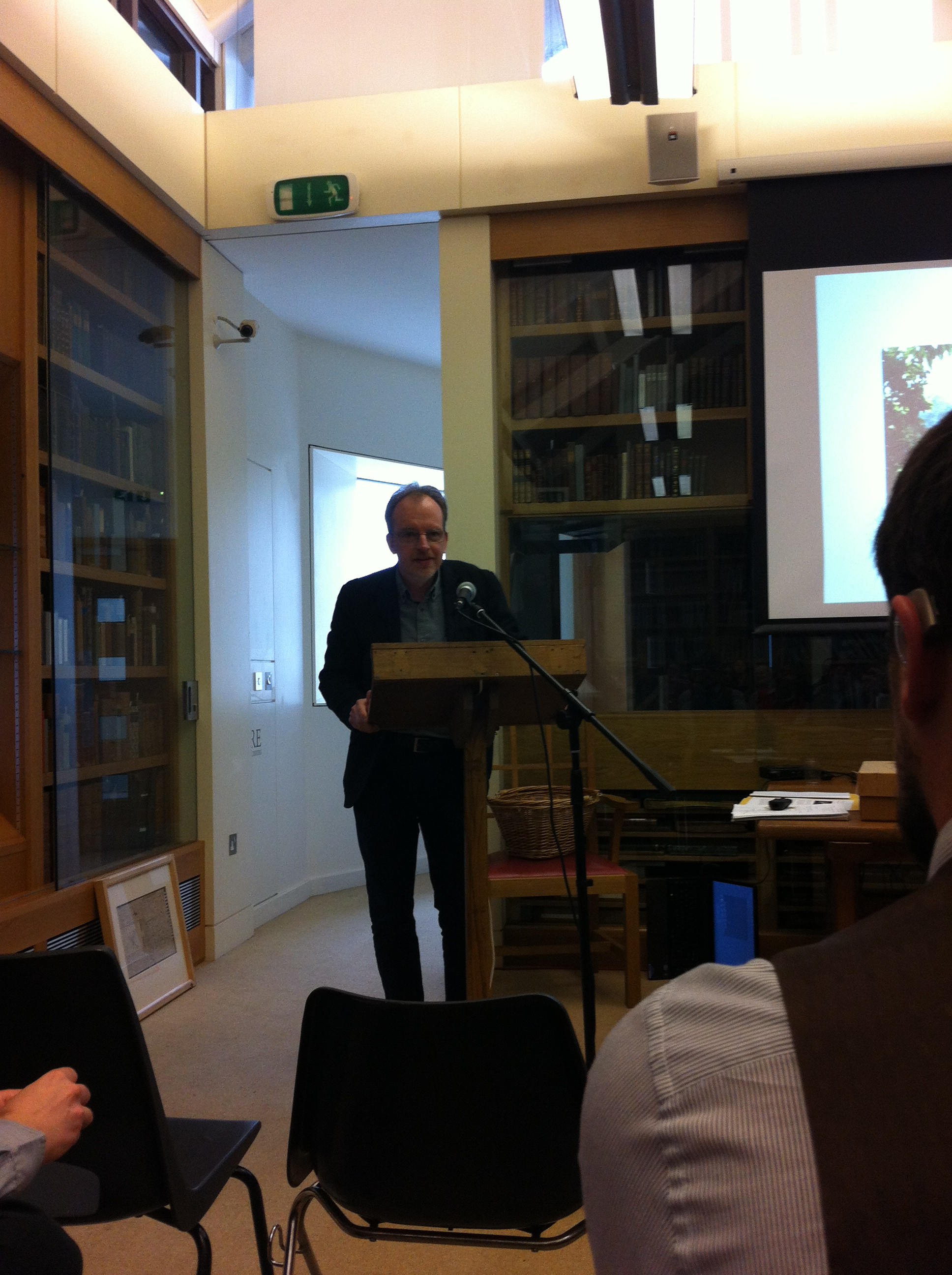
Next morning dawned bright and early, and in despite of having drunk an inadvisable amount of wine the night before, the fresh air and change of location wrought wonders. This was a good thing too, as my paper on ‘The map, the territory, and the small cloud between Scafell and Great Gavel’ opened the first panel of the day, at 9:30 in the morning. Other highlights included Philip Aherne’s ‘Incomplete Communion: The Reception of the Conversation Poem’ and Leanne Stokoe, whose paper on Jeremy Bentham, Adam Smith and Shelley’s prose I had secretly been dreading, but which turned out to be absolutely fascinating. The day was varied by a talk from Jeff Cowton, curator of the Wordsworth Trust’s collection (pictured below), who passed around plenty of original manuscripts for us to coo over and sent us home with our very own love letters – from Mary to William. This was followed by a seminar with Jeremy Davies on Percy Shelley’s time in Tremadoc, North Wales.

BARS Locations - Jeff Cowton

After the last panel of the day, we adjourned to the Traveller’s Rest for dinner. Last orders was called at eleven o’clock, but by a combination of special pleading and skilful flirting, we kept the drinks coming until well after midnight, and it was a little after two in the morning before this bleary postgraduate scrambled into his bunk. Nonetheless, Shoshannah Bryn Jones Square, Hannah Britton and Joanna Taylor had clearly eaten their Shreddies the next morning, and their panel on Romantic Borderlands was one of the best of the conference. It left me eager not only to discover Mary Shelley’s Matilda, but to reread The Eve of St Agnes and the poems of Hartley Coleridge with the benefit of their insights.

Interesting papers on Byron’s closet dramas, Mary Tighe’s sonnets and the layout of Hardwick Park followed, alongside a film by MA students from Newcastle University, who took on the challenge of presenting Wordsworth to a new audience with fortitude and invention. Sadly, after two nights of wine and revelry, not even the combined brilliance of Craig Lamont, Tristan Burke and Mary Shannon could keep my head from nodding a little during the final panel. I was, however, much refreshed by the second plenary lecture, where Professor Nicola Watson, president of BARS (below), entertained us all with her tales of fell walking with Jonathan Bate and Duncan Wu, and the wizard-like way in which she transformed a block of wood from a thing, to an object, to a literary artifact before our very eyes.

BARS Locations - Nicky Watson

With that, the conference concluded. Some were whisked off by minibus to Windermere to begin their journey home, while others (myself among them) remained for a weekend of walking the fells and communing with nature. As Wordsworth said,

Enough of science and of art;
Close up these barren leaves;
Come forth, and bring with you a heart
That watches and receives.

On the arrangement of books

A rainbow of books

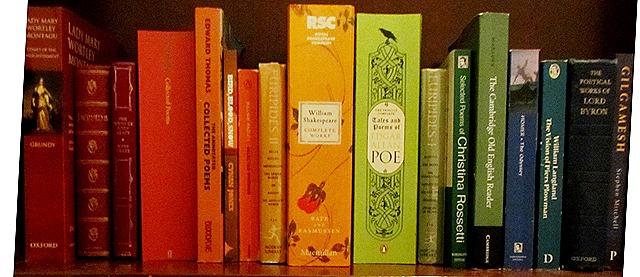
Clearing out my childhood bedroom recently, I found throwing out all my old books to be a miserable experience. There’s something crushing about coming face-to-face with those hopes and ambitions of long ago and realising that there’s no day rainy enough that I’m going to read the Mahabharata, that research project on Dark Age Wales has long since fallen by the wayside, and that no-one, not even Andrew Motion, has ever written a halfway satisfactory sequel to Treasure Island. Still, now that I’ve moved them all to my new flat and have begun to find them homes on my shelves, I find the cliché is truer that many people realise: books really do furnish a room. Of course, you can bind them all identically in morocco leather and house them in oak cabinets; or you can buy individual cased hardbacks from the Folio Society to adorn your living room in style; but even my ragtag collection of poetry, science fiction, outdoor adventure and Russian Literature; ranging from svelte, selected modern paperbacks to tome-like turn-of-the-century collected works; even this can furnish a room. It provides an abstract pleasure for the eye as it slides along the row of spines, enjoying the change of colour and texture from jacket to jacket without thinking unduly of authors or subjects. A well-tuned bookcase can be a work of art, a kind of linear mosaic that provides visual pleasure independent of intellectual association. After having moved and reshelfed several times in the past few months, I can see fragments of the old patterns on my shelves, broken up where I unloaded a box in a different order, or found space to squeeze in an extra volume. It would be possible to agonise infinitely over the placement of everything, but I’ve decided to slot them in in any order and let them settle in for themselves.

A French friend once asked my advice on ordering her books, and I flippantly suggested colour-coding them by spine. What I didn’t realise is that French paperbacks are an almost uniform flat white, of a sort I only recall seeing here on the spine of a 1970’s Dickens reprint, so that idea was doomed from the start. English books may be more colourful, but they present their own problems. Do I shelf the matte black Penguin Classics together in one great uniform block, or leaven the effect by scattering them among the more vivid shelves? What do I do with something like Branch Lines: Edward Thomas and Contemporary Poetry, whose publishers gave it a dust jacket that was half green, half brown? Do I even own any indigo or violet books? At least the Faber and Faber paperbacks provide a basic spectrum from which to expand.

All this for the moment is academic; perhaps some very rainy day, after I’ve laid the Mahabharata aside, I may set to work on an aesthetic theory of bookshelves. In the meantime, it merely adds a new pleasure to that small empty space in the bottom right hand corner, where every night, at the stroke of midnight, the ghosts of all the books I have ever owned and am yet to acquire flicker past; red, purple, green and sober black, they dance briefly and then vanish into a haze of possibility.

Bridge Swinging

Swing collage
Before — During — After

Not many adventure sports begin by punting down the Isis on a sunny afternoon. To our left, a posse of medical students were drifting by on a relaxed revision cruise, testing each other’s gynaecological knowledge with the aid of various textbooks. No dirty joke here – this was what they were actually doing. To our right, there was nothing but green fields, cows, and the occasional jogger – that portion of Oxford that I only ever seem to see from the river.

We, the relics of a garden party for my sister’s 21st birthday, were in two groups. In my punt was Tom Codrington, who had the build I normally associate with a racing biker, but who turned out to be a rock climber – and a dab hand with the punting pole. His girlfriend Tabitha was with us. In the second, much rowdier punt were my sister Jessamy, her boyfriend Steve, and a smattering of friends from Oxford and Winchester. They had all the left over food from the garden party, some of which they would thoughtfully toss our way whenever the punts bumped together.

So far, there was nothing to separate us from the dozens of other luncheon parties on the river, save perhaps for the coils of climbing rope, carabiners, and tangled harnesses in the till of the punt. That, and the energetic way in which, when the punt came to a low-lying bridge, the occupants would swarm up over the side of it and drop back down into place, while the punt glided smoothly on beneath.

After about half an hour’s lazy cruising, we came to a taller bridge. It was a gorgeous twenty foot arch that crossed the river in a single span, simple, functional, yet still of a piece with Oxford’s greater architectural glories. Here we moored down stream, gathered up the rope and harness, and set to work getting the whole thing set up.

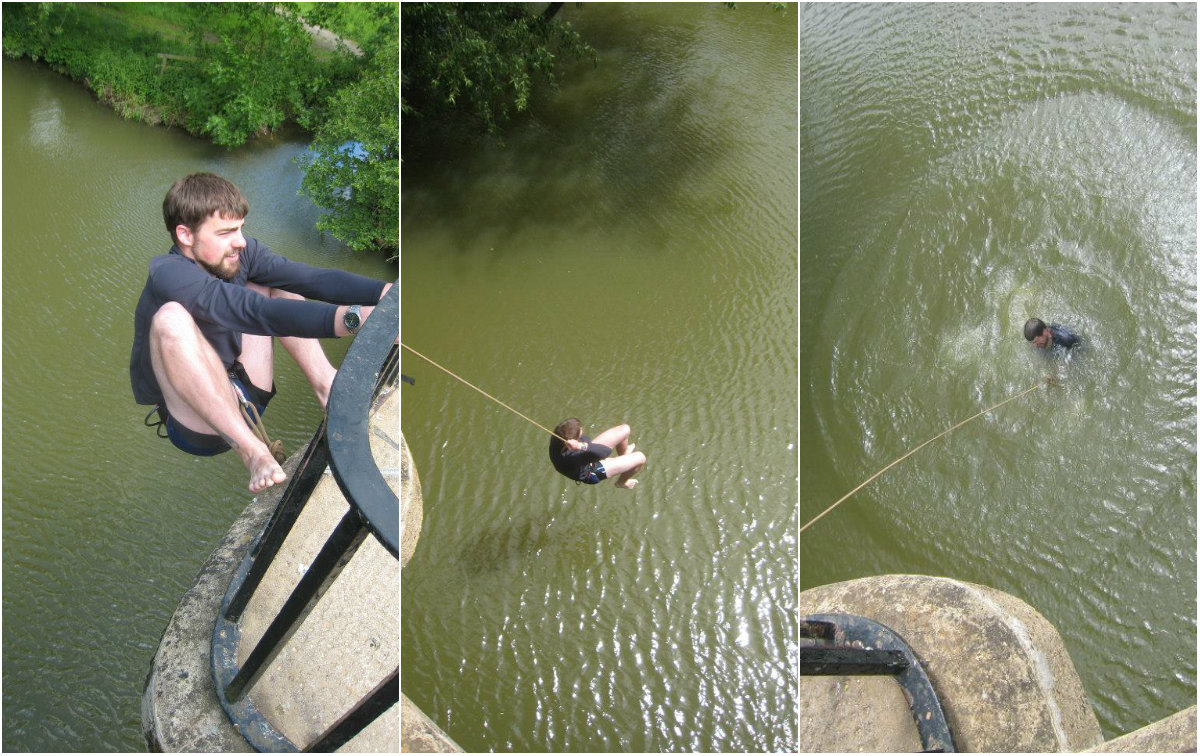
Bridge swinging, in its commercial form, is an alternative to bungee jumping where people swing to-and-fro like a pendulum instead of bouncing up and down like a yo-yo. Large sums of money are paid to do this. In its amateur form, I found, you fix a rope to the railings of the bridge, cross to the the far side, and then swing the other end underneath, high enough so someone on the other side of the bridge can catch it. This is a complex activity which requires timing, foreshortening, and good reflexes on the part of the person in charge of catching the rope. Tom Codrington proved to be expert at this, as well. When that’s done, all you need is someone foolhardy enough to climb into a fluffy, tatty climbing harness, long since discarded from actual climbing duties, clip themselves to the far end of the rope and leap over the railings. My sister went first, and I was close behind.

It was a nervous business, actually, since I had got to get as low as possible to be sure of a good swing, feet pressed flat to the stone and fingers gripping the railings for dear life, while the people on the other end of the bridge took in the tension until this new umbilical was stretched almost horizontal under the bottom of the bridge, taught as a guitar string. Then all I had to do was let go.

Three or four wild, whooping arcs ensued, as I swung crazily between the bridge and the water: then, at the apex of the upswing, Tom Codrington slacked his hold and I crashed into the silver-green Isis, surfacing seconds later, gasping for breath and wiping the water from my eyes. I trod water for a minute while I fumbled with the carabiner’s screw-lock, detached from the rope, and struck out for shore.

Except for Jess’s boyfriend Steve, who was too cool for it, we all took a turn. The girls shrieked, the boys whooped – even the most timorous went, after a false start or two. I went three more times, with varying degrees of disaster – the  first time I leaned too far back and inverted, swinging around upside-down like a bungee jumper in a high wind. Then Tom Codrington and I decided to do a swing together, but the rope stretched too much and we kept crashing into the water on the down swing, slowing us down and taking up from the perpendicular to the pendulous in seconds.

We finished up utterly soaked, thoroughly exhilarated, and with the satisfaction of giving all those picnicking upon the riverbank a little lunchtime entertainment. It was a good afternoon’s work.

2swing collage

Oats and Water

A new word hit the OED in November of 2010 – Glamping. It’s a form of luxurious camping where you’ve got all the pleasures of the outdoors without any of the trials – where your tent, for instance, happens to be an Indian tepee or a Mongolian yurt, and your campsite includes a sauna and a jacuzzi.

My formative camping experience was my Duke of Edinburgh expeditions, where you carried everything you’d need for the next 3 or 4 days on your back. Buying anything, or sleeping beneath a roof, was forbidden. Strictly speaking, they weren’t keen on you walking through towns or along roads, either. Hence, my idea of camping is the opposite of glamping. It’s a holiday from the luxuries, as well as the distractions of urban life. Unless I’m bedding down on a battered roll-mat with a bundled-up jumper for a pillow, in a campsite where the plumbing runs to two toilets and a cold tap, it doesn’t really count as camping.

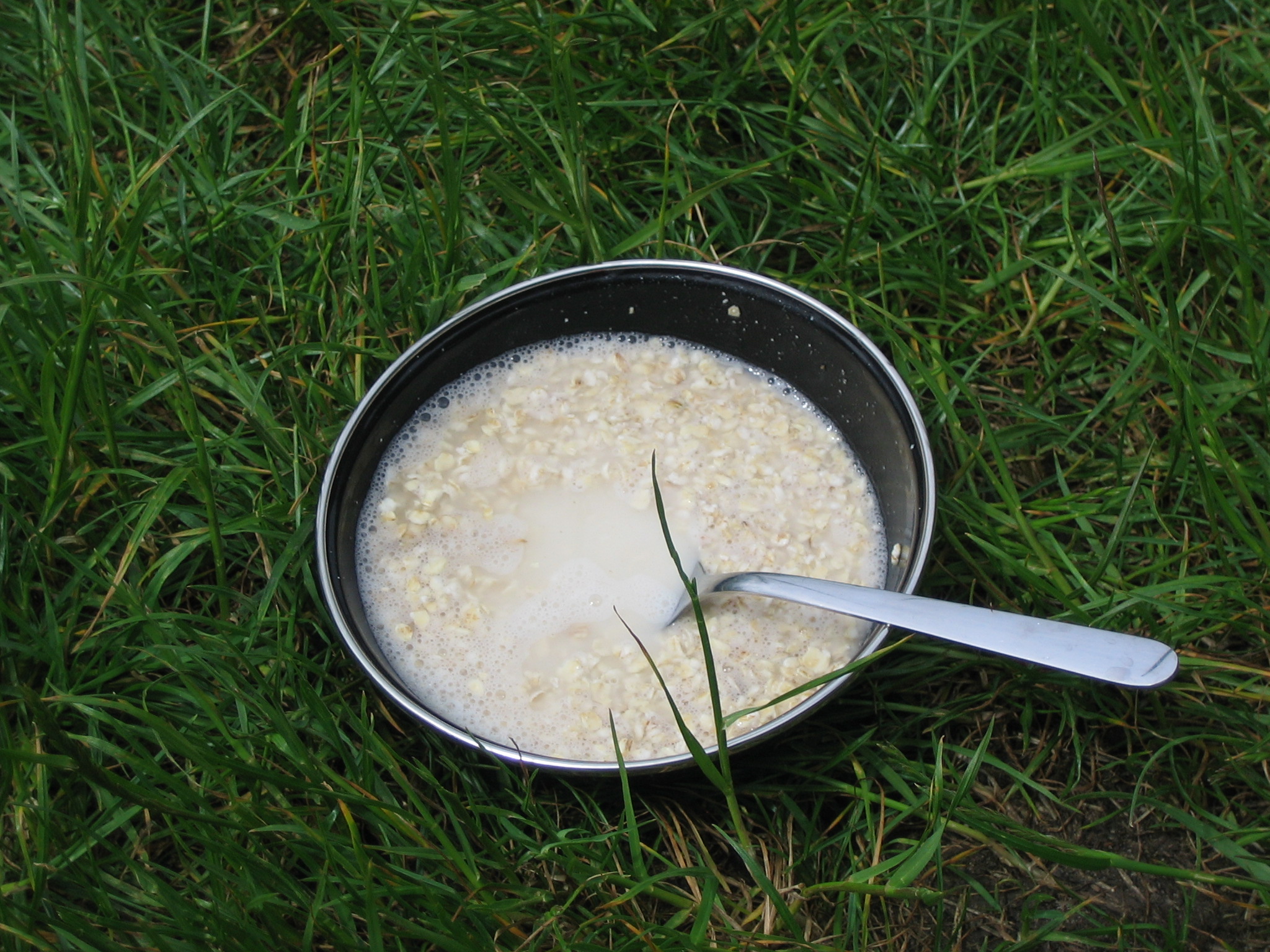
IMG_4205A whole new level of asceticism was reached while I was preparing for a weekend in the Highlands of Scotland. I had to bring along my own breakfast and lunch for both days, but I couldn’t be bothered to bring anything fancy. So I brought four bags of oats. One with hot water for breakfast, and one with cold water for lunch. I was thinking chiefly of Robert Louis Stevenson’s Kidnapped, where David Balfour and Alan Stewart go on the run through the heather with nothing but a bag of oats to sustain them – hot porridge when they can risk a fire, cold porridge without. I seem to remember it being called skillet, like the frying pan, but a brief search of the online text reveals I was probably making that up. The recipe is:

  1. Take 250-300g of oats, for one serving.
  2. Add water until the oats are submerged. Stir until the water goes a milky colour.
  3. Eat.

It is lightweight, compact, hydrating, extremely economical, and leaves you with a pleasant feeling of having eaten something. It gets you plenty of attention and something of a hard-man reputation from those you’re walking with. On the other hand, you have to really, really like the taste of oats. Even so, it’s a pretty grim meal. I generally eat a chunk of fruit and nut chocolate afterwards to balance the carbohydrate with some sugar. Yet it’s quite reassuring, I think, to know that if things get really tough, in life or on the trail, all I really need to survive indefinitely is access to fresh water and a really, really big bag of oats.

Spring on the Airfield

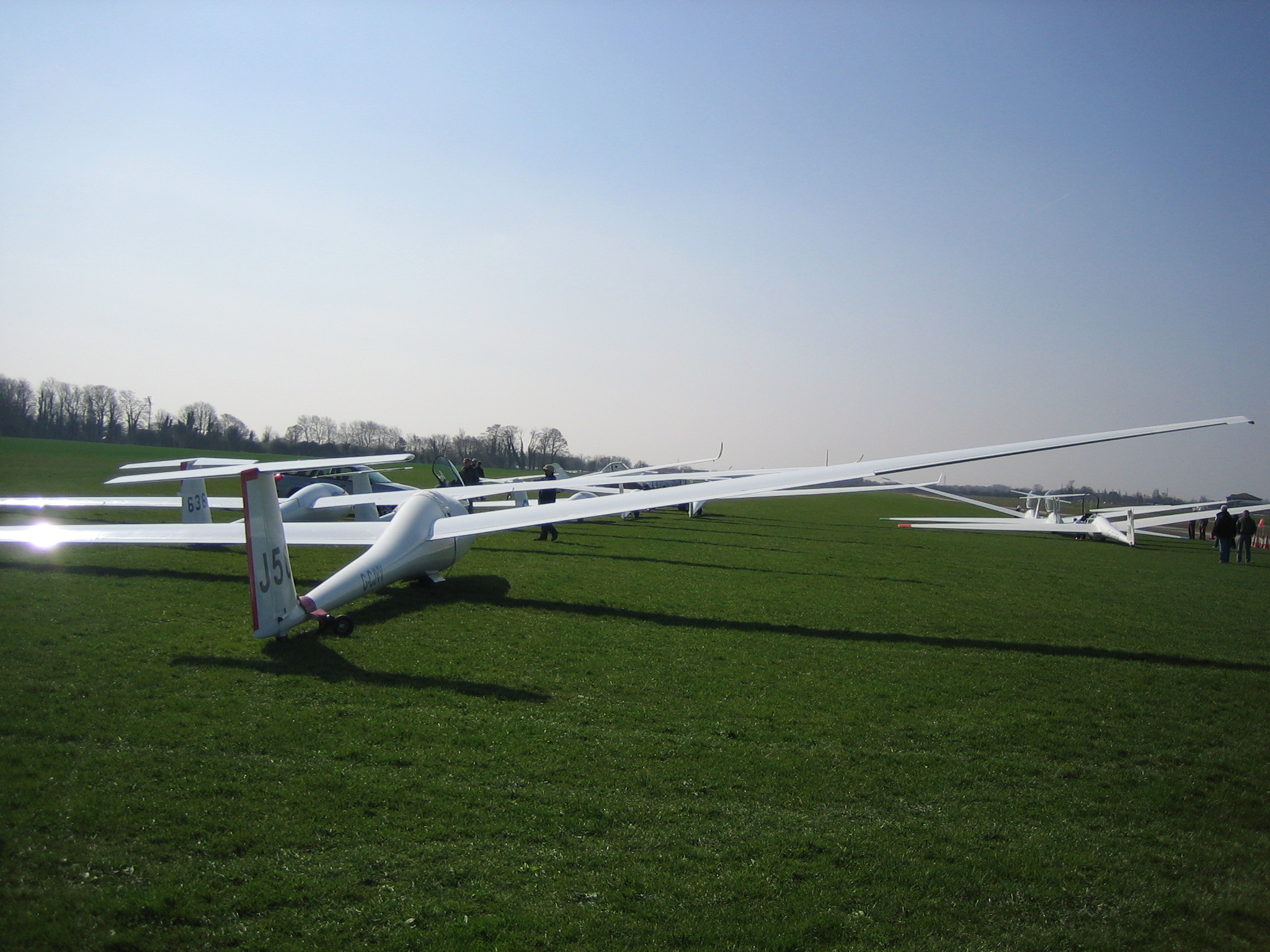
IMG_4181A belated spring has finally reached Britain. The trees are beginning to come into leaf, a couple of months after the first flowers poked their heads above ground, only to be buried deep in snow and frozen into submission. Down at Pocklington airfield, everyone is out of doors and a grand fleet of gliders is lined up in two orderly queues, for winch launches and aerotows respectively. The first of the spring thermals have arrived, and no-one wants to miss a moment of flying time.

Thermals are columns of hot air rising from the earth below, which can be hijacked by gliders and used to gain height. The lack of any warm air at all during the winter months is what makes gliding relatively neglected for half a year, when all anyone can do is descend as slowly as possible. In spring, when the nights are cold and the days are warm, and the temperature differential is at its strongest, the thermals are at their fiercest. It is possible to climb thousands of feet in just a few minutes.

I’ve been gliding all winter through, and coming out to Pocklington once a fortnight on average. I’ve been up a dozen times, but even so my total flight time is still just under an hour. An average winter flight lasts about 5-7 minutes, and even if you’re lucky and get 3 flights in a day, it’s still not a lot of time. Often rain, or adverse winds, or ice on the wing, will scupper your chances of getting into the air.

By contrast, my first flight this spring lasted 38 minutes, and took me to heights of 3500 feet. It was terrifying – but then I find everything terrifying while I’m flying a glider. It’s part of the reason I go. In this case, my head knew, abstractedly, that the higher we are the safer we are, that we have more room to manoeuvre, more opportunities to find another thermal,even – God help us – more time to bail out should anything go catastrophically wrong. My stomach, however, has only just got used to seeing Pocklington from a thousand feet up, and is really unused to this new perspective. It doesn’t help that climbing in a thermal involves spiralling inside a column of hot air, and maintaining that spiral in despite of all the efforts of wind and turbulence to force you out of it. It requires a tight look out, careful handling of the controls, and a strong stomach, particularly on rough days. By the time I land, I am noticeably green around the gills.

Yet there’s fun to be had on the ground too. Once we huddled in the tea bus, hunkered over our mugs and shivering, while mist poured from our mouth and nostrils with each exhalation. Now everyone is sat out around a table, telling the tall tales of lightning strikes and crash landings that are so much a part of the gliding experience. All around us, the birds are back in force. Since almost all our aircraft are silent, and the one strip of tarmac we have dates back to World War Two and is harder to land on than the grass, there’s little to scare them away. The swallows are all over the place, and popular with everyone except the man who’s job it is to keep them out of the aircraft hanger, where they have an irritating habit of nesting inside the gliders. The moment one entrance is stopped up, they find another. It’s a never ending task. Swifts and skylarks are to be seen in profusion, and I was once halfway through my circuit when I looked to my right and found two buzzards flying a few feet off my wing. Of course, I couldn’t let that go by without writing a poem.

Birdwatching on the Airfield.

The swallows nest in gliders in the spring.
Leave one uncovered for a week and when
You check inside the canopy or wing,
You’ll find them stowed away there in their den,
Awaiting launch by aerotow or cable,
As if they thought to fly up like the wren
Upon the eagle’s back, in Aesop’s fable.
This spring, there’s many kinds of birds around,
I’d name them all for you, if I were able,
But of the ones whose proper names I’ve found,
I like the skylark best for its ambition.
Because, like us, they’re born upon the ground
But will not be content with their condition.
To see them struggling skywards in full song
Fills we with – well, a kind of recognition
Of my desires in them. Oh, prove me wrong
If you’ve a mind to, but I think we share
A certain glee in flight, now Winter’s gone.
It wasn’t long ago I saw a pair
Of buzzards in a thermal spiralling
Beside my glider on the rising air,
And as we soared together, wing to wing,
I thought: to us, with human speech’s gift
There’s mystery in all they do or sing,
But sympathy as well. Why, take the swift:
Would it play all the games it does in flight
With drag and thrust and gravity and lift
If with us it shared not the same delight
In ease and speed and silentness and height?

Benjamin Franklin meets Voltaire

Portrait of Benjamin Franklin

History is full of great men and women running into each other by coincidences that must have seemed like nothing at the time, but which often throw their biographers into flights of speculation as to what was said, and what was thought, and how each must have reacted. Sometimes the results are seismic, but too often the encounter ends in disappointment. John Keats meeting William Wordsworth was, by all accounts, a social disaster. Elizabeth Gaskell, the industrial novelist, lived on the same street for years as Friedrich Engels, co-author of The Communist Manifesto, without either of them appearing to know who the other was. Edward Thomas and Wilfred Owen would have known each other by sight without either of them having any idea that the other wrote poetry – much less some of the best poetry of World War One.

In the case of Benjamin Franklin meeting Voltaire, however, the charm of the occasion is that the spectators appear to have pre-empted the biographers, and been positively rabid with excitement.

On a Wednesday in April 1778, Benjamin Franklin, at that time a Minister Plenipotentiary to the newly formed United States of America, had with dinner with John Adams, the commissioner and the future President of the United States, and both went afterwards to hear a few papers read at the Academy of Sciences, the premier intellectual gathering in Paris. Benjamin Franklin was already famous throughout France for his discovery of the lightning rod and the electric properties of thunderstorms, in addition to his many literary and philosophical works and his staunch defence of his country’s new independence. Dubbed L’ambassador electrique, he moved among the social circles of Paris with much greater facility than Adams, whose stern republicanism was shocked at the frivolity the French mixed together with the serious affairs of science and diplomacy.

Also attending the Academy of Sciences that night was Voltaire, a voluminous writer whose religious and political scepticism had made his life one long litany of imprisonment in, and banishment from, his native France, but whose many sufferings had never stopped him writing , and served but to increase his fame and popular appeal. Now aged 83 and aware he had only a few months to live, and that the current climate was sympathetic to his opinions, he had broken a three decade sentence of exile and returned to Paris.

According to Adams’ account, the meeting began routinely enough, with D’Alembert, the president, reading eulogies on the recently deceased members of the Academy. But some of the crowd, electrified at the presence of two living legends of the Enlightenment among them, began to demand that Franklin and Voltaire be introduced to one another. The two philosophers bowed formally and spoke to one another, but this was no satisfaction to anyone, and served but to increase the clamour of the audience. As Adams dryly notes:

Neither of our Philosophers seemed to divine what was wished or expected. They however took each other by the hand…. But this was not enough. The Clamour continued, untill the explanation came out “Il faut s’embrasser, a la francoise.” The two Aged Actors upon this great Theatre of Philosophy and frivolity then embraced each other by hugging one another in their Arms and kissing each others cheeks, and then the tumult subsided.

What the two thought of each other, we hardly know, and the meeting led onto nothing new in the careers of these two titans of the Enlightenment, whose greatest triumphs were now behind them. All the same, one would have loved to have been there.

Super Tramp Chicken

Anyone who has ever been camping will know and recognise how much better everything tastes when cooked outdoors over a campfire, though not every outdoor cook would go to the lengths taken by W.H. Davies, a tramp and minor poet of the early 20th century, now probably best known for his poem ‘Leisure’ (‘What is this life if, full of care’), best known to those my age from a successful Centre Parks advert.

Originally from Newport, Davies spent much of his early life as a homeless vagabond travelling around the United States and Canada. He made his way by begging, for the most part, but also tried his hand at fruit-picking and canal building, and made several Trans-Atlantic trips as a cattle-man. All that came to an end one day in Canada, when he had the misfortune to stumble whilst trying to jump onto a moving freight train, and the wheel severed his right foot at the ankle.

Five weeks later, he returned to Britain, equipped with a new wooden leg, and began his attempts to establish himself in a literary career. This recipe is taken from The Autobiography of a Super Tramp, his most popular prose work.

  1. Take one chicken, unplucked.
    N.B. It is probably not a good idea to inquire too closely into where this unplucked chicken came from. The choice of the verb ‘Take’ is not as innocuous as it might be in other cookbooks.
  2. Cover it in a thick layer of mud.
    You heard me.
  3. Bake under a pile of hot ashes, until the mud has dried into a solid crust.
  4. Break off the mud crust. The chicken beneath should be ‘as clean as a new born babe, with all its feathers and down stuck hard in the mud.’

The result, according to Davies, is a chicken ‘far more tasty than the one at home, that was plucked and gutted with care and roasted or baked to a supposed nicety’ – though perhaps it is best suited to those who bemoan, like him, that  ‘this food of civilisation certainly seemed to suffer from a lack of good wholesome dirt, and I should have liked to have had my own wood fire at the end of the backyard, were it not for shame.’

Stargazing

English: The most famous depiction of the 1833...
One of the many ways artists make shooting stars look far more exciting than they actually are.

One clear night in North Wales, after everyone else had retired to their tents, my friend and I stayed out with a flask of whisky to watch for shooting stars. The Leonids were passing over that weekend, and it was supposed to be quite a show.

Shooting stars are literal blink-and-you’ll-miss-them affairs, fleeting streaks of light across the sky that last less than a second, and leave you wondering if you really saw them, or whether it was just your imagination playing tricks. My friend saw a couple, and I saw one – and then we saw the same one together. Having my sighting corroborated was utterly thrilling. It might just have been that I was three sheets to the wind at the time, but I went back to my sleeping bag grinning all over my face.

True-color picture of Saturn assembled from Vo...
Exactly like this, but smaller.

I first began to stargaze in college, heading out to the back garden on clear nights, with a copy of the starchart programme Cartes du Ciel on my creaky old laptop, and my Dad’s birdwatching telescope. It wasn’t a fancy rig by any means, but it was still a revelation. The peak of excitement was catching sight of Saturn, because even through my underpowered telescope it was bright yellow and had distinctive rings. It looked like a child’s picture of Saturn someone has cut out of a book and pasted into the night sky. Mars looks a little reddish, and Jupiter has some distinctive moons, but Saturn is by far the most exciting of the planets. I also had fun observing the Orion nebula, the Pleiades, and once caught sigh of a faint, fuzzy blob I thought might be Andromeda. Rich pickings indeed, considering I hardly knew more than six constellations.

Serious astronomy fell by the wayside in University, but the knowledge never left me and proved handy on various night hikes, where I was astonished and disgusted by how many people believe that Polaris, the north star, is necessarily the brightest one in the sky. Most of the time they alighted on a planet, but at other points they ended up selecting Sirius, the dog star, which is in the south for most of the year! I wasn’t slow to set them right.

I got back into astronomy recently thanks to York University AstroSoc. Whenever there’s a clear night and the first year physics students haven’t been messing with the telescope, they’re my first port of call. Otherwise, I can be found standing stock still and gormless in some corner of the campus whenever there’s a break in the clouds, tracing the faint V-shape of Taurus where it lies beside the brilliant cluster of the Pleiades, or trying to spot the twins in Gemini. One thing I learnt only recently is that there’s not just shapes up there in the sky – there’s drama, too. Orion the hunter holds the two dog constellations of Canis Major and Canis Minor on a leash as they chase the great and little bears (Ursas Major and Minor) across the night sky. Where Leo (the Lion) and Cygnus (the Swan) come into this schematic is anyone’s guess, but it’s a nice attempt at bringing a few of the age-old figures together in a narrative. As in my postgraduate researches, I penetrate deeper and deeper into realms of fiction and history, of theme and symbol, of abstracts and theories, it’s pleasant every now and again to learn something that brings you closer to the real world, where it be learning a new knot, or the name of a wildflower by the roadside, or being able to locate a new constellation in the clear night sky.

The Big Sleep Out of 2009

While I was volunteering for Winchester Churches Nightshelter, as described in a previous blog post, I was asked if I fancied sleeping rough to raise money for them. The plan was to spend the night beneath the stars in Winchester Cathedral Close, a pleasant patch of grass behind the Cathedral that was easily shut in and quite safe. It was my gap year, and I was determined to say yes to all new adventures: on the grounds that if the expeditions I’d planned for the summer suddenly fell through, I wanted to say I’d done something, at least. So I agreed quite readily. And on a rather damp Friday night in May, I packed my sleeping bag, roll mat and woollies into my old Duke of Edinburgh rucksack, and headed down to join in.

I had doubled the £60 minimum sponsorship easily by applying diligently among my friends and acquaintances. I was even sponsored £5 by a complete stranger to whom I happened to mention it to while working on the tills at WHSmith, which was lovely. And the first part of the evening was really remarkably pleasant. The Army caterers came out and did us a fantastic bowl of curry, and it was great to have the whole of Winchester Cathedral to ourselves for the evening, without tourists or services to disturb us. That said, the program organised by the people in charge was extremely thought provoking. We heard from Ed Mitchell, a talented journalist who had fallen into alcoholism and ended up sleeping on the streets, and an accountant from Eastleigh whose business had failed, and who ended up sleeping rough in Winchester, having nowhere else to turn. It really did go to show how being homeless could happen to anyone.

Around eleven o’clock, when the real rough sleepers were settling down for the night in the grounds outside the Cathedral, we settled down in Cathedral Close. And here a series of small disasters occurred. Firstly, I had forgotten my survival bag, a big orange heat-trapping plastic sack, within which I’d hoped to spend the night in a tolerably snug and waterproof fashion. Secondly, while I’d been socialising and gobbling up the curry, everyone else had been preparing immaculate cardboard palaces in which to spend the night – and there was none left for me. Fortunately, I eventually managed to scrounge a few forgotten sheets from behind the bins, tucked my feet into my rucksack, and bedded down. I actually changed into pyjamas first, which gives you some idea how little about roughing it I knew. Not having anywhere dry to leave my hearing aids – for they don’t work at all if the damp gets into them – I clutched them in my right hand all night.

I woke up about 1 am because it was raining on my face. This was round about the time many people made a sudden dash for inside of the Cathedral and a drier night, but whether from drowsiness or my own natural bloody mindedness, the thought never occurred to me. There wasn’t enough cardboard to pull it over my head, so I dropped my hat over my eyes instead, and listened to the rain drumming against the waxed cotton brim. I tried to recite all I could remember of Robert Browning’s ‘Childe Roland to the Dark Tower Came‘. And somewhat miraculously, I fell asleep.

I have never been quite so glad in my life to wake up at 5am and find the sun up. People were up, and moving around, there were cups of tea to be had, and I could divest myself of my cardboard cocoon, now a claggy coat of mush, and my damp sleeping bag. I could get up and chase the chill out of my bones. And this is what I did. I wandered around the Cathedral for the next few hours, reading Milton and feeling pleasantly chewed out and hoary. Then they fed us a bacon sandwich, and we all went home to our beds – suddenly much more comfortable by comparison.

I’ve slept rough twice since then – once on the streets of Bilbao when we couldn’t get a room, which was just another lousy episode in a lousy trip, and once again for charity, which was embarrassingly easy. I had a good sleeping bag and we were in a car park instead of under the stars, so I got an uninterrupted 7 hours and went home quite refreshed. The Big Sleep Out was the hardest and most authentic it got – and the most authentic I hope it gets, for me.