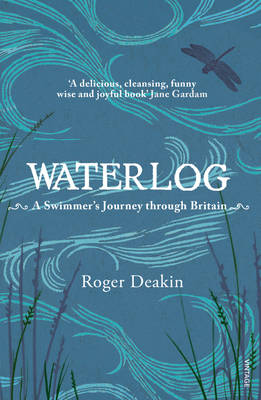
Waterlog 5: Holy Isle, Scotland

WaterlogThe seasonality of wild swimming is an organising theme of Roger Deakin’s Waterlog, which begins in April in the Scilly Isles, and climaxes with a Christmas Day plunge into the North Sea. If I haven’t been quite so adventurous as to keep my wild swimming habits up in the depths of the English winter (I gave up in November), at least my season opener, a fortnight earlier than Deakin’s plunge, and in the far north of the country, has a certain daring to it.

Holy Isle, Scotland

I rose from my sleeping bag on our second morning of camping out, feeling greasy and hungover, and smelling strongly of BO and woodsmoke. Our campsite  had no showers, and offered little to do after dark but build enormous campfires and drink heavily. We were on the Isle of Arran, just off the west coast of Scotland. It had made the news a fortnight ago by suffering snowstorms so severe that the north end of the island had been virtually buried, and all power from the mainland broken off. When we arrived, the snows were gone save from the tops of the very highest peaks, and the sole memory of that week were the great rectangular generators, lined up on trucks all down the Brodick seafront, and still visible down many a highway and byway throughout the island. We had some fears that the islanders might have resorted to cannibalism, but it turns out that when face with the breakdown of civilisation, they had done the British thing, and retired to the pub to play board games.

Even in the absence of snow, the morning was remarkably chilly, and I pulled on every scrap of clothing I had as I went about the morning chores of making skillet and filling my water bottle. A thin, chill mist hung over everything, blurring the peaks that had been pin-sharp yesterday, and making the sunlight fall weak and watery on our faces. The decision was made to go for a walk on Holy Isle, just off the coast of Arran, once the hermitage of a Celtic Saint and now the location of a successful Buddhist retreat. Half the island is a nature reserve, and some of it is devoted to a group of reclusive nuns who’ve retired from the world for the next four years, but there’s still plenty of scope for a hike up the island’s sole mountain, Mullach Mor, and a walk back along the seashore.
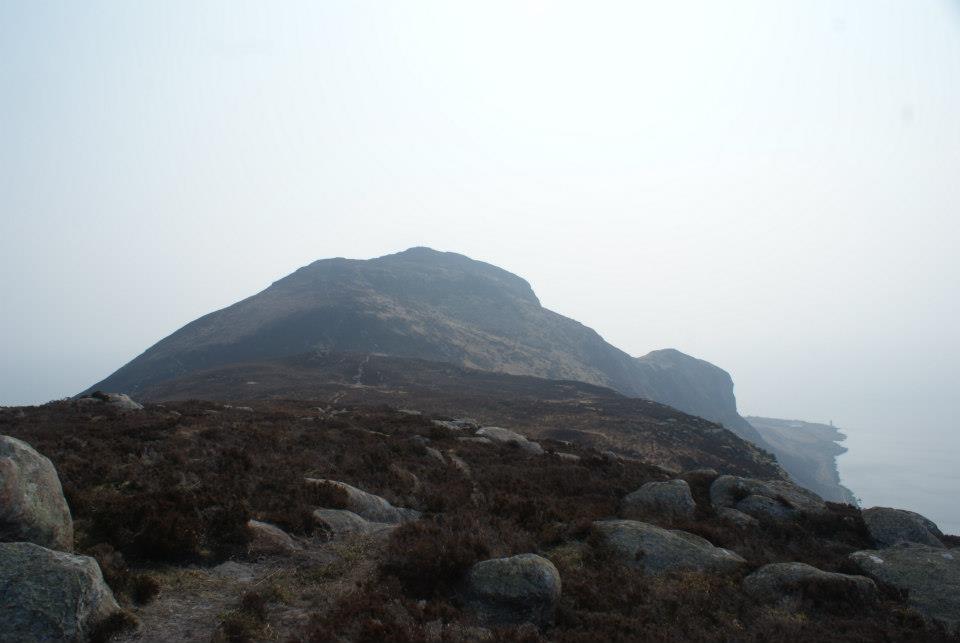
ArranThe island was an odd place, with bright, wind-ragged Buddhist banners flying high above the heather, and hardy brown Asian sheep, with great curved horns, browsing on the thin winter grass. As we reached the top of the mountain it became clear that the chill morning mist had somehow turned to baking noon haze, without thinning or thickening or altering in the slightest. The mainland was completely cordoned off from the eye, and the isle was covered in a luminous, Celtic Twilight atmosphere that photos don’t really do justice to. Temperatures were reaching 18 degree highs, and all the softshells and banded jackets we’d donned that morning were being stuffed back into our groaning daysacks.

Cooling off slightly, we came down to the shore, where some split off to wander into the caves, others to admire the beautiful Stevenson lighthouse, and still others to skim stones skillfully across the water. I decided to paddle – but paddling is an art I’ve never quite mastered. Somehow, I always seem to end up going swimming – and even when I don’t, I still get damp shorts. In this case, I waded in and splashed my face for a bit, and then thought ‘Hell with it’ and took the plunge.
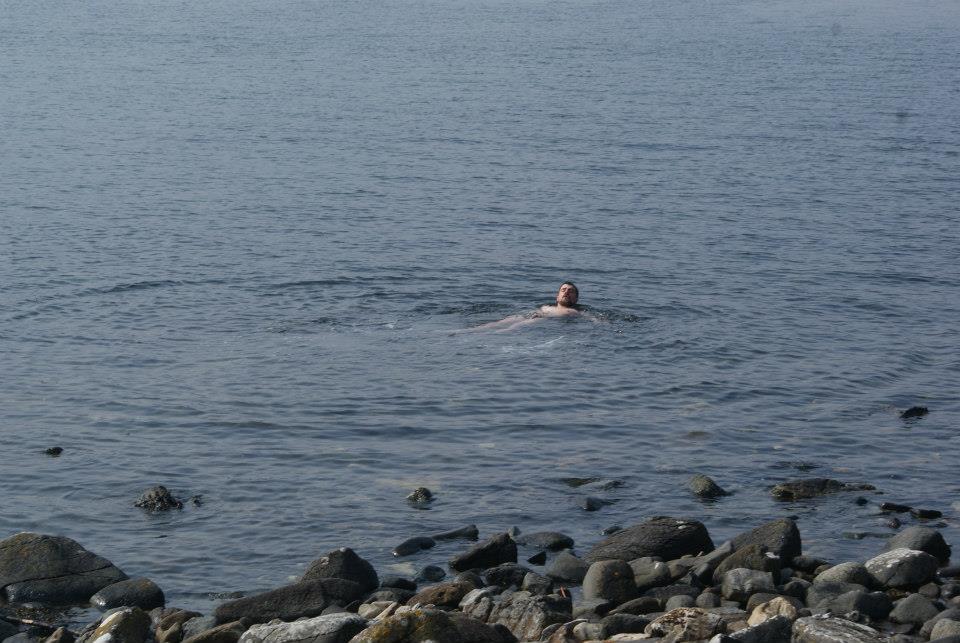
in the seaThe agony and the ecstasy of the water was almost sexual in its intensity. I drifted out from shore on my back, hyperventilating mildly from the cold shock, while my friends on shore waved and cheered. It felt like I was undergoing a whole body attack of pins and needles. Every drop of blood beneath my skin had decided there was somewhere else it would much rather be, and fled back to my core. A deep and purifying cold was scouring the sweat and woodsmoke from me.

I rolled over onto my front and executed four strong strokes towards Arran, with swiftly numbing limbs; then thought the better of it, turned again, and struck out for the shore. I had swum almost a mile in the sea off Mallorca a week ago – but that had been the warm Mediterranean, and I’d still emerged shivering and blue around the edges. Outside of a wetsuit, this was not a sea in which you would want to spend a lot of your time. As I emerged and began to towel some feeling back into my limbs, I had the pleasant experience of seeing my friends cautiously dipping their feet into the water, and jerking back with pained expressions. And so a new year of wild swimming begins!
Waterlog 4: Squam Lake and the River Derwent

WaterlogLooking again through Roger Deakin‘s classic wild swimming manifesto, Waterlog, I realised that while there’s an awful lot of swimming for pleasure, or adventure, or exploration, he never really covers jumping in the lake as an alternative to jumping in the tub. Quite often, after the really long cold swims, he has a piping hot bath awaiting him when he gets out – and actually, it’s hard to blame him for that. But this got me thinking of the two times in my life where swimming has replaced washing, and what that felt like.

Squam Lake, New Hampshire.

It was my first time in America, and we were paying a visit to some family friends called the Butterworths. They had visited England when my father was a kid, but apart from the prosaic business of having children and letting their hair grow white, they didn’t seem to have grown much older in the meantime. Which suited me fine, seeing that I was nine at the time.

This was their summer holiday, and the whole extended family were living in log cabins they’d built for themselves, on the edge of Squam Lake. Electricity really ran out at the fridge, which was in a little hut of its own a few hundred yards up the road. It limped on as far as the main cabin, where it powered a single bulb – but that was it. No modern plumbing, no TV or radio, no hot water. You woke up, went for a swim, then had breakfast. I was nine, and it was paradise. I’d never been around people with their own canoes before, and suddenly it was Swallows and Amazons come to life. It was a perfect, innocent, boys’ own adventure story.

Case in point RE the innocence – it was accepted etiquette for those living on the opposite side of the lake to swim across and greet new arrivals, rather than going to all the trouble of walking round. Our nearest neighbours happened to be a pair of Swedish girls, and as they rose dripping from the water to introduce themselves, I couldn’t work out for the life of me why my father was so impressed, and my mother so irate with him. It would continue to be a mystery to me for a good couple of years.

We pretty much lived in the water – it was always cool, but it was never a shock to get into, and even when we were mucking around in canoes, we were always looking for an excuse to capsize or fall overboard. Being in the water was simply much more fun than being on it -and that’s an opinion I hold to this day.

I’ve forgotten most of it now, and envy my sister’s memory, who can ever recall the pattern on the sides of the canoe, and the path through the woods to every hut. For me, the whole thing has receded into the golden mists of boyhood, and I can hardly believe I ever lived a life that much like something out of a book.

The River Derwent, Peak District

Swimming didn’t replaced bathing again until a recent trip to the Peak District with a walking group from Cardiff. Our bunkhouse was close on the River Derwent, and while we were searching for a footpath that the river, then in spate, had completely overflowed, we discovered a rather convenient bathing hole by the side of an old mill. Upstream the river was shallow and tame – downstream it thundered down a long stretch of rapids out of sight, and in the middle there was a long deep pool on the edge of the weir where a man could get a few strokes in before beaching himself on the gravel.

It was nothing like Squam, where the lake was deep and the swimming was limitless. Unlike the gentle American waters, the river was cold enough to take my breath away, even in summer. But it was a beautiful river, between the moorhens and the willows on one side and the foam, spray and thunder on the other. When our hastily re-routed walk was over, I returned to wash off the dust – and returned again, morning and evening, for the next four days, sometimes with friends and sometimes alone. It was astonishing how it would alter my mood. I’d walk down tired and snappish and grimy, and return revitalized, cheerful, and awake. Everyone I swam with commented on it. For four days I neither soaped, shampooed or showered, but plunged in the river and emerged feeling like a king. But then the rain came down, the temperature dropped a few degrees, and I made a cowardly retreat to the hot water of the bunkhouse bathrooms. Yet just as I was finishing up, my hand found the temperature dial and gave it a sudden, violent, anticlockwise twist, and I gasped and spluttered beneath an ice-cold torrent for thirty excruciating seconds before I got out. That too has become a habit.

Benjamin Franklin meets Voltaire

Portrait of Benjamin Franklin

History is full of great men and women running into each other by coincidences that must have seemed like nothing at the time, but which often throw their biographers into flights of speculation as to what was said, and what was thought, and how each must have reacted. Sometimes the results are seismic, but too often the encounter ends in disappointment. John Keats meeting William Wordsworth was, by all accounts, a social disaster. Elizabeth Gaskell, the industrial novelist, lived on the same street for years as Friedrich Engels, co-author of The Communist Manifesto, without either of them appearing to know who the other was. Edward Thomas and Wilfred Owen would have known each other by sight without either of them having any idea that the other wrote poetry – much less some of the best poetry of World War One.

In the case of Benjamin Franklin meeting Voltaire, however, the charm of the occasion is that the spectators appear to have pre-empted the biographers, and been positively rabid with excitement.

On a Wednesday in April 1778, Benjamin Franklin, at that time a Minister Plenipotentiary to the newly formed United States of America, had with dinner with John Adams, the commissioner and the future President of the United States, and both went afterwards to hear a few papers read at the Academy of Sciences, the premier intellectual gathering in Paris. Benjamin Franklin was already famous throughout France for his discovery of the lightning rod and the electric properties of thunderstorms, in addition to his many literary and philosophical works and his staunch defence of his country’s new independence. Dubbed L’ambassador electrique, he moved among the social circles of Paris with much greater facility than Adams, whose stern republicanism was shocked at the frivolity the French mixed together with the serious affairs of science and diplomacy.

Also attending the Academy of Sciences that night was Voltaire, a voluminous writer whose religious and political scepticism had made his life one long litany of imprisonment in, and banishment from, his native France, but whose many sufferings had never stopped him writing , and served but to increase his fame and popular appeal. Now aged 83 and aware he had only a few months to live, and that the current climate was sympathetic to his opinions, he had broken a three decade sentence of exile and returned to Paris.

According to Adams’ account, the meeting began routinely enough, with D’Alembert, the president, reading eulogies on the recently deceased members of the Academy. But some of the crowd, electrified at the presence of two living legends of the Enlightenment among them, began to demand that Franklin and Voltaire be introduced to one another. The two philosophers bowed formally and spoke to one another, but this was no satisfaction to anyone, and served but to increase the clamour of the audience. As Adams dryly notes:

Neither of our Philosophers seemed to divine what was wished or expected. They however took each other by the hand…. But this was not enough. The Clamour continued, untill the explanation came out “Il faut s’embrasser, a la francoise.” The two Aged Actors upon this great Theatre of Philosophy and frivolity then embraced each other by hugging one another in their Arms and kissing each others cheeks, and then the tumult subsided.

What the two thought of each other, we hardly know, and the meeting led onto nothing new in the careers of these two titans of the Enlightenment, whose greatest triumphs were now behind them. All the same, one would have loved to have been there.