Poetry Reading: A Chilean Pine in Wales

The monkey-puzzle tree tosses its boughs
Like great green fishbones swimming on the wind,
The wind that swept the high Welsh hillside bare
And tumbled every stone from stone to ruin
Where once a farmhouse stood beneath its shade,
Now roofless, roomless, shelterless and lone.
Made fanciful, I wonder at the cat
That stripped the fishflesh from these kippered bones
And who would hang them up and let them grow
So mouldering and green – so dead and full
Of life. This might have been a home of giants;
These branches might have been the skeletons
Of salmon, spawned from him that secret lies
In Llyn Llifon, the Ancient of the World
That once bore Arthur’s knights upon his shoulders.
The family that planted first the seed
Is vanished into history or myth,
Yet still the Chilean pine remains and thrives.
You might have thought it swam its way across
The wide Atlantic on its own, so strong
And agilely the branches tailfins flick
With stroke on stroke upon the fluid air.

From my diary of the time: ‘Sunday [29th May 2012] I dared the rain and high winds & set off to Neath with the ramblers. We had an interesting walk on the Afan forest trail. I enjoyed the windswept ridge, & the ruined farmhouse where we stopped for lunch, with the wildly out of place monkey puzzle tree tossing its branches above us, like great green fishbones trying to swim on the wind. Unfortunately, by the walk’s end my arms were stinging with the cold, & my toes wet in my boots, so it was a relief to reach the minibus & be back to James and Julie’s house for tea and biscuits.’

The first image of the fishbones was with me from the start, but the rest of the poem was slow in coming. The tree was stuck in my imagination. Flourishing and verdant and completely out of place, it seemed to have a mythic power that was completely disproportionate to its origins. It reminded me in some ways of the dragon bones I once saw, which they still keep chained up outside the Wawel Cathedral in Krakow, Poland. The guidebook said that they were probably bones of a mammoth, or a rhinoceros, or a whale, but it was impossible to believe they were anything other than a dragon. Equally, it was impossible to believe that such a tree had been so prosaically carried across the ocean and planted here, as the noticeboards said, and I began to think of other explanations.

The salmon of Llyn LLifon is one of the most fascinating figures in the surviving Welsh mythology. He first appears in the magnificently bonkers tale of How Culhwch won Olwen, in the Mabinogion, where Kei and Bedwyr (Kay and Bedivere) ride upon his shoulders to the rescue of the imprisoned knight, Mabon son of Modron. I borrowed him from a wonderful early R.S. Thomas poem, ‘The Ancients of the World‘.
The Big Sleep Out of 2009

While I was volunteering for Winchester Churches Nightshelter, as described in a previous blog post, I was asked if I fancied sleeping rough to raise money for them. The plan was to spend the night beneath the stars in Winchester Cathedral Close, a pleasant patch of grass behind the Cathedral that was easily shut in and quite safe. It was my gap year, and I was determined to say yes to all new adventures: on the grounds that if the expeditions I’d planned for the summer suddenly fell through, I wanted to say I’d done something, at least. So I agreed quite readily. And on a rather damp Friday night in May, I packed my sleeping bag, roll mat and woollies into my old Duke of Edinburgh rucksack, and headed down to join in.

I had doubled the £60 minimum sponsorship easily by applying diligently among my friends and acquaintances. I was even sponsored £5 by a complete stranger to whom I happened to mention it to while working on the tills at WHSmith, which was lovely. And the first part of the evening was really remarkably pleasant. The Army caterers came out and did us a fantastic bowl of curry, and it was great to have the whole of Winchester Cathedral to ourselves for the evening, without tourists or services to disturb us. That said, the program organised by the people in charge was extremely thought provoking. We heard from Ed Mitchell, a talented journalist who had fallen into alcoholism and ended up sleeping on the streets, and an accountant from Eastleigh whose business had failed, and who ended up sleeping rough in Winchester, having nowhere else to turn. It really did go to show how being homeless could happen to anyone.

Around eleven o’clock, when the real rough sleepers were settling down for the night in the grounds outside the Cathedral, we settled down in Cathedral Close. And here a series of small disasters occurred. Firstly, I had forgotten my survival bag, a big orange heat-trapping plastic sack, within which I’d hoped to spend the night in a tolerably snug and waterproof fashion. Secondly, while I’d been socialising and gobbling up the curry, everyone else had been preparing immaculate cardboard palaces in which to spend the night – and there was none left for me. Fortunately, I eventually managed to scrounge a few forgotten sheets from behind the bins, tucked my feet into my rucksack, and bedded down. I actually changed into pyjamas first, which gives you some idea how little about roughing it I knew. Not having anywhere dry to leave my hearing aids – for they don’t work at all if the damp gets into them – I clutched them in my right hand all night.

I woke up about 1 am because it was raining on my face. This was round about the time many people made a sudden dash for inside of the Cathedral and a drier night, but whether from drowsiness or my own natural bloody mindedness, the thought never occurred to me. There wasn’t enough cardboard to pull it over my head, so I dropped my hat over my eyes instead, and listened to the rain drumming against the waxed cotton brim. I tried to recite all I could remember of Robert Browning’s ‘Childe Roland to the Dark Tower Came‘. And somewhat miraculously, I fell asleep.

I have never been quite so glad in my life to wake up at 5am and find the sun up. People were up, and moving around, there were cups of tea to be had, and I could divest myself of my cardboard cocoon, now a claggy coat of mush, and my damp sleeping bag. I could get up and chase the chill out of my bones. And this is what I did. I wandered around the Cathedral for the next few hours, reading Milton and feeling pleasantly chewed out and hoary. Then they fed us a bacon sandwich, and we all went home to our beds – suddenly much more comfortable by comparison.

I’ve slept rough twice since then – once on the streets of Bilbao when we couldn’t get a room, which was just another lousy episode in a lousy trip, and once again for charity, which was embarrassingly easy. I had a good sleeping bag and we were in a car park instead of under the stars, so I got an uninterrupted 7 hours and went home quite refreshed. The Big Sleep Out was the hardest and most authentic it got – and the most authentic I hope it gets, for me.

Evenings with the Homeless

cropped-outside_article_imageThe Service section of my Gold Duke of Edinburgh’s award required a twelve month stint doing charitable work in the community, but just what to do was a puzzle to me. I’d collected my silver award by doing a stint behind the till in a charity shop, but I fancied something a bit more challenging. Besides, at that point, being behind the tills was my day job, and I was already starting to get customers coming and going in my dreams.

I tried hospital radio for a bit, but it didn’t really gel. Then I thought I’d try the local homeless shelter, the Winchester Churches Nightshelter, and ended up doing my year’s stint there. In fact, I ended up being so interested that I slept rough outside Winchester Cathedral to raise money for them, came back for multiple shifts during the University holidays, and even got my parents into the routine of  cooking for them once in the month. I still look in, if I’ve got a few weeks free and nothing to do.

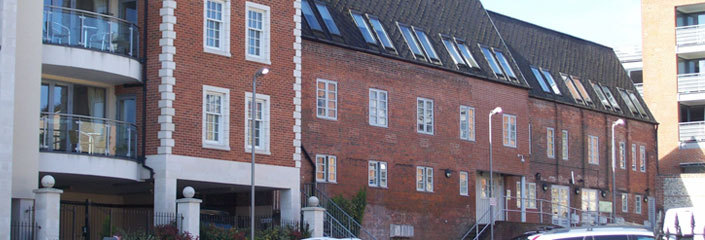
The nightshelter is well known, but rarely noticed. Its premises are tucked in beside the library – or the Winchester Discovery Centre, if you favour the rebrand – and behind Maison Blanc, bordering on a small car park so busy that the nightshelter parking spaces have to be guarded with multiple traffic cones and religious zeal. Inside there are 17 beds in single and double rooms, showers, laundry facilities, a TV and computer lounge, a dining hall and a kitchen, in addition to the daytime offices. The staff consists of one supervisor, who stays till morning; one or two evening helpers who stay from 6-9pm; an overnighter, who stays from 9pm till morning; and visiting cooks. All but the supervisor are voluntary. The homeless visitors – ‘guests’ in the nightshelter parlance – are breathalised as they come in, and sent for a brisk walk down to the King Alfred statue and back if their blood alcohol content is too high. So it’s never rowdy, and usually ends up being a quiet night in front of the TV in the lounge. They’re an incredibly mixed bunch, of every age and nationality. I’ve met people who’ve been long term homeless and sleeping on the streets; married men and women who’ve been thrown out of the house; men who’ve just got out of prison and need somewhere to go; and even ex-students who could be me in  a couple of years (most unnerving). Occasionally you’ll get someone who’s the life of the party, but mostly the guests are a bit glum, or grumpy – and with good reason, to be honest. I’ve met some great people, and I’m always willing to talk if someone wants to, but mostly we leave each other alone.

I started off as an evening helper, and found it a remarkably comfortable and easy way to tick off my award. Once in a while I got asked to make the tea, or do some washing, or help with the meal, but mostly I just sat in the corner with a book or watched whatever’s on TV with the other guests. And then, when dinner’s served, I tend to eat larger portions than any of the homeless! Being an overnighter takes a bit more effort. The room you get is windowless, and usually stifling. There is AC, but hardly anyone knows how to use it, so I usually come in to find the isolator switch turned off and buried behind a mountain of junk. After my first few nights of trying to sleep on the bed, I gave up, and started bringing a sleeping bag and stretching out on the floor, where I can usually get four or five hours of sleep. It’s not exciting, it’s not picturesque and it doesn’t feel particularly philanthropic – until I think that just because I’m here, rolling around in my sleeping bag or sat reading in a clapped-out armchair, 17 people are getting TV, internet, a full meal, and a warm place to stay, who would otherwise be on the streets. If you’re living in Winchester, and can spare a few hours of your evening, you could do a lot worse with your time.

Poetry reading: Love song of Iron


Love song of Iron

“Like a blacksmith the Love God has hammered me and crushed me
on his anvil, and has plunged me in a wintry torrent”
Anacreon of Teos, translated by Richmond Lattimore

Blacksmith girl, bright sweat pearled, copper skin flaring red,
Seizing me up from the flames of your forges, you
Held me in tongs as you hammered me, moulded me.
Pinned on your anvil, by hot fires made pliable,
Slowly I yielded, I bent to your rhythmic strokes,
Took to the shapes that your great strength impressed on me;
Ornamentations and stamps of your craftsmanship,
Bent to your blows, till at last you were satisfied.
Then when you took me and plunged me in cold water,
Hissing and spitting around me in spitefulness,
Chilling my heart till I set hard, unchangeable;
No longer flexible, fluid, mercurial;
Lumpen and cold with a frigid solidity.
Now as I lie here forgotten and purposeless,
Rusted, decaying and crumbling to uselessness,
Buried in scrapheaps in desolate wastelands, I
Yearn for the forges, the touch of high temperatures,
Scorching away at the tarnish of centuries,
Rending me down and restoring to purity
My mundane metal, recasted, reborn again
Reshaped anew at the hands of the blacksmith girl.


As a self-taught poet, the hardest part of learning the craft was iambic pentameter. No-one could seem to make it clear. They would say “It has ten syllables, and goes “dee-dum dee-dum dee-dum dee-dum dee-dum”, and I would be as in the dark as I ever was. Fortunately, I had a job on the tills at WHSmiths at the time, and had taken up memorising poetry as something to do to keep my brain alive and prevent me from becoming a check-out zombie. Halfway through Tennyson’s ‘Ulysses’, iambic pentameter simply decoded in my head. Like the proper union of gin and vermouth, it was a great and sudden glory.

It was still a long while and many scratched out lines of verse before I could write confidently in metre. ‘Love song of Iron’ is only the second poem I ever wrote that I am prepared to exhibit, and dates that my learning period. Yet this ended up somewhat to the poem’s advantage. It was not written in iambic pentameter, but in a spondaic metre I devised from scratch while I was trying to get my head around the difficult metres of Ancient Greek poetry. If it ever sounds forced, it’s because it was written to the sound of hammer on metal – a repetitive three-beat DONG-DONG-dong. That beat rang out in my head for years, and made it impossible to read the poem properly. I was reading to the hammer blows, not to the natural rhythm of the words, and under those impacts the poem shattered to pieces in my mouth. Much later, when the hammer beat had faded, I came back and read it again, and – to my surprise – found it satisfactory. This is a natural, unforced reading of the poem – yet I think you can still hear the hammer beats beneath it, the relentless rhythm that is driving the poem on.

The City of Dreadful Night

durer_melancholia_i

Lo, thus, as prostrate, “In the dust I write
My heart’s deep languor and my soul’s sad tears.”
Yet why evoke the spectres of black night
To blot the sunshine of exultant years?
Why disinter dead faith from mouldering hidden?
Why break the seals of mute despair unbidden,
And wail life’s discords into careless ears?

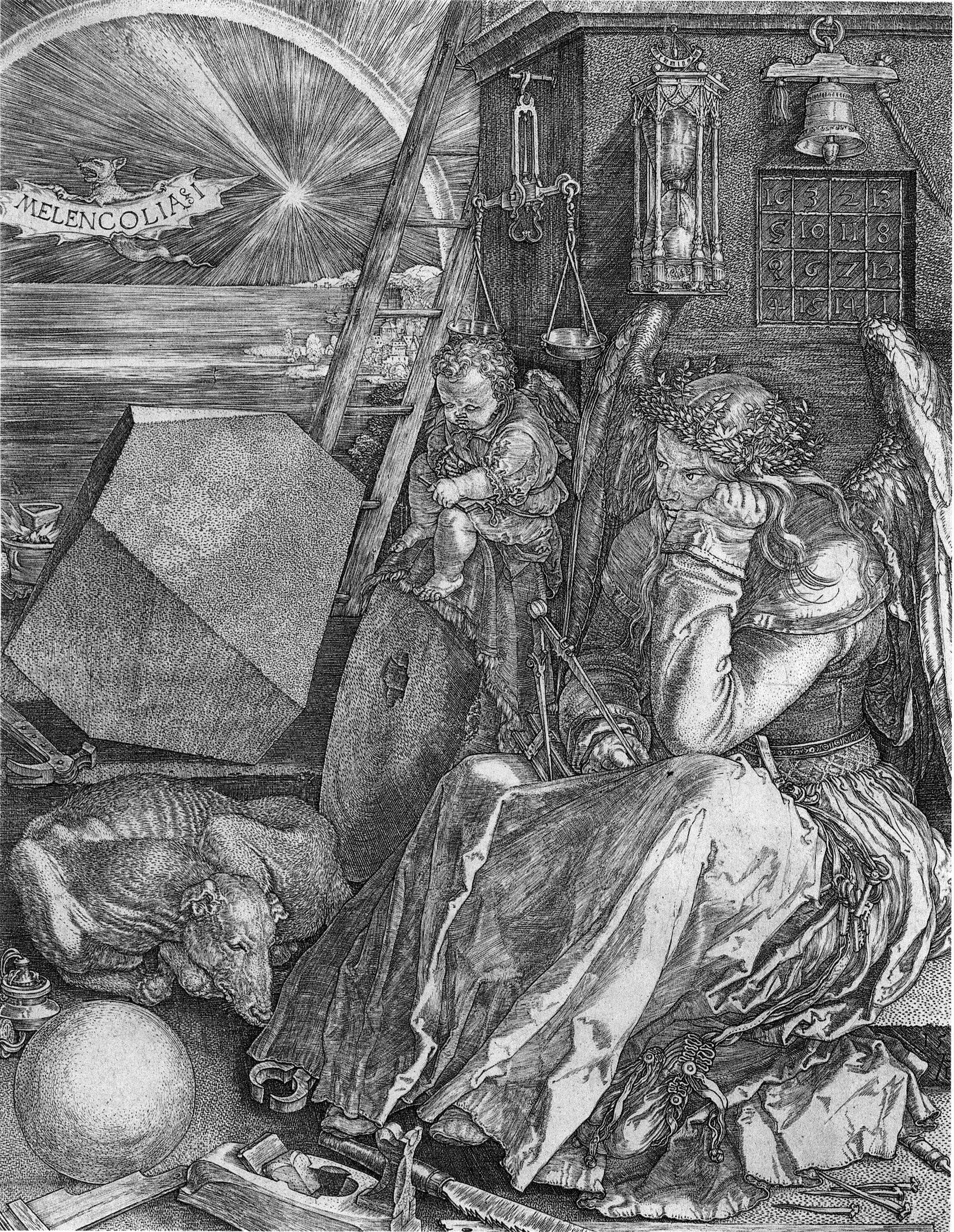
So begins James Thomson’s The City of Dreadful Night, a work with justifiable pretence to the title of the most depressing poem ever written. Throughout its 21 separate sections it fleshes out an urban nightmare – a lifeless city of perpetual darkness illuminated only through the baleful glare of street lamps, along the streets of which lost souls wander aimlessly, each weighed down by their own tragedies. It is a place where the poet’s own alcoholism and depression, interlocked with the poverty and inequality of Victorian London, becomes solidified in bricks and mortar. No resolution or glimpse of a happy ending is offered, and at the close of the poems alternating sections of tragic narrative and Gothic description, Thomson leaves us only with ‘confirmation of the old despair.’ As far as I know, it is the only poem ever to advocate mass suicide:

They leave all hope behind who enter there:
One certitude while sane they cannot leave,
One anodyne for torture and despair;
The certitude of Death, which no reprieve
Can put off long; and which, divinely tender,
But waits the outstretched hand to promptly render
That draught whose slumber nothing can bereave.

Perversely, I love it. I must have read it twenty times over, and no matter how miserable, worthless and forlorn I feel at the time I pick up the book, by the time I put it down I always feel that perhaps my life really isn’t quite that unbearable after all. The world seems a brighter place in comparison with the gloom of the City, and after bearing with the unnameable sins and sorrows of the characters for a thousand lines or so, my heart leaps with catharsis. Not only that, but much of the poem’s violent atheist rhetoric is enjoyable and intensely quotable.

“The vilest thing must be less vile than Thou
From whom it had its being, God and Lord!
Creator of all woe and sin! abhorred,
Malignant and implacable! I vow

“That not for all Thy power furled and unfurled,
For all the temples to Thy glory built,
Would I assume the ignominious guilt
Of having made such men in such a world.”

“As if a being, God or Fiend, could reign,
At once so wicked, foolish and insane,
As to produce men when He might refrain!

A more pungent antidote to the mellifluous platitudes of Victorian religious verse cannot be imagined!

Its extremism offends perhaps as much as it entertains, but it is a helpful extremism, a place which marks the far end of the scale of disillusionment on which we all have to live. Somewhere between the rose-tinted glasses, and Thomson’s ‘bitter, old and wrinkled truth’, we have to strike a balance. The City of Dreadful Night is a warning not to slide too far to one end of the scale, and let your worldview become an unbearable trap. Even Thomson himself was happy for a good deal of his life, and other’s among his collected poems, such as ‘Sunday Up the River’ are joyous celebrations of bourgeois domesticity. Unsurprisingly, they don’t exact the same pull as the great gloomy Gothic edifice of his most famous work.

I have never believed in Thomson’s City to the extent that I have been prepared to throw myself off a bridge, but I have found the scale of disillusionment has tipping his way more than once. Here, for example, is a recording of Part IV of The City of Dreadful Night I made some years ago while suffering from a broken heart and an extremely bad cold:

City of Dreadful Night Part IV

Let’s Go Fly a Glider!

048
Me and my instructor.

My every preconception of gliding was pretty much wrong. I had turned up to the Wolds Gliding Club expecting to be towed into the air strapped to the back end of an aeroplane. Instead, I had a winch launch, which means there’s a machine at the far end of the runaway with about three thousand feet of cable on a drum. This gets hauled out to the other end of the runaway by tractor and attached to your glider. When you’re ready, the winch takes in the cable really, really fast – and within 100 metres you go from being stationary on the ground to ascending at a 45 degree angle. Powered take-off is a bit cissy by comparison.

At the York University Fresher’s Fayre the week before, the gliding society had pulled me in not just by their low, low prices, but by the opportunity to do a loop-the-loop in their simulator. I was so extremely keen to do one in real life I had pictured myself sitting in the cock-pit with folded arms and refusing to land until my instructor did one for me. Unfortunately you need 2000 feet of height for a loop-the-loop, and even the best winch launch I’ve ever done only got me to 1,700. And with no thermal updraughts around during these cold winter months, there was no hope of getting any higher.

049
Instrument check.

Later on, I also had to come to terms with the fact that there’s the way the wind is blowing and the way the nose is pointing, and the way the glider is actually travelling tends to be halfway between the two. That was a whole new adjustment to make. But on the first trip, the rush of the winch launch was pleasure enough, followed by the chance to make a few turns in the glider and admire the spectacular view of Pocklington from the air. It was a clear day, and I could just make out the towers of York Minster glinting in the distance. Then, after a paltry five minutes flight time, we came in to land.

And hardly knowing how or why, I was hooked. Unlike the executives of the gliding society, for whom flight seems to be almost a calling, I can’t picture myself flying a glider outside of University. The costs go up so furiously when one stops being a student that it hardly seems worth it. Unlike, say, climbing mountains or bouldering, gliding is a part of my month I won’t miss desperately when it’s gone. I tell myself I’ll get to the level of skill where I can go solo and fly a glider by myself, and then I’ll quit. In the meantime, though, there is something glorious about living the dream of unpowered flight, which 99% of humanity have never had the chance to realise. Even if gliding is an abberation in my career, it remains no less of a fantastic opportunity.

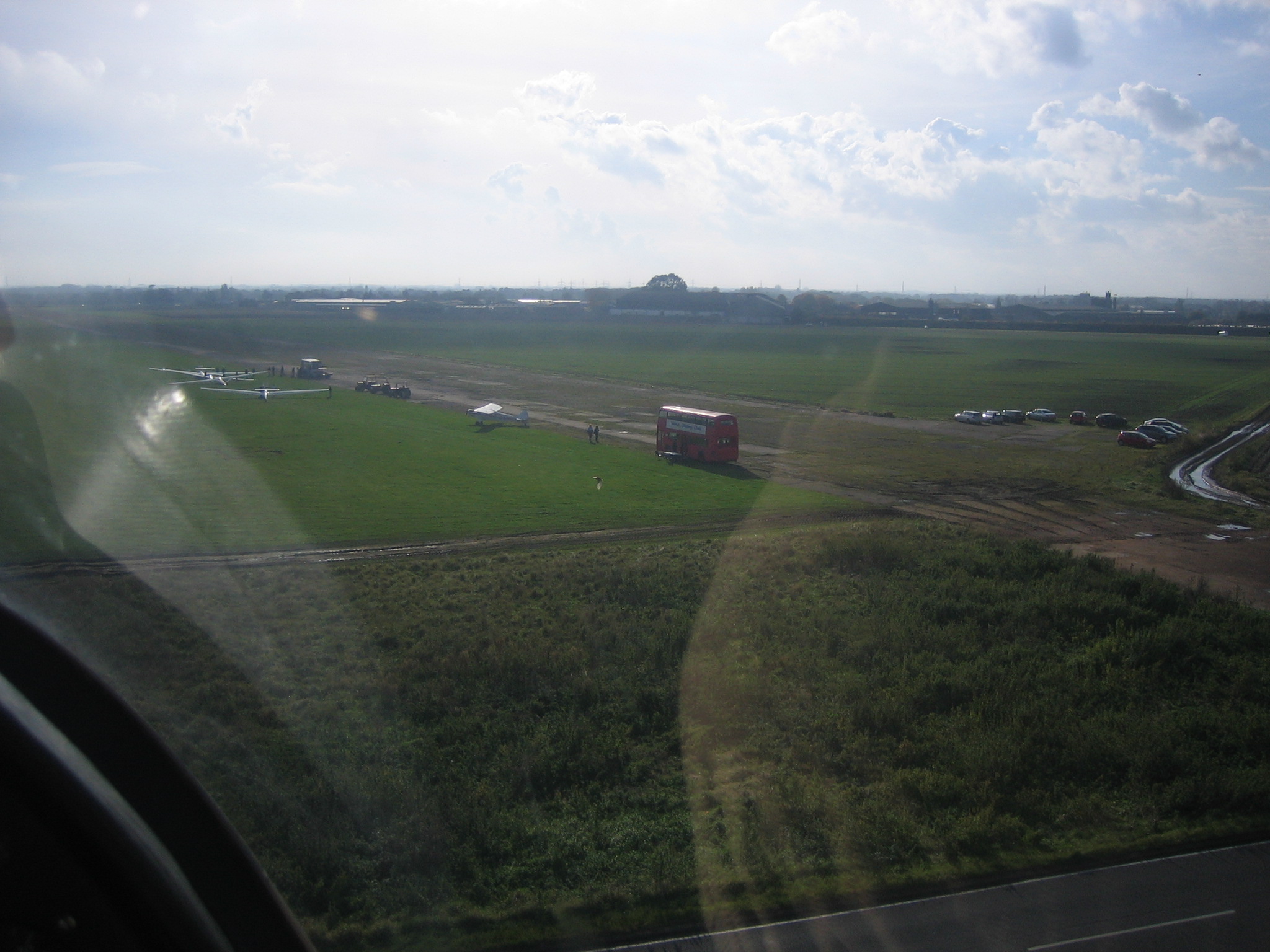
The trouble with flying in winter is that you generally get three five minute flights – sometimes only one flight – and have to wait around all day for them. But there are compensations. Chief among them is the fantastic tea bus, run by a Canadian woman named Donna, who does what would be the greasiest and most evil sausage and bacon sandwich I’ve ever tasted – if I hadn’t lived in Cardiff for the past three years. It was until recently an extremely clapped out red double-decker bus, but they’ve now finished kitting out a modern single decker with tables and cooking equipment, and all moved in there. It’s a great place to sit when the rain’s coming down or the wings have iced up, drinking endless cups of builders tea and talking about aeronautical matters – or in my case, doing my diary.

065
You can just see the old tea bus on the runway, with the gliders lined up beside it.

Another bonus is the fact we get involved in airfield operations, which involves clearing gliders for launch, holding the wing prior to take-off, doing the signalling, keeping the flight log, and – my personal favourite – driving the tractor. It’s a big, stiff, ugly machine, but compared to the Cardiff Student Union van, which I one had the misfortune to take into the suburbs of Cardiff on an errand, it handles like a Mini Cooper. Whenever there’s gliders or cables to be retrieved, I can hop on the tractor and roar away happily.

I’ve done eight full flights now, as noted in my very glamorous Pilot’s Log Book. One typical entry reads: ‘3x WL [winch launch] flew after release practiced turning and trimming the glider. Follow through on launch and landing. Good progress.’ I’m as proud of that ‘Good Progress’ as I ever was of the ‘Very well done’ stickers I used to get on my work in Primary School.

On my most recent flight, I landed the glider for the first time – which was fantastic, because I hadn’t expected to land it at all. I just kept doing the turns as the instructor told me to, expecting to hand back control to him at any moment. And then he was telling me how to do the approach, with me on the joystick while he handled the airbrakes – and then we were skidding down the runaway to a halt. It wasn’t a very orthodox landing. But once again, it was an incredible rush.

Wing-heeled Thomas: Getting my First Tattoo

IMG_4129It was the summer of 2010. I was to turn twenty in August, and I had decided that before I left my teenage years behind I wanted to shock and horrify my parents one last time. A tattoo was something I had always fancied, but the standard fall-backs of stars or Celtic knots had failed to take my fancy. I wanted something that would be witty, different and visually appealing. Fortunately, it was a warm summer, and I was able to turn my eye on a lot of exposed tattoos for inspiration. Somewhere amid the crowd, I caught a glimpse of a woman with wings on her ankles, and I was immediately taken with the idea. I’d seen people with wings tattooed across their shoulders before, but I’d always been conservative enough to think it slightly sacrilegious. Wings on the ankles, though – that was fine! That was classical! It would recall Hermes (or Mercury in the Roman tradition), messenger of the Gods, slayer of hundred eyed Argus, and the guider of souls to the next world. It would reflect my speediness. I could imagine being an oldhermes man shuffling about the house, looking down at the wings on my ankles, and remembering how fast I used to be. It was a perfect fit.

Having found a design that I was happy to live with for the rest of my life, I browsed dozens and dozens of pictures of wings on the internet, until I found one that took my fancy. Then two days before my twentieth birthday I sauntered down to my local tattoo parlour, having carefully neglected to tell my family where I was going beforehand.

The best thing about getting my tattoo was that someone walked in halfway through with an idea that was much, much sillier than mine. It was a massive rampant brown bear, almost the height of an A4 sheet, that he wanted tattooed on his right buttock. I wonder if the guy ever got it, and how long it was before he managed to sit down afterwards.

The worse thing about getting my tattoo was that it was both ankles. The tattoo artist told me beforehand that one leg was going to hurt more than the other. It’s just the way the nerves work. And after having gritted my teeth and tried to concentrate on Shakespeare’s sonnets for twenty minutes, it turned out that the other leg was going to be considerably more painful.

Still, it was soon done. I sauntered out around the town to show them off, and then headed home to gauge the reactions.

I think my sister’s was the best. ‘And you haven’t told the parents yet, Thomas?’ she boggled. ‘They’re going to go spare! They’re going to go absolutely spare!’

Having set such high expectations, approaching my father was rather a disappointment. He raised an eyebrow disapprovingly, and said ‘Well it’s your body, Tom, and you can do what you like with it.’ And dismissed me.

Then my mother came home. She was standing halfway up the stairs, swapping small talk about her day, and suddenly Dad and my sister caught each other’s eyes and started grinning. ‘What? What’s going on?’ Mum asked. I told her. ‘Give me strength!’ she ejaculated forcefully, rolling her eyes and collapsing against the banisters. Yet having seen them, she was almost won over. I was, of course, extremely naughty, but so long as we could hide them when we went to see my Gran, it would be fine.

‘If it was me, they’d have gone spare.’ my sister sniffed. I didn’t argue.

Bouldering at The Red Goat

red goatBouldering, for the uninitiated, is like wall climbing but without any of that paraphernalia of ropes and knots and harnesses that makes wall climbing so complicated. No bouldering wall is much above two stories in height, and the floor below is padded. It’s useful for those on a budget because so much less is needed. Your own pair of climbing shoes, ideally – though you can hire those. A bag of chalk for freshening up those sweaty hands for a crucial grip is also handy – but there are big family sized bags lying about anyway.

I wasn’t much into bouldering before I came to York. The Boulders climbing center in Cardiff had a sizeable bouldering area, but it always seemed like a sideshow compared to the larger climbing walls. With York, that all changed. My third week in, I took a little trip with their climbing society and discovered The Red Goat, tucked away in an industrial area behind the Morrisons.

The Red Goat does bouldering and bouldering only. The walls are a varied mix, some leaning outwards at steep angles, other with massive square overhangs to test your grip, others cluttered with lumpy ‘features’ to test your agility. A range of plastic hand and footholds are bolted sparsely to the wall, colour-coded by degree of difficulty. The yellow ones look like enormous chunky sweets, the black ones are slightly slimmer, and the whites and greens are tiny slivers of nothing that I can’t even get my head around gripping yet. I once got halfway up a white, and can do the blacks with a modicum of reliability. By the end of the session, though, when my forearms feel like bundles of birch rods and my fingers couldn’t grip a pencil, I’m lucky if I can do the most basic yellow. It’s the kind of activity where you cycle down in t-shirt and jumper and overcoat, and cycle home in t-shirt and shorts. You do lose skin off your hands, before they toughen up. After my first session, I was lifting my teacup with my left hand for days.

The camera is not at an angle!

But there’s more to it than the physical side. It’s almost like doing a jigsaw puzzle, working out where to put your left foot, and how to hook your fingers round a hold, and how to shift your balance so the next hold is in reach. There are wonderful moments where nothing seems to exist but the wall, and the next handhold, and the one after that. The focus is total. It gets better with friends, figuring out each stretch of the wall by turns until one of you reaches the top, and the others can follow his example. I’ve never done something that’s so physical and cerebral at the same time.

None of this would mean anything if you were doing the same old routes to death, but the routes seem to be scattered and reassembled as regularly as the magnets on a fridge. And the place is full of other surprises, like a real wood stove, a well-stocked cafe and a wide range of board games. It’s become a weekly treat for me.

I’m only sorry I got into climbing so late. Back in Boulders Cardiff, I used to look at the adults sitting in the cafe with the Sunday papers while their children were scrambling up these sheer walls, and marveling at what a wonderful recipe for a quiet and stress-free afternoon it seemed to be. I’d have liked to have been one of those kids – but on the chalk downs of Hampshire, the facilities weren’t really around.

I also attach a few (rather questionable) verses I wrote many years ago, and entitled ‘Composed half-way up a climbing wall.’

Twenty feet in the air, I’m out of luck
I pause to think and swiftly find I’m stuck
And though I’m still a long way from the top
Beneath me there’s a long, unlovely drop
Down to the ground. Now I begin to tire.
My fingers ache, my palms freely perspire.
Those early holds, that felt so good to grasp
Like friendly hands, locked in the firm dry clasp
Of binding contract, now are smooth and small;
So slick with sweat, so spaced across the wall,
They offer almost nothing I can grip.
My fragile hold gives way. I flounder – slip –
And dangle there. My friend below, belaying
Shouts up advice. I can’t hear what he’s saying
But I can clearly see what must be done
The handholds and the footholds, every one
The route I must take could not be more plain
I find a hold, attempt to climb again;
But no amount of willpower can avail
To bear me up. My arms and fingers fail;
Their muscles sunk to such a sorry state
That they can scarce support my body’s weight.
With cramping fingers, to the wall I cling
And make a badly judged attempt to spring
Upwards, in desperation – though I brush
My hold, I lose it – fumble, fall, and crush
My balls (and hopes) against the harness straps
And here, my fraying patience finally snaps
(Bruised testicles are horrid handicaps
To masculine concentration and morale).
I’ll go find some more climable locale.
Though since, despite the pain, I am most loath
To own I have been beat, I swear an oath
When I have been better equipped and trained
With legs unwearied, and with arms unstrained
I shall return – this shall not be the end!
Then call down to my partner, and descend.

Discovering Seafood with Keith the Fish

HobbitI came back to York University early in order to spend New Year with some friends, and I’m alone in the house tonight. Well, alone except for the wonderful smell of grilled herring that’s wafting up the stairs. I ate it with steamed green beans and boiled potatoes, and felt like Bilbo Baggins before the rascally dwarves burst in to steal his supper. Best of all, the herring cost me precisely 67 pence, and it wasn’t even going off! What a preposterously undervalued fish it is.

You would not catch the smell of fish wafting up the stairs in my home in Winchester. My father doesn’t like it, and while my mother has always had a thing for sardines, she refuses to let me eat my beloved breakfast kipper underneath her roof for fear of the smell. Given my oily-fish deprivation, it’s amazing I’ve turned out as smart as I have.

It all started with kippers, really. I ate my first kipper in a guest house near Campbeltown in Scotland, on the morning of the 27th of August, 2007 (O, historic date!) It was fresh, local, and delicious, and once I’d figured out the challenge of separating the fish from the bones, I was hooked. By the time I came to Cardiff University in October 2009, the two things I wanted to cook and expected to live off were kippers for breakfast and yorkshire pudding for tea.

I never really managed to do yorkshire pud successfully (I kept forgetting to add hot oil to the pan first) and I now shudder to think of those breakfast kippers. They were cheap fillets from Tesco, three-to-a-vacuum-pack, which I’d microwave and eat. I liked them well enough at the time, but the rest of the flat weren’t terribly happy with stumbling hung-over into the kitchen of a morning to be confronted with the rich, kippery scent of my breakfast. After I found ‘AARGH KIPPERS’ spelled out in fridge magnets a few too many times, I quietly dropped the habit. And for six months, I returned to the fishless days of my youth.

And then, as my second year in Cardiff began, I discovered Keith the Fish.

Keith the Fish takes some discovering. Tucked away behind Marks and Spencer‘s off of Queen Street, he’s definitely off the beaten track. To make matters worse, his operating hours are 9-12 Tuesday through Saturday, so he’s quite hard to catch. I forget what dire exigency could have gotten me out of bed before noon, but I happened to pass by and ask if he did kippers. Turns out he did Manx kippers a pound a time, so I bought one and ate it jugged the next morning. To jug a fish, you pour boiling water over it and leave it for six minutes, then pull it out, slap it on a plate and eat it. It’s not pretty, but it’s fast, it’s delicious, and provided you don’t leave the bones lying around, surprisingly fragrant.

My visits to Keith the Fish became weekly, and I got to know Keith himself, a grand old survivor of the fishmonger’s trade who recently celebrated

Keith with a whopper of a catch!

his seventieth birthday. Our conversations always began the same way. ‘The fish trade in this country is going to the dogs!’ he’d growl, before going on to lambast supermarket fishmongers for their smelly fish, or the Arab Spring for driving up the price of his petrol. His main complaint was the lack of fish getting into children’s diet. He loved kids. He had a wonderful trick to pull if any kid came by. There was always some mighty salmon sprawled out across the shopfront, his tail tucked away beneath the display. Keith would pretend to be fussing with something up another end of the stall, lay his hand on the fish’s tail and give it a few twitches. When the screams began he knew he’d done his job!

I slowly got up the confidence to attempt something requiring more complex cookery skills than the application of boiling waterI can’t say I ever really cooked white fish to my satisfaction, but my grilled rainbow trout was so fresh I could taste the water it was caught in, and moule mariniere remains the best thing I have ever cooked for myself.

Now, alas, I have moved into York and all is changed. I have yet to really get a taste for Whitby kippers, and fresh cockles are impossible to find. I was forced to purchase my grilled herring from Keith’s despised supermarket. If I really wish to remain true to his standards, I reckon I’m going to have to take up rod and waders and go angling.