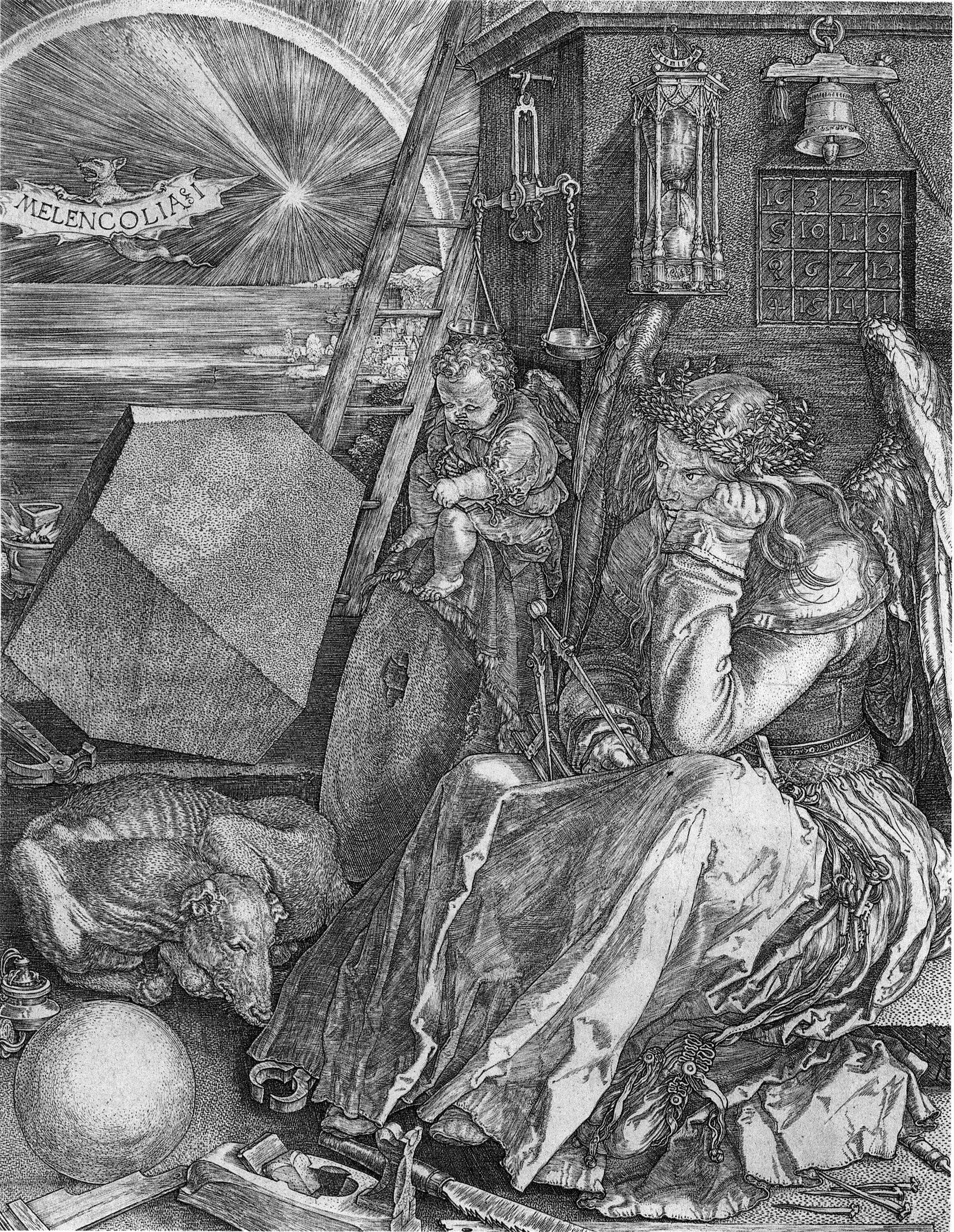
The City of Dreadful Night

durer_melancholia_i

Lo, thus, as prostrate, “In the dust I write
My heart’s deep languor and my soul’s sad tears.”
Yet why evoke the spectres of black night
To blot the sunshine of exultant years?
Why disinter dead faith from mouldering hidden?
Why break the seals of mute despair unbidden,
And wail life’s discords into careless ears?

So begins James Thomson’s The City of Dreadful Night, a work with justifiable pretence to the title of the most depressing poem ever written. Throughout its 21 separate sections it fleshes out an urban nightmare – a lifeless city of perpetual darkness illuminated only through the baleful glare of street lamps, along the streets of which lost souls wander aimlessly, each weighed down by their own tragedies. It is a place where the poet’s own alcoholism and depression, interlocked with the poverty and inequality of Victorian London, becomes solidified in bricks and mortar. No resolution or glimpse of a happy ending is offered, and at the close of the poems alternating sections of tragic narrative and Gothic description, Thomson leaves us only with ‘confirmation of the old despair.’ As far as I know, it is the only poem ever to advocate mass suicide:

They leave all hope behind who enter there:
One certitude while sane they cannot leave,
One anodyne for torture and despair;
The certitude of Death, which no reprieve
Can put off long; and which, divinely tender,
But waits the outstretched hand to promptly render
That draught whose slumber nothing can bereave.

Perversely, I love it. I must have read it twenty times over, and no matter how miserable, worthless and forlorn I feel at the time I pick up the book, by the time I put it down I always feel that perhaps my life really isn’t quite that unbearable after all. The world seems a brighter place in comparison with the gloom of the City, and after bearing with the unnameable sins and sorrows of the characters for a thousand lines or so, my heart leaps with catharsis. Not only that, but much of the poem’s violent atheist rhetoric is enjoyable and intensely quotable.

“The vilest thing must be less vile than Thou
From whom it had its being, God and Lord!
Creator of all woe and sin! abhorred,
Malignant and implacable! I vow

“That not for all Thy power furled and unfurled,
For all the temples to Thy glory built,
Would I assume the ignominious guilt
Of having made such men in such a world.”

“As if a being, God or Fiend, could reign,
At once so wicked, foolish and insane,
As to produce men when He might refrain!

A more pungent antidote to the mellifluous platitudes of Victorian religious verse cannot be imagined!

Its extremism offends perhaps as much as it entertains, but it is a helpful extremism, a place which marks the far end of the scale of disillusionment on which we all have to live. Somewhere between the rose-tinted glasses, and Thomson’s ‘bitter, old and wrinkled truth’, we have to strike a balance. The City of Dreadful Night is a warning not to slide too far to one end of the scale, and let your worldview become an unbearable trap. Even Thomson himself was happy for a good deal of his life, and other’s among his collected poems, such as ‘Sunday Up the River’ are joyous celebrations of bourgeois domesticity. Unsurprisingly, they don’t exact the same pull as the great gloomy Gothic edifice of his most famous work.

I have never believed in Thomson’s City to the extent that I have been prepared to throw myself off a bridge, but I have found the scale of disillusionment has tipping his way more than once. Here, for example, is a recording of Part IV of The City of Dreadful Night I made some years ago while suffering from a broken heart and an extremely bad cold:

City of Dreadful Night Part IV

Let’s Go Fly a Glider!

048
Me and my instructor.

My every preconception of gliding was pretty much wrong. I had turned up to the Wolds Gliding Club expecting to be towed into the air strapped to the back end of an aeroplane. Instead, I had a winch launch, which means there’s a machine at the far end of the runaway with about three thousand feet of cable on a drum. This gets hauled out to the other end of the runaway by tractor and attached to your glider. When you’re ready, the winch takes in the cable really, really fast – and within 100 metres you go from being stationary on the ground to ascending at a 45 degree angle. Powered take-off is a bit cissy by comparison.

At the York University Fresher’s Fayre the week before, the gliding society had pulled me in not just by their low, low prices, but by the opportunity to do a loop-the-loop in their simulator. I was so extremely keen to do one in real life I had pictured myself sitting in the cock-pit with folded arms and refusing to land until my instructor did one for me. Unfortunately you need 2000 feet of height for a loop-the-loop, and even the best winch launch I’ve ever done only got me to 1,700. And with no thermal updraughts around during these cold winter months, there was no hope of getting any higher.

049
Instrument check.

Later on, I also had to come to terms with the fact that there’s the way the wind is blowing and the way the nose is pointing, and the way the glider is actually travelling tends to be halfway between the two. That was a whole new adjustment to make. But on the first trip, the rush of the winch launch was pleasure enough, followed by the chance to make a few turns in the glider and admire the spectacular view of Pocklington from the air. It was a clear day, and I could just make out the towers of York Minster glinting in the distance. Then, after a paltry five minutes flight time, we came in to land.

And hardly knowing how or why, I was hooked. Unlike the executives of the gliding society, for whom flight seems to be almost a calling, I can’t picture myself flying a glider outside of University. The costs go up so furiously when one stops being a student that it hardly seems worth it. Unlike, say, climbing mountains or bouldering, gliding is a part of my month I won’t miss desperately when it’s gone. I tell myself I’ll get to the level of skill where I can go solo and fly a glider by myself, and then I’ll quit. In the meantime, though, there is something glorious about living the dream of unpowered flight, which 99% of humanity have never had the chance to realise. Even if gliding is an abberation in my career, it remains no less of a fantastic opportunity.

The trouble with flying in winter is that you generally get three five minute flights – sometimes only one flight – and have to wait around all day for them. But there are compensations. Chief among them is the fantastic tea bus, run by a Canadian woman named Donna, who does what would be the greasiest and most evil sausage and bacon sandwich I’ve ever tasted – if I hadn’t lived in Cardiff for the past three years. It was until recently an extremely clapped out red double-decker bus, but they’ve now finished kitting out a modern single decker with tables and cooking equipment, and all moved in there. It’s a great place to sit when the rain’s coming down or the wings have iced up, drinking endless cups of builders tea and talking about aeronautical matters – or in my case, doing my diary.

065
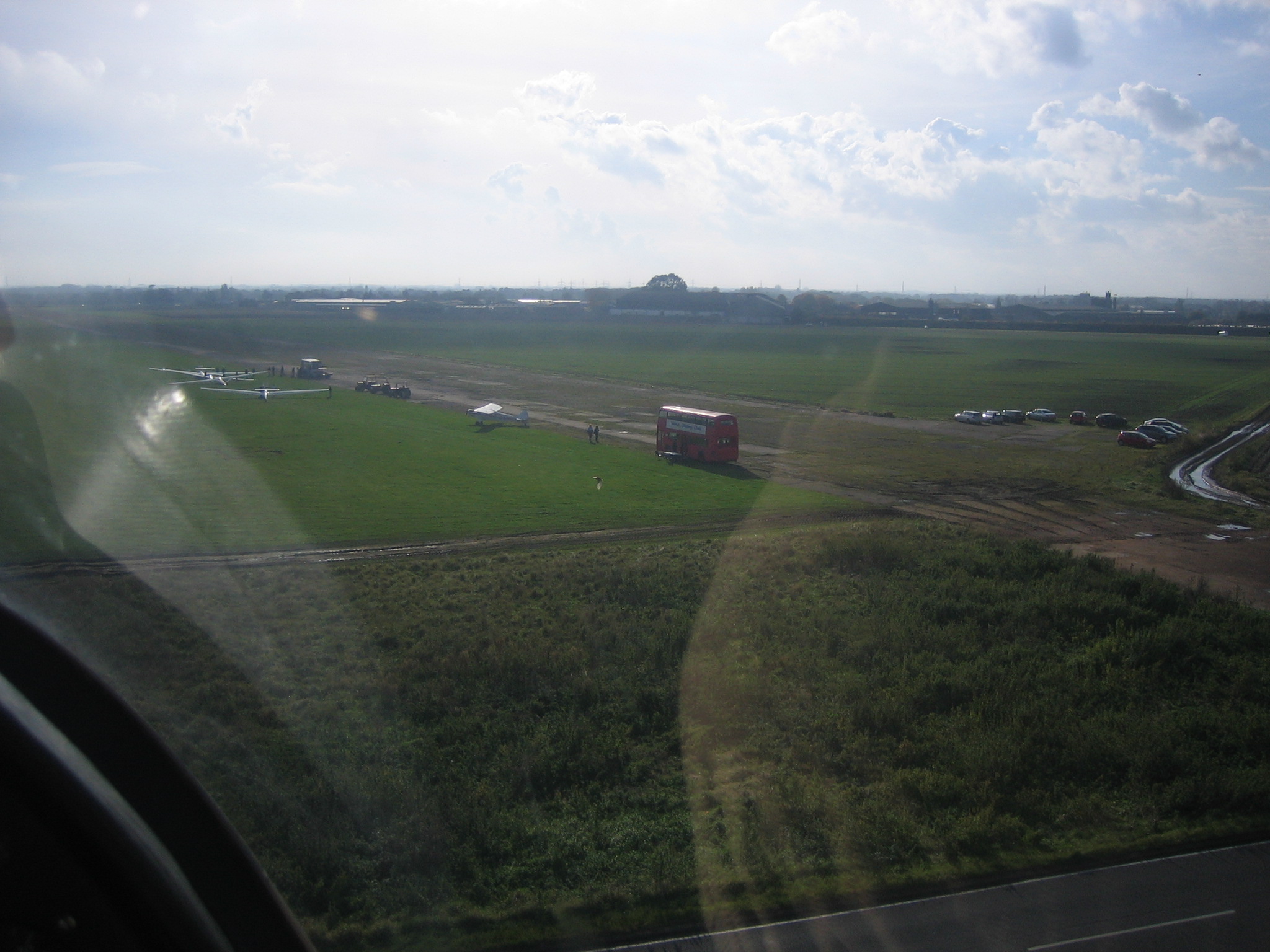
You can just see the old tea bus on the runway, with the gliders lined up beside it.

Another bonus is the fact we get involved in airfield operations, which involves clearing gliders for launch, holding the wing prior to take-off, doing the signalling, keeping the flight log, and – my personal favourite – driving the tractor. It’s a big, stiff, ugly machine, but compared to the Cardiff Student Union van, which I one had the misfortune to take into the suburbs of Cardiff on an errand, it handles like a Mini Cooper. Whenever there’s gliders or cables to be retrieved, I can hop on the tractor and roar away happily.

I’ve done eight full flights now, as noted in my very glamorous Pilot’s Log Book. One typical entry reads: ‘3x WL [winch launch] flew after release practiced turning and trimming the glider. Follow through on launch and landing. Good progress.’ I’m as proud of that ‘Good Progress’ as I ever was of the ‘Very well done’ stickers I used to get on my work in Primary School.

On my most recent flight, I landed the glider for the first time – which was fantastic, because I hadn’t expected to land it at all. I just kept doing the turns as the instructor told me to, expecting to hand back control to him at any moment. And then he was telling me how to do the approach, with me on the joystick while he handled the airbrakes – and then we were skidding down the runaway to a halt. It wasn’t a very orthodox landing. But once again, it was an incredible rush.

Wing-heeled Thomas: Getting my First Tattoo

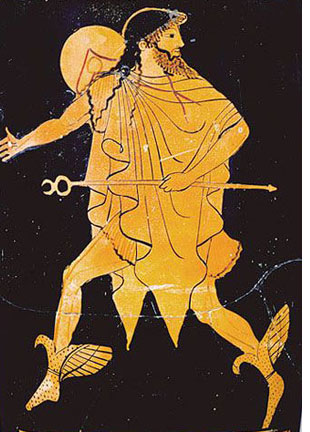
IMG_4129It was the summer of 2010. I was to turn twenty in August, and I had decided that before I left my teenage years behind I wanted to shock and horrify my parents one last time. A tattoo was something I had always fancied, but the standard fall-backs of stars or Celtic knots had failed to take my fancy. I wanted something that would be witty, different and visually appealing. Fortunately, it was a warm summer, and I was able to turn my eye on a lot of exposed tattoos for inspiration. Somewhere amid the crowd, I caught a glimpse of a woman with wings on her ankles, and I was immediately taken with the idea. I’d seen people with wings tattooed across their shoulders before, but I’d always been conservative enough to think it slightly sacrilegious. Wings on the ankles, though – that was fine! That was classical! It would recall Hermes (or Mercury in the Roman tradition), messenger of the Gods, slayer of hundred eyed Argus, and the guider of souls to the next world. It would reflect my speediness. I could imagine being an oldhermes man shuffling about the house, looking down at the wings on my ankles, and remembering how fast I used to be. It was a perfect fit.

Having found a design that I was happy to live with for the rest of my life, I browsed dozens and dozens of pictures of wings on the internet, until I found one that took my fancy. Then two days before my twentieth birthday I sauntered down to my local tattoo parlour, having carefully neglected to tell my family where I was going beforehand.

The best thing about getting my tattoo was that someone walked in halfway through with an idea that was much, much sillier than mine. It was a massive rampant brown bear, almost the height of an A4 sheet, that he wanted tattooed on his right buttock. I wonder if the guy ever got it, and how long it was before he managed to sit down afterwards.

The worse thing about getting my tattoo was that it was both ankles. The tattoo artist told me beforehand that one leg was going to hurt more than the other. It’s just the way the nerves work. And after having gritted my teeth and tried to concentrate on Shakespeare’s sonnets for twenty minutes, it turned out that the other leg was going to be considerably more painful.

Still, it was soon done. I sauntered out around the town to show them off, and then headed home to gauge the reactions.

I think my sister’s was the best. ‘And you haven’t told the parents yet, Thomas?’ she boggled. ‘They’re going to go spare! They’re going to go absolutely spare!’

Having set such high expectations, approaching my father was rather a disappointment. He raised an eyebrow disapprovingly, and said ‘Well it’s your body, Tom, and you can do what you like with it.’ And dismissed me.

Then my mother came home. She was standing halfway up the stairs, swapping small talk about her day, and suddenly Dad and my sister caught each other’s eyes and started grinning. ‘What? What’s going on?’ Mum asked. I told her. ‘Give me strength!’ she ejaculated forcefully, rolling her eyes and collapsing against the banisters. Yet having seen them, she was almost won over. I was, of course, extremely naughty, but so long as we could hide them when we went to see my Gran, it would be fine.

‘If it was me, they’d have gone spare.’ my sister sniffed. I didn’t argue.

Bouldering at The Red Goat

red goatBouldering, for the uninitiated, is like wall climbing but without any of that paraphernalia of ropes and knots and harnesses that makes wall climbing so complicated. No bouldering wall is much above two stories in height, and the floor below is padded. It’s useful for those on a budget because so much less is needed. Your own pair of climbing shoes, ideally – though you can hire those. A bag of chalk for freshening up those sweaty hands for a crucial grip is also handy – but there are big family sized bags lying about anyway.

I wasn’t much into bouldering before I came to York. The Boulders climbing center in Cardiff had a sizeable bouldering area, but it always seemed like a sideshow compared to the larger climbing walls. With York, that all changed. My third week in, I took a little trip with their climbing society and discovered The Red Goat, tucked away in an industrial area behind the Morrisons.

The Red Goat does bouldering and bouldering only. The walls are a varied mix, some leaning outwards at steep angles, other with massive square overhangs to test your grip, others cluttered with lumpy ‘features’ to test your agility. A range of plastic hand and footholds are bolted sparsely to the wall, colour-coded by degree of difficulty. The yellow ones look like enormous chunky sweets, the black ones are slightly slimmer, and the whites and greens are tiny slivers of nothing that I can’t even get my head around gripping yet. I once got halfway up a white, and can do the blacks with a modicum of reliability. By the end of the session, though, when my forearms feel like bundles of birch rods and my fingers couldn’t grip a pencil, I’m lucky if I can do the most basic yellow. It’s the kind of activity where you cycle down in t-shirt and jumper and overcoat, and cycle home in t-shirt and shorts. You do lose skin off your hands, before they toughen up. After my first session, I was lifting my teacup with my left hand for days.

The camera is not at an angle!

But there’s more to it than the physical side. It’s almost like doing a jigsaw puzzle, working out where to put your left foot, and how to hook your fingers round a hold, and how to shift your balance so the next hold is in reach. There are wonderful moments where nothing seems to exist but the wall, and the next handhold, and the one after that. The focus is total. It gets better with friends, figuring out each stretch of the wall by turns until one of you reaches the top, and the others can follow his example. I’ve never done something that’s so physical and cerebral at the same time.

None of this would mean anything if you were doing the same old routes to death, but the routes seem to be scattered and reassembled as regularly as the magnets on a fridge. And the place is full of other surprises, like a real wood stove, a well-stocked cafe and a wide range of board games. It’s become a weekly treat for me.

I’m only sorry I got into climbing so late. Back in Boulders Cardiff, I used to look at the adults sitting in the cafe with the Sunday papers while their children were scrambling up these sheer walls, and marveling at what a wonderful recipe for a quiet and stress-free afternoon it seemed to be. I’d have liked to have been one of those kids – but on the chalk downs of Hampshire, the facilities weren’t really around.

I also attach a few (rather questionable) verses I wrote many years ago, and entitled ‘Composed half-way up a climbing wall.’

Twenty feet in the air, I’m out of luck
I pause to think and swiftly find I’m stuck
And though I’m still a long way from the top
Beneath me there’s a long, unlovely drop
Down to the ground. Now I begin to tire.
My fingers ache, my palms freely perspire.
Those early holds, that felt so good to grasp
Like friendly hands, locked in the firm dry clasp
Of binding contract, now are smooth and small;
So slick with sweat, so spaced across the wall,
They offer almost nothing I can grip.
My fragile hold gives way. I flounder – slip –
And dangle there. My friend below, belaying
Shouts up advice. I can’t hear what he’s saying
But I can clearly see what must be done
The handholds and the footholds, every one
The route I must take could not be more plain
I find a hold, attempt to climb again;
But no amount of willpower can avail
To bear me up. My arms and fingers fail;
Their muscles sunk to such a sorry state
That they can scarce support my body’s weight.
With cramping fingers, to the wall I cling
And make a badly judged attempt to spring
Upwards, in desperation – though I brush
My hold, I lose it – fumble, fall, and crush
My balls (and hopes) against the harness straps
And here, my fraying patience finally snaps
(Bruised testicles are horrid handicaps
To masculine concentration and morale).
I’ll go find some more climable locale.
Though since, despite the pain, I am most loath
To own I have been beat, I swear an oath
When I have been better equipped and trained
With legs unwearied, and with arms unstrained
I shall return – this shall not be the end!
Then call down to my partner, and descend.

Discovering Seafood with Keith the Fish

HobbitI came back to York University early in order to spend New Year with some friends, and I’m alone in the house tonight. Well, alone except for the wonderful smell of grilled herring that’s wafting up the stairs. I ate it with steamed green beans and boiled potatoes, and felt like Bilbo Baggins before the rascally dwarves burst in to steal his supper. Best of all, the herring cost me precisely 67 pence, and it wasn’t even going off! What a preposterously undervalued fish it is.

You would not catch the smell of fish wafting up the stairs in my home in Winchester. My father doesn’t like it, and while my mother has always had a thing for sardines, she refuses to let me eat my beloved breakfast kipper underneath her roof for fear of the smell. Given my oily-fish deprivation, it’s amazing I’ve turned out as smart as I have.

It all started with kippers, really. I ate my first kipper in a guest house near Campbeltown in Scotland, on the morning of the 27th of August, 2007 (O, historic date!) It was fresh, local, and delicious, and once I’d figured out the challenge of separating the fish from the bones, I was hooked. By the time I came to Cardiff University in October 2009, the two things I wanted to cook and expected to live off were kippers for breakfast and yorkshire pudding for tea.

I never really managed to do yorkshire pud successfully (I kept forgetting to add hot oil to the pan first) and I now shudder to think of those breakfast kippers. They were cheap fillets from Tesco, three-to-a-vacuum-pack, which I’d microwave and eat. I liked them well enough at the time, but the rest of the flat weren’t terribly happy with stumbling hung-over into the kitchen of a morning to be confronted with the rich, kippery scent of my breakfast. After I found ‘AARGH KIPPERS’ spelled out in fridge magnets a few too many times, I quietly dropped the habit. And for six months, I returned to the fishless days of my youth.

And then, as my second year in Cardiff began, I discovered Keith the Fish.

Keith the Fish takes some discovering. Tucked away behind Marks and Spencer‘s off of Queen Street, he’s definitely off the beaten track. To make matters worse, his operating hours are 9-12 Tuesday through Saturday, so he’s quite hard to catch. I forget what dire exigency could have gotten me out of bed before noon, but I happened to pass by and ask if he did kippers. Turns out he did Manx kippers a pound a time, so I bought one and ate it jugged the next morning. To jug a fish, you pour boiling water over it and leave it for six minutes, then pull it out, slap it on a plate and eat it. It’s not pretty, but it’s fast, it’s delicious, and provided you don’t leave the bones lying around, surprisingly fragrant.

My visits to Keith the Fish became weekly, and I got to know Keith himself, a grand old survivor of the fishmonger’s trade who recently celebrated

Keith with a whopper of a catch!

his seventieth birthday. Our conversations always began the same way. ‘The fish trade in this country is going to the dogs!’ he’d growl, before going on to lambast supermarket fishmongers for their smelly fish, or the Arab Spring for driving up the price of his petrol. His main complaint was the lack of fish getting into children’s diet. He loved kids. He had a wonderful trick to pull if any kid came by. There was always some mighty salmon sprawled out across the shopfront, his tail tucked away beneath the display. Keith would pretend to be fussing with something up another end of the stall, lay his hand on the fish’s tail and give it a few twitches. When the screams began he knew he’d done his job!

I slowly got up the confidence to attempt something requiring more complex cookery skills than the application of boiling waterI can’t say I ever really cooked white fish to my satisfaction, but my grilled rainbow trout was so fresh I could taste the water it was caught in, and moule mariniere remains the best thing I have ever cooked for myself.

Now, alas, I have moved into York and all is changed. I have yet to really get a taste for Whitby kippers, and fresh cockles are impossible to find. I was forced to purchase my grilled herring from Keith’s despised supermarket. If I really wish to remain true to his standards, I reckon I’m going to have to take up rod and waders and go angling.

My First Time Drinking Mead

In hindsight, my mistake was in thinking I was a Viking.

It was a houseparty for one of my friends in Cardiff, the delightful Cathy. She will laugh at anything, and is never found out of her hoodie, and she may drink her ale in lady-like halves, but she can still match me drink for drink with ease. I was sprawled out on the sofa introducing myself to some Spanish exchange students when my friend Jamie came in, carrying a five-litre plastic container, something like the size of a desk drawer on its end. A rich and mysterious looking brown liquid was sloshing about within.

‘What is it?’ I asked, wondering if one of his regular home-brew disasters had finally come to fruition.

He slapped the container. ‘This, my friend, is mead.’

‘Mead?’

‘Medieval mead. Specially brewed for authenticity. Have a glass if you fancy.’ And he went off to talk with Cathy.

I have never been behindhand in trying new drinks. My glass of warmish ale swiftly vanished, and I got to my two tipsy feet to sample the mead. The only thing I knew about it was that the Vikings drank it in horns, and that a horn held about two pints. So I poured myself a pint of mead, and sat down again.

It was delicious. I have never been much for sweet drinks since I sampled my first Guinness, but the mead was flowery, dark and sweet and tasting of all the scents of summer brewed together. It vanished with surpassing swiftness.

‘The mead’s lovely, isn’t it?’ I shouted to Jamie, when he glanced my way.

‘It’s great. You’ve got rather a large glass there, haven’t you?’

I looked at my quarter-pint incredulously. ‘Don’t be stupid. Vikings used to drink it in horns. I haven’t even drunk half a horn yet!’ I stood up on feet that suddenly seemed even tipsier than before, and carefully poured myself another pint of mead.

Everything gets a bit hazy from thereon in. I think someone tried to explain to me that mead was 14.5% abv, and that I’d been drinking wine like beer. Someone else told me it was probably time to go home. I just remember lying back on that sofa, grinning toothily at the ceiling, the most chemically happy I had ever been in my life. If Vikings felt like this every time they got drunk, how did they ever manage to get up the testosterone for all that raiding and burning and pillaging? This was bliss!

And then my friend Chris was walking me home, whilst I was laughing at everything and qupting the Rubiayat of Omar Khayyam at the top of my voice. That was my first night drinking mead, but it wouldn’t be the last by a good way.

Chawton House Library

Chawton House panorama

It is always nice to turn up at a country house as something other than a paying visitor. The best part of collecting my Gold Duke of Edinburgh’s Award, for example, was turning up at St James’ Palace with an invitation. Compared to that, the two minutes of bob and nod with the Earl of Wessex was something of a disappointment – we didn’t even get Prince Philip. Yesterday, I was not a daytripper but a visiting scholar, and at nine o’clock I was making the 45 minute drive in the pouring rain to Chawton, just outside of Alton – home not only to Jane Austen’s House, but to Chawton House Library, one of my new favourite places to study.

Owned by Jane’s brother Edward Austen in the Georgian era, Chawton House was bought by a charitable foundation in the eighties and, as well as being a fine country house in its own right, now functions as a Centre for Woman’s Literature 1600-1850. This means that, with a few days forward notice, even sciolists like myself can turn up and have access to the main library collections. As the public is only allowed in for brief tours at 2:30pm on Tuesdays and Thursdays, I effectively have a fine old country house to myself. The prospect never fails to raise my spirits.

Yesterday, for example, I came in from the rain to find a lovely smell of woodsmoke seeping back into the ancient boards, from the Edwardian Christmas event held a few days beforehand. The (insanely lucky) visiting fellows who dwell in cottages around the back of the house had all wound their projects down and gone home, and aside from me, the librarian and the receptionist, there was hardly anyone around. In the faint December light, it seemed the ideal place for Gothic fantasies, but I had an essay to write and was too busy to dream for long.

The library is on the first floor, blessed with good light and fine, weighty desks to study from, though to someone used to padded deskchairs the wooden frames take some getting used to. The only sound is the whirr as the air conditioner keeps the room cooled to British Library specifications. At my elbow five massive leatherbound quarto volumes of Catharine Macaulay’s History of England sat, second editions from 1766 that I would never get a chance to handle in a university library. I browsed through them, enjoying Macaulay’s republican rhetoric and the wonderful texture of the old book, with its long s’s and strange spellings, and Capitalisation of abstract Nouns. But this was no time to idle, for I had an essay to write, and was swiftly constructing my plan and pulling in quotations from a dozen different sources, scattered through the library – pausing only to divert myself briefly with some of the Juvenelia of Jane Austen.

The library closes for an hour at lunchtime, and I took the opportunity to wander through the old house, whose floorboards roll and buck beneath you like rough ground, looking up at the pictures of famous women they’d assembled, and blundering into rooms I’d never seen before. I finished curled up in a bay window behind a curtain, reading a publishers catalogue and trying to pretend I was Jane Eyre. Then, back to the library again, until by 4pm I had a one page plan and three pages of usable quotations, and saw myself out with some sadness. I would have liked to remain, and read through Austen’s juvenelia until my stomach began to rumble uncontrollably. I would like to have stayed the night in one of the bedrooms, or the cottages of the visiting fellows. But alas! I had to return to my parents modern house, with its televisions and kitchens and conveniences, and leave grand old Chawton House behind.

Dreaming in Verse

English: Draft of Samuel Taylor Coleridge's po...
English: Draft of Samuel Taylor Coleridge’s poem Kubla Khan (Photo credit: Wikipedia)

When I was hired to take in the harvest in the autumn, I used to dream every night that I was back in the orchard rows, picking apples. When I was working as a shop assistant, I used to dream I was serving customers all night. This was, as you can imagine, absolutely exhausting.

Now that work involves reading books, or in the worst case critics (O happy state of University life!) my dreams have taken a different turn. Sometimes, after falling asleep in the middle of Keats’ Endymionor Wordsworth’s Prelude I end up dreaming in poetry, which is infinitely more interesting.

This is no new thing. Tennyson apparently composed a fifty line poem about fairies in his sleep, and forgot it all the moment he woke up in the morning. Coleridge worked out a three hundred line poem on Kubla Khan, of which he famously only wrote fifty before he was rudely interrupted by an anonymous person from Porlock and forgot the rest (though as his was an opium induced slumber, it shouldn’t, strictly speaking, count). My favourite is A.E. Housman, who woke in the small hours with these words on his lips:


When the bells justle in the tower
The hollow night amid,
Then on my tongue the taste is sour
Of all I ever did.

Which makes it look as easy as pie. It isn’t. Most of the time, the poetry gets forgotten the moment, or I gradually come to consciousness clutching to myself a golden and gleaming fragment of verse, which melts away to the profoundest nonsense in the morning’s rational light. One example which I did note down:

The Comte is the Comte
A most unhappy man
And these three creatures, strange and rare
Would cuckold him of his despair
And from her breed some bastard heir:
That seems to be their plan.

God (or Freud) alone knows what that means, except that possibly I’d been reading too much Byron. Yet I liked the idea of cuckolding someone of their despair so much I actually bothered to roll out of bed and fetch my notebook. There was one time where I did get a usable lyric out of a dream:

Are you cold? she asked me. I said I was
Though I was not really, for even then
I slept naked, beneath a thin duvet
And counted myself in the warm. But when

The voice seductive from the darkness calls
To ask you if you are not feeling cold
She wants the truth no more than you to tell it.
Go meet and warm her ere the night grows old.

I think the first verse is pretty much as dreamt, the second one mostly invented later. There was a lot of bizarre stuff about the sacrament of the snake which I had to cut out, and it took rather a long time to edit into a form where I was happy with it. I think it was either Pope or Swift who once made the lofty boast of never having excused a poem for the sake of a few lines, or a few lines for the sake of a poem. My notebooks are full of lingering, melodic lines without any context whatsoever, and it’s an unspeakable relief to finally hedge a poem around them. Dreaming up a few new fragments to puzzle over is no help at all.

While I was pouring over my files of snatches and doggerel for this, I also found this fragment, which I dug out of my 2007 diary, having completely forgotten about it since I was seventeen years old:

The lights go down, the music fades,
There’s silence in the aisles.
The first few frames begin to roll
Above the cinephiles.

It’s not a very remarkable poem. What spooks me slightly is that I wrote this almost two years before I developed any interest in writing poetry, and certainly long before I had any idea of iambics, and the metrical patterns of the ballad stanza – and yet this is a perfectly acceptable ballad verse. Odd, the things your brain can do while you aren’t really using it.

Last night, by contrast, I dreamt I was sharing my bed with an adder and a small baby leopard, which is much more typical. Of my dreams, that is.

The Thirty-Three Happy Moments

Of all the books on my shelves, one of the ones I’m fondest of is also one of the shabbiest. It’s a small, gunmetal grey volume about the size of an old tobacco tin, heavily creased up and down the spine. It’s called ‘The Knapsack’.

Even if it were not a proverbial sin to judge a book by its cover, the utilitarian appearance of my volume is easily excused by the fact it was designed as an anthology of prose and verse for the use of servicemen in World War Two. My secondhand copy advertises itself in the inside cover as belonging to an E. Riley of Hull; there’s no indication whether E. Riley ever served in the war, or carried it into action, but I like to think he did, and while away my time imagining the battles and foreign fields this shabby volume was borne through.

The anthology, as edited by Herbert Read, has an understandably martial and Christian theme to it in many of its sections, but it is very rarely less than entertaining. As the original vehicle for introducing me to the wild and Celtic wanderings of the Irish Saint Brandon, to the ancient ballad of Chevy Chase and the beautiful lyrics of Shelley, it has a place in my heart – but what really won me over are the half-dozen pages in the back reserved for ‘Notes and Additions’.

One of my favourite items is ‘The Thirty-Three Happy Moments‘ of Chin Sheng’tan. The story of its composition is a simple one. It was a rainy day in 17th century China, and the playwright Chin found himself shut indoors with a friend. To while away the monotony of their seclusion, Chin began to compose a list of the truly happy moments in his life. They are an entertainingly varied selection, ranging from the worthy and spiritual:

I am not a saint, and am therefore not without sin. In the night I did something wrong and I get up in the morning and feel extremely ill at ease about it. Suddenly I remember what is taught by Buddhism, that not to cover one’s sins is the same as repentance. So then I begin to tell my sin to the entire company around, whether they are strangers or my old friends. Ah, is this not happiness?

to the pleasures of the flesh:

To keep three or four spots of eczema in a private part of my body and now and then to scald or bathe it with hot water behind closed doors. Ah, is this not happiness?

And including both selfless actions:

I have nothing to do after a meal and try to go through the things in some old trunks. I see there are dozens or hundreds of IOUs from people who owe my family money. Some of them are dead and some still living, but in any case there is no hope of their returning the money. Behind people’s backs I put them together in a pile and make a bonfire of them, and I look up to the sky and see the last trace of smoke disappear. Ah, is this not happiness?

And the delights of schadenfreude:

To see someone’s kiteline broken. Ah, is this not happiness?

To say more would be to deluge my article in quotations, and spoil the pleasure of reading The Thirty-three Happy Moments through properly. Suffice to say, I found Chin Sheng’tan’s work both amusing and inspirational. I have always been guilty of finding happiness in the little things, in the sly moments of creeping contentment rather than in great acts and crowning achievements. Here was a work that celebrated precisely those moments of joy – often small and silly and insignificant, but not the less joyous for that. In my notebooks and facebook statuses, I began compiling my own small list:

To eat a piping hot bowl osoupf soup on a cold and drizzly day. Ah, is this not happiness?

A few nights ago, I got so drunk I cannot remember what took place after a certain point in the evening. I worry that I spoke or acted rashly, and may have given offence to someone. Days later, I meet someone who was there, who assures me that I offended no-one, and that I am always fun and pleasant when I’m drunk. Ah, is this not happiness?

Comfortably finishing a book in a single sitting. Ah, is this not happiness?

I am riding my bicycle on a chill winters night, a few days after the Christmas lights have been switched of. The headwind pushes against my chest like an ice cold current, but I am too caught up in my own speed to care. Ah, is this not happiness?

I have discovered a bee in my kitchen on a sunny day. While I am still hunting around for something in which to trap it, it flied casually out of the door into the garden of its own accord. Ah, is this not happiness?

To watch McLintock! with a really good whisky. Ah, is this not happiness?mclintock

Bathing in a stream on a hot summer’s day, I decide to risk my neck sliding down a series of waterfalls. I end up in a bruised but exhilerated heap at the bottom, and acquire a limp for the next several days – but this is a small price to pay for the experience and the anecdote. Ah, is this not happiness?

It is the first really hot day of the year. I have taken advantage of the informality of the occasion to wear shorts. As my friends sweat in their thick trousers, a cool breeze rustles around my knees. Ah, is this not happiness?

To walk across a playing field in the summertime, while the swifts flit in endless circles around you. Ah, is this not happiness?

To visit your favourite pub on a Friday night, and find it doesn’t close until two am. Ah, is this not happiness?

To go climbing in good company; to lose all the skin from your hands in the pursuit of a worthy sport; and to return home to liver and onions and mustard mashed potato. Ah, is this not happiness?

Climbing Mount Parnassus

Oh thou! in Hellas deemed of Heavenly birth,
Muse! form’d or fabled at the minstrel’s will!
Since shamed full oft by later lyres on earth,
Mine dares not call thee from thy sacred hill:
Yet there I’ve wandered by thy vaunted rill;
Yes! sigh’d o’er Delphi’s long deserted shrine,
Where, save that feeble fountain, all is still;
Nor mote my shell awake the weary Nine
To grace so plain a tale – this lowly lay of mine.

Lord Byron – Childe Harold’s Pilgrimage.

One of my favourite moments in further education has to be when my tutor was checking the level of classical knowledge among our deeply dispirited early morning seminar group by asking if we’d ever heard of Mount Parnassus, legendary home to the Nine Muses of Ancient Greece.

I immediately perked up, and said that yes, I’d climbed it (well, a little bit of it).

This surprised her no end, and she went on to talk of the Welsh equivalent being Cadair Idris. Should you fall asleep on Cadair Idris, you will wake up either a poet or a madman. This I had also climbed, but had excused myself from trying the experiment on the grounds that I was already rather too much of both.

It was in the summer of 2009, in the last few months of my gap year, when I first came to Delphi, the ancient oracle and sanctuary which nestles in beneath the two cleft peaks of above it, supposedly broken in sunder by Apollo himself when he smote the areas resident monster, the Python, and became the tutelary deity of the shrine. There’s a Homeric hymn on the subject for the classical of inclination. In the modern day, Greece was obviously feeling the economic crash, but the harsh austerity measures had yet to kick in, as had the riots, the anarchists and the neo-nazis. Athens was peaceful, the buses and trains were running, and the biggest complaint on everyone’s lips was that Greece had just followed Britain in instituting an indoor smoking ban.

The town of Delphi is mostly hotels. It’s a small and sleepy place best enjoyed in the early morning, before the tourist coaches start to barge their way through. It’s vital to get a hotel room that looks out onto the valley rather than the street – this we accomplished. Delphi, like most towns in the area, is perched precariously on the the mountainside, and from our room we could look down for hundreds of feet to the bottom of Pleistos gorge – then up the same distance to Mount Kerikos on the other side of the glacial valley. To our right the Gulf of Corinth gleamed in the evening sun as my friend Sam and I drank our retsina and soaked in the atmosphere.

At that stage of my life, Romantic poetry was to me what Gothic novels were to Catharine in Northanger Abbey – less a literary interest and more a way of seeing the world. Our next stop on the trip would be Missolonghi, where Byron died of Malaria fighting for Greek, fighting for Greek independence. When he visited Delphi much earlier in his life, he had bathed in the Castilian spring, supposed to infuse poetic inspiration in the bather – but this was closed off due to the risk of falling rocks. He had also visited the Corycian cave, an ancient grotto sacred to Pan, high up above the ancient sanctuary. According to my guidebook and map of the area, this seemed eminently practical. One sunny morning, before the aforementioned coaches had begun to growl and elbow their way through the town, I set off up the mountainside. My friend, whose solitary pair of sandals had already proved inadequate to padding around the many sights of Athens, remained behind.

Zig-zagging my way up the two thousand year-old stone path, with Pleistos gorge gaping below me even more glorious than I’d seen it from my balcony, I had proof of my being the first one to take the path that day in the spiderwebs stretched across it, which came tangling perpetually around my ears. It was a hot and thirsty day, and by the time I’d reached the top, the litre of water I’d brought with me was bloodwarm and near empty. Finding a spring on the level ground beyong, I took huge gulps, and flung great handfuls of water on myself in bliss.

As I passed into the forest, I saw a dozen sheep huddled together under the shade of a single tree, which should have warned me what was coming – but the day was so bright I could hardly credit it. Thunderstorms sweep in fast from the Gulf of Corinth, however, and while they seem to avoid breaking over Delphi, they regularly drench the heights of Parnassus.

I took shelter under the wide bough of a stunted pine tree (it’s perfectly OK to shelter under a tree in a thunderstorm, so long as said tree isn’t the tallest in the forest), ate my small lunch of bread and dates and wrote a few letters home. By the time I was done the thunder, if not the rain, had stopped, and I decided to make the best of it.

I was nonetheless completely drenched by the time I bumped into a tourist information centre – one of the least likely I’ve ever encounted. It was more a hut, really, without electric light or telephone, tended by a remarkably pretty Greek lady called Aspasia, who was kind enough to offer me a piping hot cup of tea and set me on the right way to the Corycian cave.

The place, when I got there, was extremely creepy. It was a great round amphitheatre, and I suppose with a blazing fire in the middle one could just about it as the site of the wild Dionysian revels the guidebook hinted at. As it was, it was dark, damp and deeply Gothic. I had left my torch ebhind, so the dim rear of the cavern was difficult to explore, but I was determind to investigate the flickering orange light I saw in the distance. It turned out to be a candle, set into a recess in the rock: beyond it the ‘range of caverns difficult of ascent, and apparently leading to the interior of the mountain’ mentioned by Byron. The thought of exploring further by the light of this single candle flickered through my mind – but I’d had enough drama and Gothic sublimity for one day, and set the candle, with a twinge of regret, back in its resting place.

Farther down the mountain, Aspasia was waiting for me, and offered to walk me down into Delphi, as there was a public lecture she wanted to catch. We walked down together, talking of geology, of sketching, of the outdoors – with time the subjects of our conversation have faded from my mind, but the music of her voice remains. She pointed out to me a wild tortoise I would otherwise have stepped headlessly over, and handed to me a lump of orang quartz that sits on my desk at this very moment. Need I say that by the time I reached Delphi, I was hopelessly infatuated? But alas – it was not to be. Perhaps if I were Byron – but I was but a pale imitation. She went back up the mountain, and I went off to the next stop along the tourist trail. My only mementoes of her are the aforementioned lump of quartz and the fifteen Spenserian stanzas I wrote in her honour over the next two days, which sensations of acute embarrassment prevent me from affixing here. Yet even if the Muses were unimpressed with my ascent of their ancestral home, and refused to smile upon my verse – it was certainly the most poetic excursion I ever made.