As the end of my self-isolation period approaches, with just one more full day to go, I start thinking about all the things I said I was going to do but haven’t yet found time for–my tax returns, sewing that button back on my chinos, dusting the skirting boards, buying and assembling a new garden shed. That last one is excusable, given how rotten I’ve felt for the first few days.
These reflections weren’t all glum, since they got me to sit down and type up a pile of manuscript for my very-almost-nearly finished novel that I thought at one point I’d get done by Christmas. Like Stephen King says somewhere in IT, when a man writes, he thinks harder. Most of my major blocks and hitches have been because I’m too busy of anxious to think through the kind of details of plot and character that could be solved with five minutes of concentrated reflection. And as I said last entry, it helps that the physical act of typing is so much more enjoyable on this new computer.
Squish and I spend a period working back to back, she at the table and me at the desk, which is a nice way to orient things. She’s dealing with a bit of a nightmare brief at the moment: a complicated product where the company is only willing to shell out for 30 seconds of explanation. It needs a lot of restructuring and fiddly cutting down–I help by eliminating the odd split infinitive.
Not one of nature’s home workers, she’s also a bit disappointed to be working from home until Wednesday, to give her non-vaccinated co-worker a bit of space. I’m also looking forward to going back into school. It’s odd how you start craving some of the stuff you’d never have thought you’d miss–reminds me of the month I spent backpacking around New Zealand in t-shirt and shorts, and how at the end of all that I had an odd craving to wear a shirt and tie!
We order sushi for dinner, which is very satisfying, because unlike the last time we did this I can actually taste what’s going on. Later, I type up my Day 5 journal for the blog, which turns out to be the 100th blog post I’ve written since 2012. Can’t believe how that number’s crept up. Occasionally I think maybe I should try moving to somewhere more trendy like Medium, but nothing here’s broken and a couple of past posts still get regular hits from interested Google browsers.
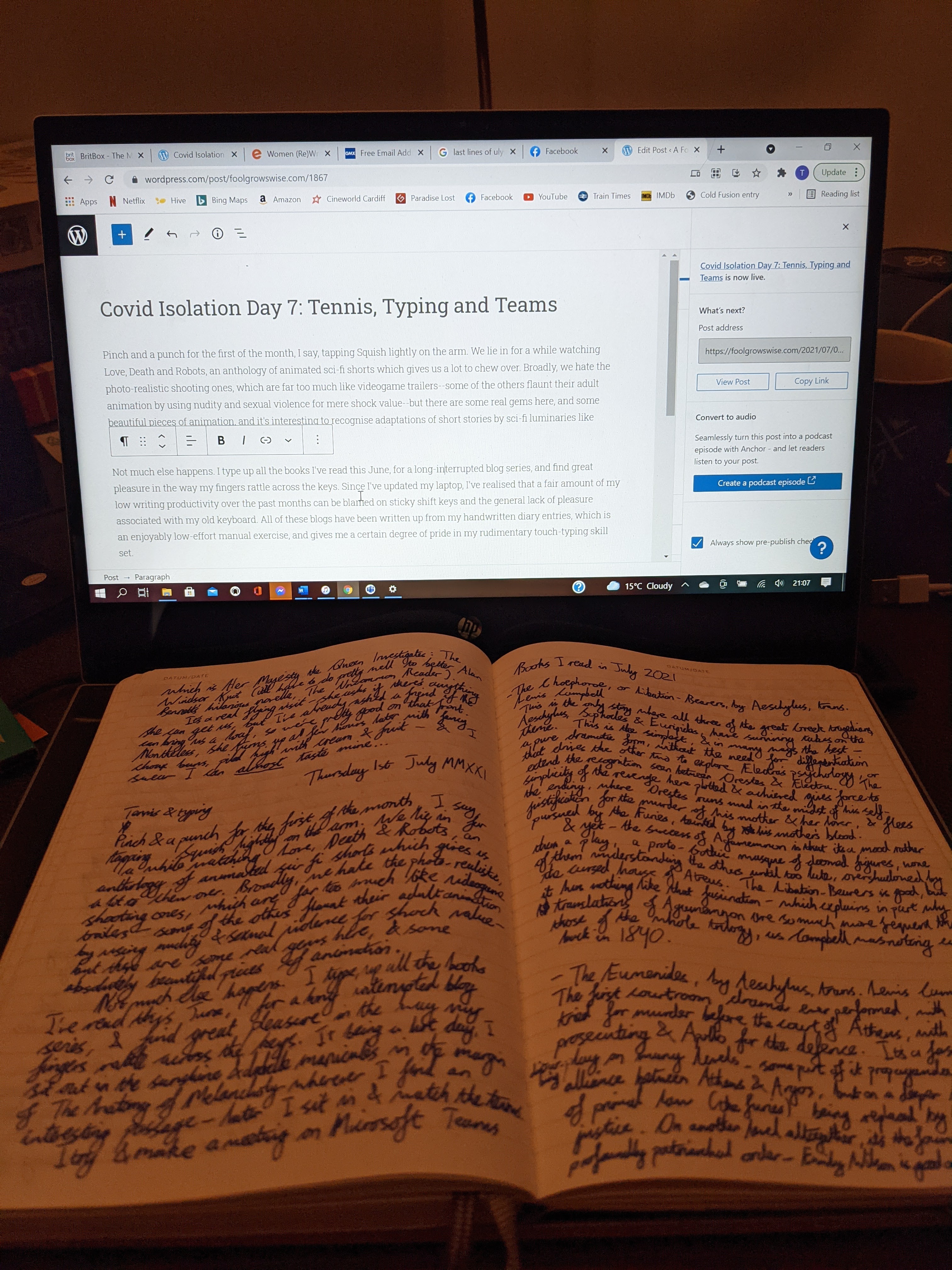
Pinch and a punch for the first of the month, I say, tapping Squish lightly on the arm. We lie in for a while watching Love, Death and Robots, an anthology of animated sci-fi shorts which gives us a lot to chew over. Broadly, we hate the photo-realistic shooting ones, which are far too much like videogame trailers–some of the others flaunt their adult animation by using nudity and sexual violence for mere shock value–but there are some real gems here, and some beautiful pieces of animation, and it’s interesting to recognise adaptations of short stories by sci-fi luminaries like Alistair Reynolds, J.G. Ballard and Peter F. Hamilton.
Not much else happens. I type up all the books I’ve read this June, for a long-interrupted blog series, and find great pleasure in the way my fingers rattle across the keys. Since I’ve updated my laptop, I’ve realised that a fair amount of my low writing productivity over the past months can be blamed on sticky shift keys and the general lack of pleasure associated with my old keyboard. All of these blogs have been written up from my handwritten diary entries, which is an enjoyably low-effort manual exercise, and gives me a certain degree of pride in my rudimentary touch-typing skill set.
It being a hot day, I sit out in the sunshine and doodle manicules in the margin of The Anatomy of Melancholy wherever I find an interesting passage–later I sit in and watch the tennis. I try to make a meeting on Microsoft Teams for form tutors at my new school who will teaching Year 7 from September–how exciting is that going to be, having my own tutor group–but I don’t find out what time it is due to differences in the Teams set-up between their email and mine. I come in at the end after everyone’s left and have a quick chat with the Head of Transition, who is very welcoming and understanding. Covid’s played havoc with my plans to visit the school and meet the department, but there’s hope I can squeeze a visit in this Friday, which is an inset day at my regular school.
By the sixth day of self-isolation, most of my symptoms have cleared up. Occasional coughs and sneezes are the worst of it–and sometimes I can cough so hard it makes my head hurt. But I feel I’m pretty much back to full power, and some faint sense of tast may even be returning, to judge by the tingling on the right hand side of my tongue.
It’s rougher on Squish, who is still struggling with the gastric aspect of the Delta variant, something which has happily passed me by. She manages a staggered return to work today, taking a little break between projects. With my job there’s nothing I can do from home, so I lounge about playing a bit of Metroid in between frantic two-player bouts of Doctor Mario, reading Simon Armitage’s translation of Pearl to round off the month’s books, and watching the first episode of Doctor Who: The Moonbase, with Patrick Troughton. This is an animated version of a missing episode, as with The Power of the Daleks, but I really like this style: it’s claustrophobic, shadowy and captures Troughton’s incredible range of facial expression well. It’s enough to make one regret that episodes 2 and 4 survive as live action.
There’s someone at the door while Squish is in the middle of a meeting–it turns out to be her mum, Lara, popping down after a visit to Squish’s grandparents to drop off another set of hardbacks, the silliest and most enticing of which is Her Majesty the Queen Investigates: The Windsor Knot. It’ll have to do pretty well to better Alan Bennett’s hilarious novella, The Uncommon Reader, but I’ll admit to a soft spot for royal family fan fiction.
It’s a flying visit from Lara–she asks if there’s anything she can get us, but I’ve already asked a friend if he can bring us a loaf, so we’re pretty good on that front. Nontheless, she turns up half an hour later with fancy choux buns, piled high with cream and fruit–and I can almost taste mine…
I wake up from various anxiety dreams where I’m wandering around school and breathing on people to the familiar four walls of quarantine. The fear of accidentally giving a bunch of people this virus can be quite paralysing and I’m a bit worried how fast I’m going to adapt to going out into the world again, given how hard I’ve found it to move out of a lockdown mindset before.
A Tesco order arrives, meaning I finally get to eat the bowl of rice krispies I’ve been craving since yesterday, and it certainly brings an interesting texture to the feelingless desert that’s my mouth right now.
I manage to hammer out a review of a poetry collection, but it’s the kind of day when I’m struggling to settle into things. Squish finds out that Track and Trace has been in touch with her office and advised them all to self-isolate until the 3rd. She feels rotten about this, especially since Track and Trace have been dragging their feet and she was hoping they wouldn’t have to shut the office. All her colleagues are getting PCR tests, and we’re really hoping they all come out negative. Squish is scared they will think the worse of her for it; I told her that they understand it’s just one of those things that happens in a pandemic, but she was inconsolable for a little while.
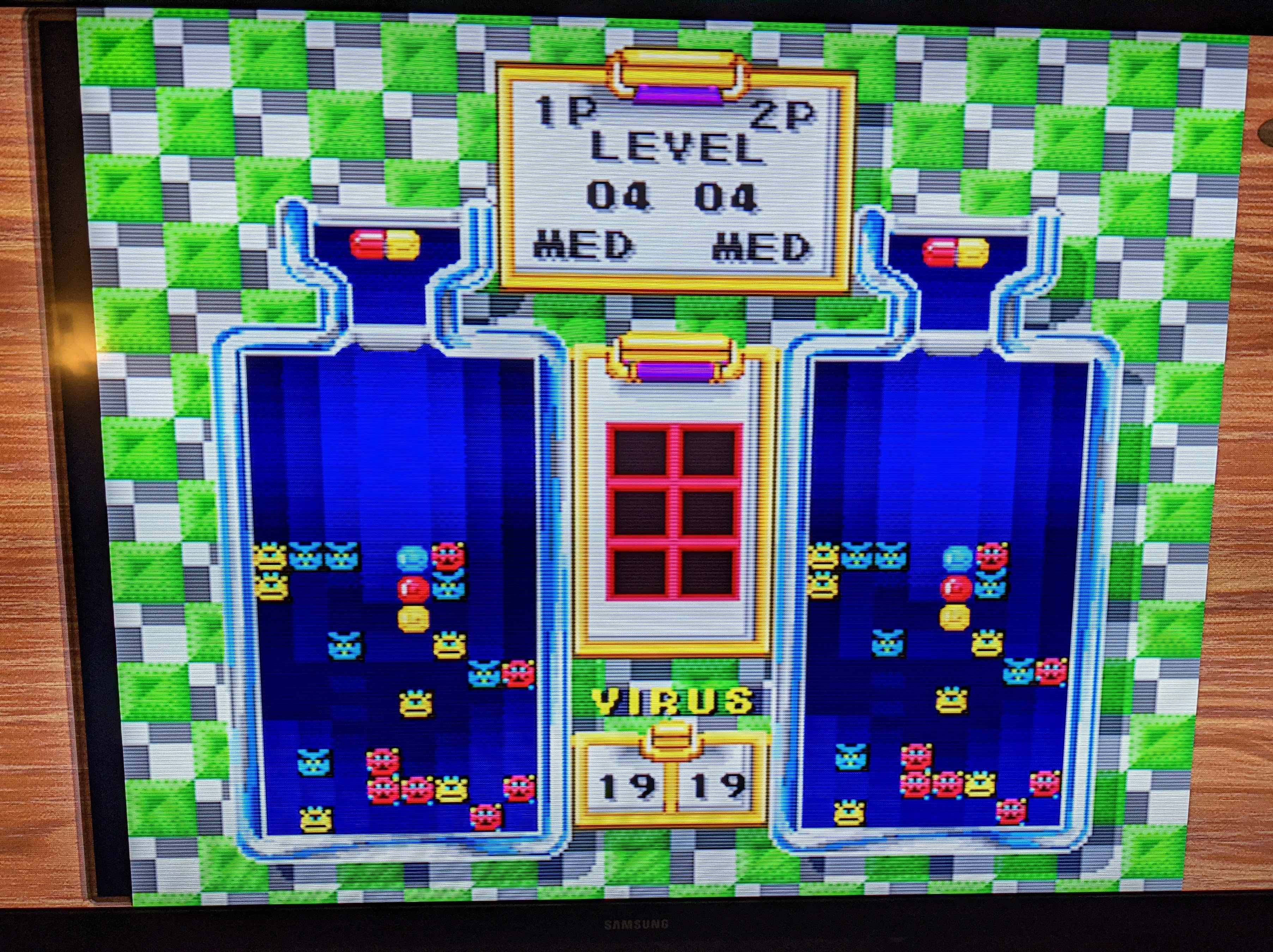
Today’s distraction has been Dr Mario, an ancient 16-bit puzzle game. I bought a mini-SNES a while back for a bit of retro gaming, and discovered you can download a program that hacks it and will let you insert the ROM from any old SNES game, downloadable for free on the internet. It’s a simple game about lining up coloured pills to wipe out cartoon vriuses, but the difficulty is flexible and our competition to finish first can be fierce. Plus, playing it with Covid gives the whole thing a pleasant sense of irony!
Battling coronavirus the old-fashioned way
The Game Boy Advance was my favourite console as a kid, and as with the iPod nano, I’m so comfortable with low-tech 16 bit games and pixel art that I rarely see the appeal of polygons and first person shooters. Sometimes I get so involved that I won’t stop even when I’m not enjoying it any more, and I’ve had to take measures to cut down on my gaming hours in lockdown. Dr Mario, however, hits the spot precisely. It’s just lovely to play a two-player game that we’re both reasonable good at and can get a bit competitive about.
I finish my book, rattle out a diary entry and blog in the evening, which gives a sense of acheivement to a diffuse sort of a day. We watch the next episode of the Harley Quinn TV series, which is punky and good fun–a bit bloodsoaked, but it doesn’t feel as unnecessary in the adult cartoon as it does in the Birds of Prey movie.
It’s been a while since I last posted about the books I’ve been reading. I never stopped keeping records in my journal of what I was reading, but my laptop got slow and the keys started sticking, and I got less and less keen to devote an hour or two to typing when the first of the month roled around. Happily, I’ve got myself a new laptop that makes it a pleasure to rattle my fingers over the keys; less happily, I’ve got nothing but time at the moment, for reasons mentioned below.
I got myself into the middle of any number of books this month, and idly flitted between them without progressing very far with any. However, very late in the month, I came down with that coronavirus that everyone has been making such a fuss about, and I was able to get in some good reading time during quarantine, in between the coughing and sneezing, making eleven books this month in all.
Mathilda, by Mary Shelley
This is a cursed novella, and reading it between the staid, reassuring covers of a Penguin Pocket Classics edition does little to alleviate its uncanniness. Shelley wrote it whilst in Italy, as a means of working through her depression following the deaths of her two young children. It follows the blighted life of Mathilda, whose widowed father first confesses his incestuous passion for her, then commits suicdie by drowning. Shattered, Mathilda retires to a hermit-like life in the countryside while she hesitates over whether to kill herself in turn. Counselled by Woodville, a character transparently based on Percy Shelley, she half-heartedly embraces life, but as the book ends a late night outdoors in the chill damps of nature seems likely to accomplish what Mathilda would not do by her own hand.
Quite aside from the grief Shelley was working through at the time, the death of Mathilda’s father seems strangely to predict Percy Shelley’s own death-by-drowning. When Mary sent it to her own father, William Godwin, he refused to return it to her, fearing that the incest episode, read autobiographically, might ruin his reputation. Knowing the PR disaster that was his own, too revealing biography of his late wife, Mary Wollstonecraft, he may have had a point. Not published until 1959, it’s one of the eeriest and most unsettling survivials of the Romantic era.
The Broken Heart, by John Ford
A love tragedy something like Romeo and Juliet for the unhappy and middle-aged, the most blazing romantic passion in this play is from the woman who agrees to marry her suitor provided her father and brother agree to the match. The inciting incident happens before the play begins, when Ithocles forces his sister Penthea to marry the monstrously jealous Bassanes rather than her true love, Orgilus. What follows is highly poetical and beautifully constructed, but reminds one now and again how much more life and vigour there is in Shakespeare, or even in Ford’s own taboo-busting incest tragedy, Tis Pity She’s A Whore.
Pattern Beyond Chance, by Stephen Payne
Why did this collection resonate with me when so much modern verse leaves me equivocal? The style, for a start–crisp, grammatical, rhythmically composed and aware. It works on my nostalgia for the university in a collection that bridges the academic and the everyday, and I like that the perspective of the poems is slightly out of the common way, grounded on Payne’s professorship of human-centred systems rather than an Eng Lit role. And he simply comes across as very sympathetic–the poems are full of touching human moments, with a wry melancholy that keeps them from being oversweet. I’ve heard him read a few times before, and he’s always come across as confident but not electric. On the page, though, his verses sing.
The Far Side of the World, by Patrick O’Brian, read by Ric Jerrom
All the plot points of this book were muddled in my head with the faithful but dreary film, and it was a delight and surprise to find the book far more various and interesting, with a murder suicide like something out of the Newgate Calendar, an encounter with a boatful of Polynesian warrior women who threaten to castrate our hetoes, and a tense island reckoning that surpasses the usual naval engagement. It’s perhaps a little unwieldy that Aubrey and Maturin contrive to be marooned twice over a period of as many weeks, but this remains a very satisfying entry.
The Gododdin: Lament for the Fallen, by Gillian Clarke
Wrote this up for Wales Arts Review, with some musings on what the long reign of the short lyric has meant for the translation of longer poems.
The Relapse, by John Vanbrugh
Felt like cheering myself up on the first day of self-isolation with a frothy Restoration comedy. This fitted the bill admirably, with plenty of beaus, libertines, cheeky servants and country misses. Of its two plots, only one comes to a truly satisfactory close, but there’s such high energy to the plotting and wit and vigour in the dialogue that this doesn’t matter much overall.
Timewyrm: Revelation, by Paul Cornell
I’ve spent a little time trying to nail down the perfect reading material for free periods at my job. Long poems by Robert Browning, unsurprisingly, were not the answer. Blogs are good, but too much archive diving cloys. Digital comics are entertaining but expensive. Free pdfs of out-of-print Doctor Who novels absolutely hit the spot. This one was famous in its day, a surreal adventure through the dreamscape of the seventh Doctor’s mind, written only a couple of years after the series was cancelled in 1989. It’s both a grand epic on a mythic scale, and something that feels almost parochial compared to the Time War mythos that underlies Doctors nine to thirteen.
Agamemnon, by Aeschylus, trans. Lewis Campbell
A Victorian translation from 1890, this is not exactly up to date, but I’ve always had affection for it as an excellent rendering into Shelleyan verse, with some really inventive stanzas and verse forms used for the choral sections. Otherwise, what stands out to me on a reread is just how much Clytaemnestra is mocked, patronised and spoken down to by the chorus, and the fact that despite this, she never gets the chance to claim the audience’s sympathy by speaking her mind. It’s an opportunity Euripides was quick to percieve and made stupendous use of with Medea and Hecuba.
Windfalls, by Susie Wild
A collection of two halves, each of which would make a fine pamphlet on its own: ex-boyfriend poems and 2020 poems. Wrote a review for Wales Arts Review, which should be out in a few days.
The Warrior Queens: Boadicea’s Chariot, by Antonia Fraser
This is an interesting book–in part a reception history of Boadicea, in part an investigation of the psychology of nations under female war leaders, but centrally and structurally a series of short biographies of the Queens themselves, running from Cleopatra up to the somewhat unlikely figure of Margaret Thatcher. Familiar figures like the Empress Mathilda and Queen Elizabeth I mix with lesser-know royals like the Rani of Jhansi and Queen Tamara of Georgia. The argument for a certain constancy in the figure of the warrior queen across millenia of eastern and western history is surprisingly concise and convincing, and I rather regret that there’s no additional, updated final chapter, analysing the shades of Boadicea that linger in the public images of Theresa May and Hilary Clinton.
Pearl, trans. Simon Armitage
I’m not a great fan of his very acclaimed Gawain and the Green Knight translation, because I think it’s too focused on the big dramatic set pieces and doesn’t pay enough attention to the less conspicuous verses. This, however, I remembered being impressed by, and I still think it’s one of the the best things he’s done, catching the sombre mood of a Middle English poem about losing a daughter in a way that can often be unbearably moving. He also makes the wise choice to keep the alliteration and repitition of the orignal, but abandon the unduly constricting rhyme scheme. It’s hard to imagine this being done much better, and my remaindered hardback edition is a beautiful piece of printing to boot.



 A Fool Grows Wise