A Year in Shakespeare: The Comedy of Errors

Cardiff University Library: Special Collections and Archives
Cardiff University Library: Special Collections and Archives. Illustrations by John Austen

After reading Measure for Measure last week in a heavily annotated scholarly edition, I thought I’d take a new tack for The Comedy of Errors and read something designed for pleasure rather than education. It’s hard to get hold of the really, really nice editions on a student budget – neither the city nor the university libraries are likely to put them on loan, and my shelves run more to secondhand paperbacks than illustrated luxury hardback editions.

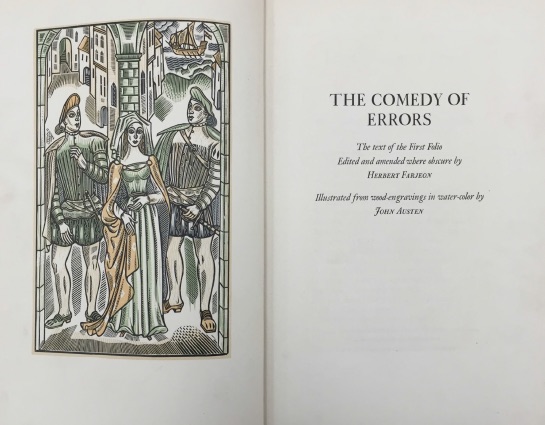
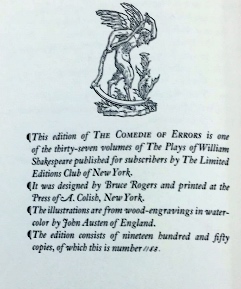
Fortunately Cardiff University has a handsome, modern and well-equipped Special Collections and Archives division – SCOLAR for short – in the basement of the Arts and Social Sciences Library. I turned up, surveyed the catalogues, ordered a few things and finally settled on a 1939 private press edition, published in New York by the Limited Editions Club.
Cardiff University Library: Special Collections and Archives.

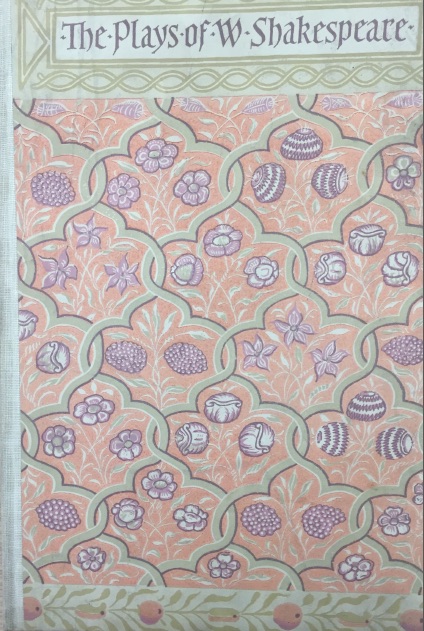
According to the notes in the library catalogue, the book is ‘quarter bound in white buckram over decorative paper-covered boards displaying floral and fruit motifs on pink ground with an abbreviated half title set within decorative border on upper front cover.’ Dr Melanie Bigold, my PhD supervisor, gets very excited by bookbinding, and can use it to tell you where the book was first printed and sold and what the printer had for breakfast that morning – talk about judging a book by its cover! As a complete layman in that field, I couldn’t say much about it – but there’s no denying it’s a beautiful piece of work.

The rest of the book held up to the promise of the cover. I can’t say any of the accompanying illustrations by John Austen ever particularly gripped me, but they were a colourful art deco diversion, and the artist had made the best of it given The Comedy of Errors isn’t a visually spectacular play to begin with. The paper was thick and creamy, the margins generous, the typeface bold and eye-catching. After the Arden edition of Measure for Measure where the footnotes often swallowed up half the page, it was pleasant to be reading something with no critical apparatus whatsoever – the last time that had happened was reading The Merry Wives of Windsor in a Complete Works edition where the text was squeezed in to the very edge of the page with hardly any margin at all. Also – in a first for this project – this edition preserves the original first folio spelling, which adds a wonderful texture to even the less interesting lines of dialogue:

Why prat’st thou to thyselfe, and answer’st not?
Dromio, thou drone, thou snaile, thou slug, thou sot.

The Comedy of Errors itself is a piece of comic virtuosity, the story of a pair of identical twins with the same name, separated at birth and unaware of each others existence, and their identical twin servants, ditto. Naturally everyone keeps mistaking Antonio and Dromio for their opposite numbers – I confess that, without the aid of footnotes or an introduction, I didn’t entirely follow who was supposed to be on stage at once – but I think some confusion is part of the point. After various misunderstandings, during which each Antonio is respectively arrested and committed, the play concludes with the usual scene of recognition, and the family reunited.
coe2
Cardiff University Library: Special Collections and Archives

In addition to having the most complex plot, it’s also the most elaborately poetic Shakespeare play I’ve read so far, even more so than Two Gentlemen of Verona, my previous benchmark. The play is written entirely in verse, and goes so far beyond the usual iambic pentameter that characters speak in rhyming couplets for entire pages – as in the quote above – and sometimes break into longer and more discursive hexameter or octameter lines. This elaborate formal invention matches well with the play’s complex, self-confident and symmetrical plotting. Reaching the final lines of Shakespeare’s shortest play, one feels its kinship to the short, controlled, rhetorically intricate forms the Renaissance revelled in, like the sonnet or the double-sestina. It will never have the popularity of one of the bawdier comedies or the bloodier tragedies – it sets itself out to be admired for its technical artistry rather than its drama or pathos – but as a work of self-conscious literary craftsmanship, it’s hard to think how it could have been done better. Reading it in an edition that was itself a work of high-end literary craftsmanship only deepened this insight.
A Year in Shakespeare: Measure for Measure

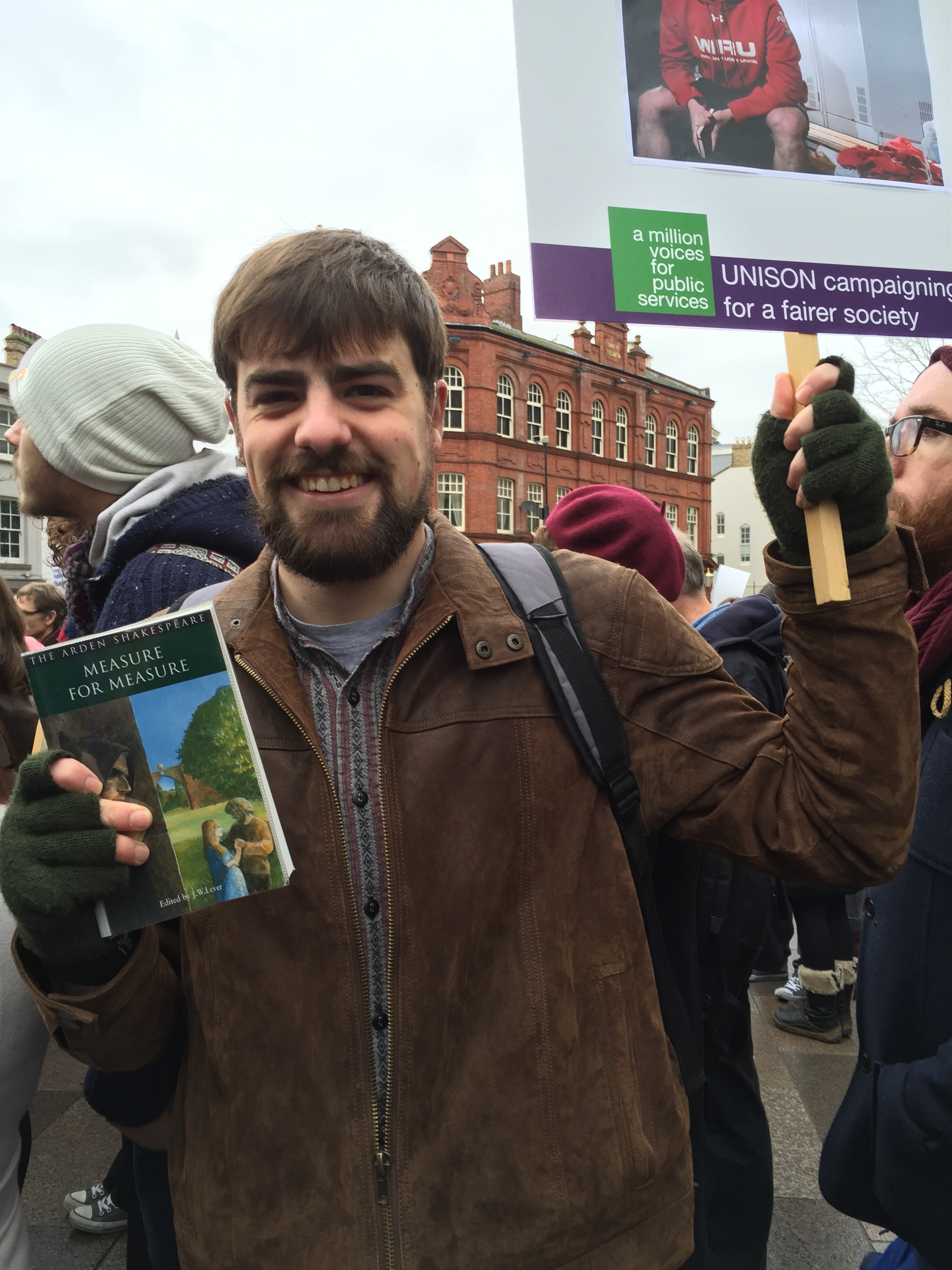
Book in one hand, placard in the other!

The Languages and Literature collection on the second floor of Cardiff Central Library was the dark secret of my undergrad. When the essay titles came out and the shelves of criticism on Beowulf, Chaucer and Shakespeare emptied as if by magic, I’d abscond to the public library. They’ve a really good range of key texts, the Cambridge Companions and popular histories, and it saved me from having to beg coursemates for books on social media, or hand over an even larger chunk of my student loan to Blackwells in return for a book I was only going to use once.

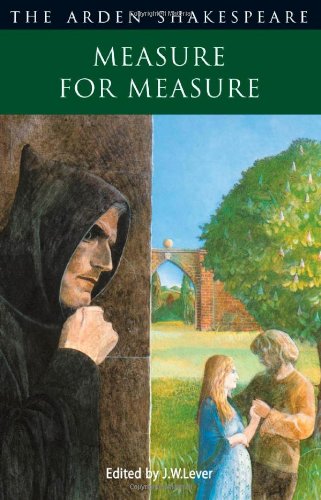
Last Saturday, I nipped upstairs, located the Shakespeare section – which features an impressive range of DVDs to complement the books – and grabbed a copy of Measure for Measure, the fourth play in my attempt to read all the plays of Shakespeare in a year. It was in the Arden Shakespeare series, the rigorously edited, comprehensively annotated scholarly edition of choice. I was pleased to see no-one had skimped on out-of-date editions. Then I hurried back out the front, grabbed a placard protesting spending cuts and joined the crowd gathering in front of the building, clutching their favourite books in hand.

Cuts are biting hard in Cardiff, and the library service is taking the brunt. It’s usual for cuts to pinch hours and services, but Cardiff’s Central Library, one of the most handsome and best-stocked libraries in the world, has been decapitated. It’s entire top floor, with its local studies collection, has been closed off and mothballed. In addition, it’s lost the ability to open on Wednesdays, it may have to share space with social services, and staff have been warned not to discuss the cuts on social media. Bad enough, but it was the council’s decision to close and sell off seven of its local branch libraries that first mustered the people of Cardiff to gather in protest and make their voices heard. In a previous job as a bicycle courier, I got to know and visit many of those libraries, relishing the time to take a break, use the loo, and cast an appreciative eye over the fiction section. All of them were bright, busy and well-stocked, and all of them will be missed. And so I chose to celebrate an institution where I’ve spent hundreds of happy hours of my life by spending a few more rereading Measure for Measure, a classic story of hypocrisy and overbearing authority. Replace the Puritan zeal of Angelo, the ruler of Vienna, with the neo-liberal zeal of Cardiff’s city councillors, and the tale becomes very timely indeed.

It’s one of my favourite Shakespeare plays – and coincidentally enough, the first Shakespeare I ever saw in Cardiff, performed on an unusual square stage down at the Bay. I was so close to the action that the actors would come and sit in the chair beside me when they were offstage – which, given that it was a reduced company, wasn’t very often. Despite this, the nightclub staging, complete with whiskey bottles (actually cold tea – I tasted) well-reflected the play’s concerns with decadence and propriety. The way the vile hypocrisy of Angelo seeps out from behind his icy facade was aptly reflected by giving the actor the dual role of Mistress Quickly, the owner of a brothel. It was one of those performances that makes someone know and understand and like the play better as a text.

measureIt’s the kind of performance worth reliving in the mind as I make my way through the pages of the Arden edition of Measure for Measure, which was all too clearly designed for scholarly use rather than reading pleasure. The introduction runs to nearly a hundred pages, devoted variously to questions of authorship, dating and sources before finally condescending to offer a few critical notes on the play. Similarly, the footnotes appear in two columns of small print and even then can swamp as much as half the page, forever sending the reader hither and thither after renaissance plays, modern critics and classical manuals of rhetoric. If you’re reading Shakespeare in order to give yourself a cheap library education, however, it’s hard to think of a better edition you could choose. Long may it grace the shelves of Cardiff Library!

A Year in Shakespeare: The Merry Wives of Windsor

Scan 7This is an odd play to come upon at this point, only three texts into my grand project to read all the works of Shakespeare in a year. In truth, it’s the closest Shakespeare ever came to writing the Renaissance equivalent of a spin-off TV show. The story goes that Queen Elizabeth I was so delighted with Shakespeare’s greatest comic creation, Sir John Falstaff, that when he stomped off the stage at the close of Henry IV Part 2, she demanded the playwright write a sequel, bringing the fat knight to England in the modern day and giving him a love story. In some accounts, she was so impatient she only gave him a fortnight to write the play. Wisely, Shakespeare did as the Queen bid him, but – perhaps wary of the possibility of having to write new episodes of The Falstaff Show until Kingdom Come – promptly killed Falstaff off at the beginning of Henry V. But all of that is a long way in the future – somewhere in June, when I’m out of the comedies and midway through the histories.

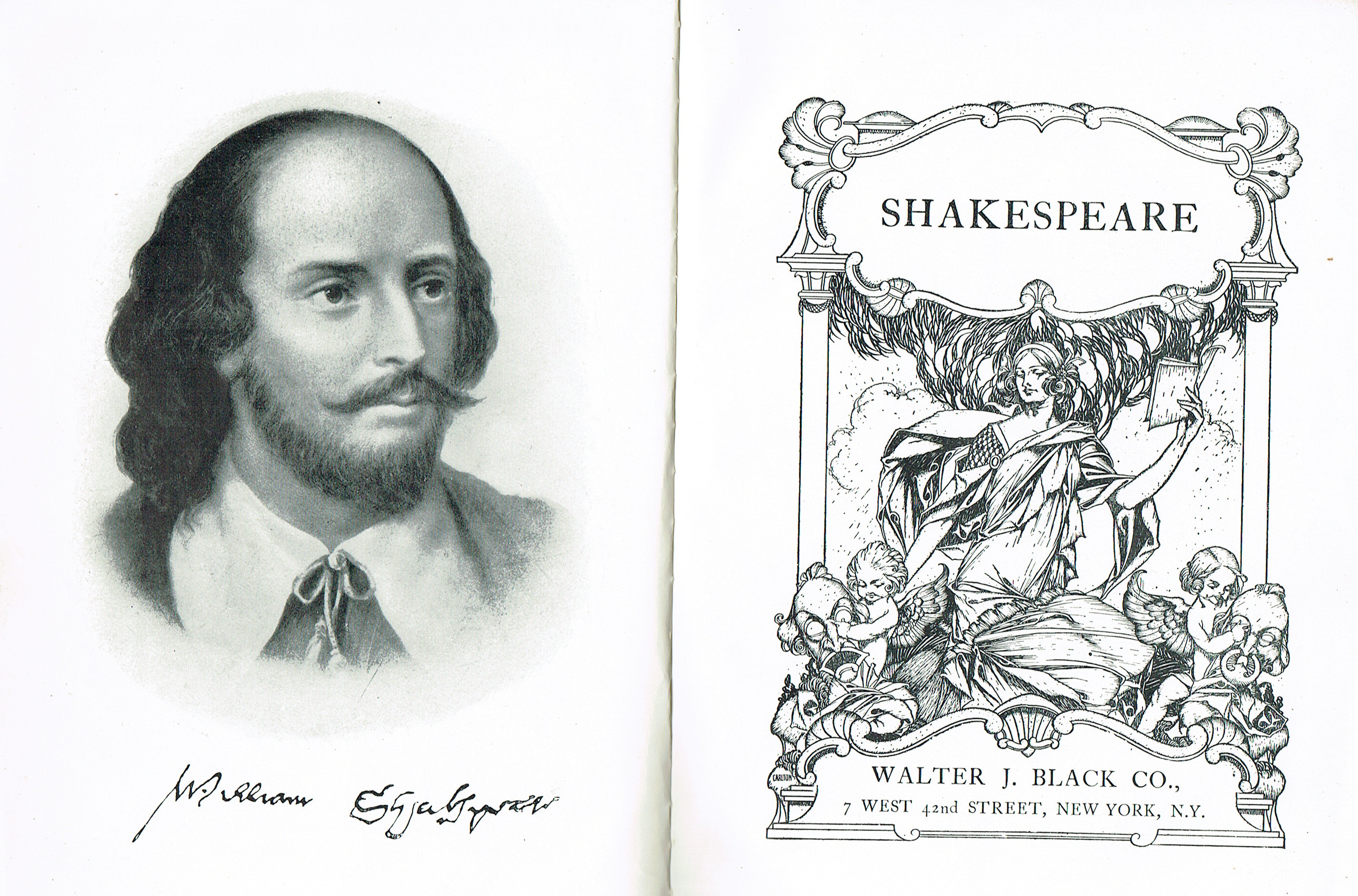
In search of an interesting edition to read the play in, I turned to the bookshelves in the postgraduate office, ever an interesting guide to people’s interests and research topics. My colleague Calum Gardner thoughtfully allowed me to borrow a thoroughly charming early twentieth-century edition, printed in New York and previously belonging to one A. Napier. There was no date on it anywhere I could spot, but it’s dedicated to Sir Henry Irving, a famous Shakespearean actor who also employed an Irish scribbler of penny dreadfuls with the unlikely name of Bram Stoker. Irving also provides part of the introduction to the edition, in a short and a wittily sarcastic essay on the Baconian controversy. His suggestion is that Francis Bacon wrote the entire output of the Elizabethan stage, including Shakespeare, but notes that who actually wrote Bacon’s work for him remains forever a mystery. It seems as likely as any of the other conspiracy theories!

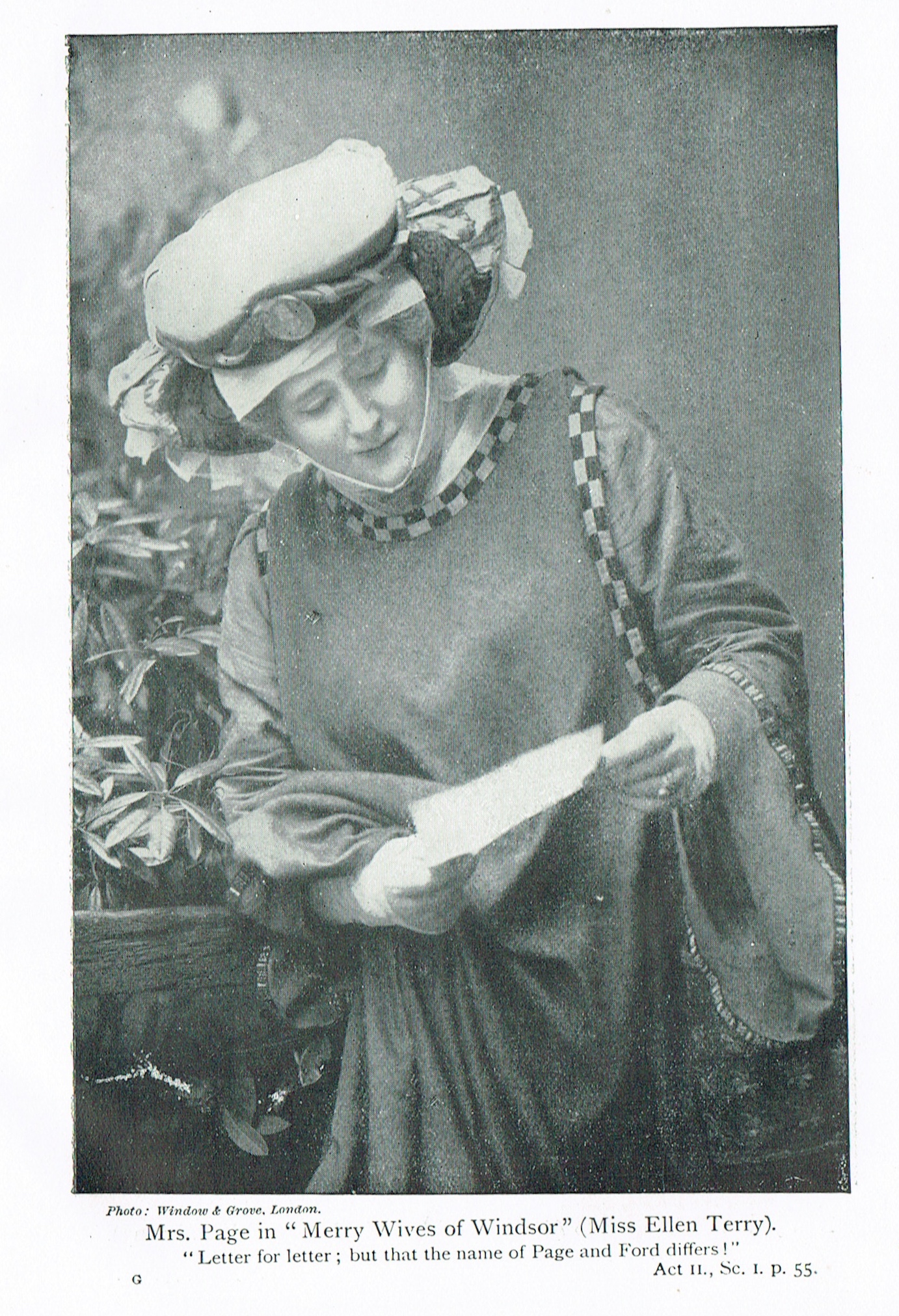
Among the other treasures in the old book are a scattering of early photographs of Shakespearean actors and actresses. The Merry Wives of Windsor is represented by a studio portrait of Ellen Terry as Mistress Ford; Terry was one of the most famous actresses of her day, now sadly only known for having been Dickens’s mistress. In a delightful period feature, a collection of tabs recessed into the sides of the pages make it easier to flick from play to play.

Turning to The Merry Wives, I am struck once again by the comparison to what went before – the language of Two Gentlemen of Verona was elaborate, beautiful and almost constantly in blank verse; Merry Wives is written mostly in prose, and the language is heavily spiced with Welsh and Spanish malapropisms from the two comic rivals in love, Sir Hugh Evans and Doctor Caius.

Scan 5But it’s not their play. It’s not even Falstaff’s play, though he steals every scene in which he appears. Uniquely, the heroes are two married women, Mistress Ford and Mistress Page, to each of whom Falstaff sends exactly the same letter, pledging his whole heart and undying affection, and not realising that these two best friends might just get together and uncover his ruse. Together, they foster a scheme not only to humiliate Falstaff for his impudence, but to teach Mistress Ford’s needlessly suspicious husband a lesson in trust, climaxing in a night of fairytale revels that looks forward to A Midsummer Night’s Dream. My favourite line in the production belongs to Mistress Page, in conversation with the jealous Mister Ford:

Ford: Well met, Mistress Page. Whither go you?

Mrs Page: Truly sir, to see your wife. Is she at home? 

Ford: Ay; and as idle as she may hang together, for want of company; I think, if your husbands were dead, you two would marry.

Mrs Page: Be sure of that, – two other husbands.

Actually, my favourite Merry Wives joke belongs not to any of the characters in the play, but to that well-known master of mirth and merriment, Kaiser Wilhelm II. It’s his only recorded joke. Due to wartime anti-German feeling, King George V issued a proclamation changing the Royal Family Name from ‘Saxe-Coburg and Gotha’ to the more English sounding ‘Windsor’. Kaiser Bill shrugged this off this snub by saying he looked forward to seeing a performance of The Merry Wives of Saxe-Coburg and Gotha.

Heh. I fancy Shakespeare would have groaned as loudly as the rest of us.